
Total Shipment Visibility, Simplified
Access all your shipment details in one place - track departures and arrivals, manage documents, notifications, invoices, and more.
Access all your shipment details in one place - track departures and arrivals, manage documents, notifications, invoices, and more.

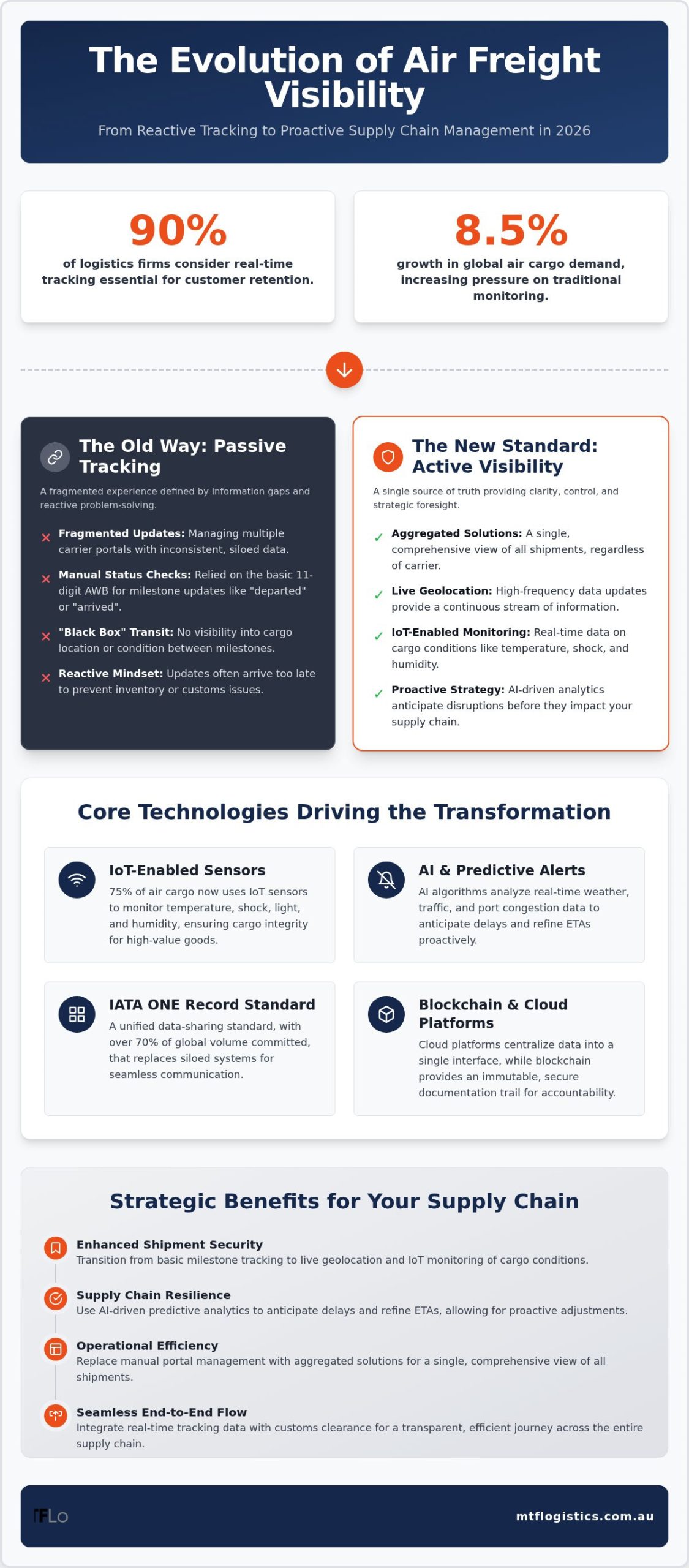
90% of logistics firms now consider real-time tracking essential for customer retention, yet the reality for many shippers in 2026 remains a fragmented experience defined by blind spots and inaccurate ETAs. You have likely felt the strain of managing multiple carrier portals while waiting for updates that arrive too late to prevent inventory issues. It is a common challenge in a volatile market where air cargo demand has grown by 8.5% over the past year, placing even greater pressure on traditional monitoring methods.
We understand that you need more than a passive notification that your shipment is in transit. This strategic analysis demonstrates how modern track and trace air freight is transforming from a basic monitoring exercise into a powerful tool for supply chain resilience. You will discover how the industry is moving toward IATA ONE Record standards and integrating IoT-enabled sensors to provide predictive alerts for potential delays. We also examine how synchronising tracking data with customs clearance creates a seamless, end-to-end flow that provides the clarity and control required for high-value logistics.
The logistics industry has moved beyond the era of manual status checks and fragmented updates. While the 11-digit Air Waybill (AWB) remains the primary identifier for shipments, it’s now considered a baseline requirement rather than a comprehensive visibility tool. Modern track and trace air freight systems have evolved to provide live geolocation and granular data that goes far beyond the basic milestones of “departed” or “arrived.” This shift is driven by the need for deeper transparency within national freight networks, where Australian importers now require precise data to manage tight inventory cycles.
This evolution represents a fundamental change in how supply chain managers interact with their cargo. The focus has moved from a reactive “where is my cargo” mindset to a proactive “when will it arrive” strategy. By utilizing high-frequency data updates, businesses can anticipate disruptions before they impact the warehouse floor. This level of foresight is essential in a market where global air cargo demand increased by 8.5% in mid-2026, making efficient space management more critical than ever.
Relying on traditional carrier status codes often leaves significant gaps in the timeline. Passive visibility only informs you after a milestone has been reached, which is often too late to resolve a delay. In contrast, active visibility provides a continuous stream of information that allows for real-time adjustments. Active visibility is the continuous stream of cargo data points. It ensures that “In Transit” is no longer a vague black box but a transparent phase of the journey where location, speed, and environmental factors are constantly monitored.
For Australian businesses, this means moving away from checking individual airline portals. Instead, they are adopting integrated solutions that aggregate data from multiple sources into a single, reliable feed. This transition reduces the administrative burden on logistics teams and provides a steady hand in managing complex international routes.
Standardisation is the backbone of modern tracking. IATA’s ONE Record initiative has become the preferred method for cargo data exchange in 2026, with airlines representing over 70% of global volumes committed to its implementation. This initiative replaces old, siloed systems with a single, standardised view of the shipment’s journey. It facilitates better communication between forwarders, carriers, and ground handlers, significantly reducing the risk of data entry errors.
This level of data accuracy is particularly vital for customs clearance Australia. When tracking data is precise and standardised, the clearance process becomes more predictable. Automated systems can ingest this data to prepare documentation well before the aircraft touches down, ensuring that high-value or time-sensitive project cargo moves through the border without unnecessary friction.
The landscape of track and trace air freight has been fundamentally altered by the rapid adoption of hardware-integrated tracking. As of 2026, the industry has moved beyond simple terminal-to-terminal scanning. Recent data indicates that 75% of air cargo shipments now utilize IoT-enabled sensors to provide a granular view of the journey. This shift ensures that visibility is no longer limited to whether a package has arrived at an airport; it now includes exactly what is happening to the cargo while it is in the air or sitting on the tarmac.
Cloud-based logistics platforms have become the central nervous system for these operations. By aggregating data from multiple airlines and ground handlers into a single interface, these platforms eliminate the need to navigate disparate carrier portals. This centralisation is supported by blockchain technology, which creates an immutable documentation trail. Every status change and environmental update is recorded in a secure ledger, providing a level of accountability that was previously unattainable in global logistics.
Modern sensors do more than report coordinates. They monitor temperature, shock, light exposure, and humidity in real time. This capability is critical for high-value air cargo Australia, where the integrity of the goods is as important as the delivery speed. For pharmaceuticals and perishable items, a light-exposure alert can indicate an unauthorised container opening, while temperature logs provide the necessary proof of cold chain compliance.
Documenting cargo integrity through these sensors also has a direct financial benefit. Many insurers now offer reduced premiums for shipments that use verified IoT monitoring. It provides an objective record of how the cargo was handled, which simplifies the claims process and encourages higher standards across the supply chain. Maintaining this level of detail helps logistics managers act as a steady hand, ensuring that sensitive shipments remain within required specifications throughout their transit.
Artificial intelligence has transformed tracking from a historical record into a forward-looking tool. By analysing vast amounts of data, AI has helped reduce shipment delays by 30% on intercontinental routes. These systems don’t just look at where a plane is; they account for weather patterns, airport congestion, and historical port performance to provide highly accurate delivery windows. This predictive modeling is a cornerstone of modern air freight Australia, allowing importers to adjust their downstream operations before a delay even occurs.
Predictive alerts serve as an early warning system for urgent logistics. If an AI model identifies a growing congestion trend at a transit hub, it can trigger an alert to reroute subsequent shipments or notify customers of a revised ETA. This proactive approach alleviates the stress of international trade by replacing uncertainty with data-driven insights. If you are looking to enhance your cargo’s security and predictability, exploring integrated logistics solutions can provide the technical edge your supply chain requires.
While the hardware discussed in previous sections provides raw data, the method you use to access that information determines its actual value to your business. Many shippers still rely on manual track and trace air freight methods, such as visiting individual carrier websites. This approach often reveals a significant gap in the logistics chain, particularly during ground handling and transshipment. Standard airline tracking frequently stops at the tarmac, leaving a “black hole” between the aircraft landing and the cargo being ready for collection.
Managed visibility solutions bridge this gap by integrating data from airlines, ground handlers, and local transport providers. This level of coordination is a hallmark of professional international freight forwarding. In 2026, where over 60% of air cargo shipments require digital documentation, having a centralised system to manage these data flows is no longer optional. It’s the difference between reacting to a delay and having the foresight to manage it effectively.
Relying on direct airline portals presents several operational hurdles. If your shipment involves multiple carriers or split consignments, your team must navigate fragmented data across different time zones and interfaces. These portals often suffer from delayed updates, where the status on the screen lags hours behind the physical movement of the goods. Additionally, carrier sites rarely provide “last mile” visibility. They fail to account for the critical transition from the airport terminal to your warehouse, which is often where the most significant delays occur.
A managed approach provides a “single-pane-of-glass” dashboard that aggregates every milestone into one professional interface. This centralisation allows for a steady hand in oversight, where logistics experts can interpret the data to resolve issues before they escalate. Instead of just seeing a status code, you receive a clear picture of how each milestone affects your overall timeline. This clarity allows your team to focus on core operations rather than chasing updates.
This managed visibility also ensures a seamless connection between tracking milestones and customs entry. By synchronising arrival data with customs systems, documentation can be processed with higher accuracy. This methodical approach reinforces the reliability of the supply chain, transforming tracking from a simple search tool into a comprehensive management resource that supports your business goals.
In 2026, the value of track and trace air freight extends far beyond the simple confirmation of a package’s location. For sophisticated importers, this data serves as a strategic asset that builds resilience into the entire supply chain. By moving from reactive tracking to data-driven analysis, businesses can transform visibility into a measurable financial advantage. This shift allows for the optimisation of inventory levels, the reduction of unnecessary storage fees, and the ability to audit carrier performance with absolute precision.
One of the most immediate benefits of enhanced visibility is the reduction of demurrage and storage costs at national airports. When you have precise arrival data, you can coordinate transport for immediate pickup the moment the cargo is cleared. This avoids the steep fees associated with cargo sitting in bonded warehouses. Over time, the tracking history also allows you to identify which airlines and routes consistently meet their ETAs, allowing you to make more informed procurement decisions based on actual performance rather than marketing promises.
High-fidelity tracking data is the foundation of modern just-in-time strategies. When you have access to real-time geolocation and predictive ETAs, the need for excessive safety stock diminishes. Reducing transit uncertainty by even a few days can have a significant impact on your bottom line by freeing up working capital that was previously tied up in buffer inventory. This level of accuracy also allows for better resource allocation, as warehouse labour schedules can be aligned with actual cargo arrivals rather than vague estimated windows.
The financial impact of reduced uncertainty is particularly evident in high-value sectors. When arrival times are predictable, the entire downstream process, from de-consolidation to final delivery, moves with greater efficiency. This methodical approach ensures that your operations remain steady even when global markets fluctuate. It creates a feeling of transparency that benefits every stakeholder in the supply chain.
Effective visibility acts as a steady hand in a volatile market. It allows logistics managers to identify bottlenecks in major transshipment hubs before they escalate into significant delays. If data indicates a growing backlog at a specific transit point, you can trigger contingency plans, such as rerouting subsequent shipments or utilising alternative transport modes to maintain flow. This proactive exception management prevents the snowball effect where one minor delay disrupts an entire month of production.
Using tracking data to manage exceptions ensures that you are always in control of the narrative, providing your customers with accurate information rather than apologies. This data-driven confidence is essential for maintaining long-term partnerships in a competitive landscape. To see how these insights can improve your specific operations, consider partnering with a specialist in air freight services that prioritises end-to-end transparency.
MTF Logistics has served as a steady hand in the Australian freight landscape since 2014. We understand that visibility is more than just a software feature; it’s a fundamental commitment to reliability and control. By combining over a decade of industry expertise with advanced technical tools, we provide a comprehensive approach to track and trace air freight. Our national coverage ensures that your cargo is managed with professional oversight at every Australian entry point, while our global network maintains transparency across international borders.
Our methodology focuses on simplifying the complex global processes that often cause stress for importers. Instead of leaving you to navigate the fragmented data of multiple carrier portals, we act as a supportive partner that centralises information. This organised expertise allows us to transform raw data into strategic insights, ensuring that your supply chain remains resilient even in a volatile market. We prioritise clarity for the client, providing a reassuring voice that emphasises stability and accuracy throughout the shipment’s journey.
Our digital approach is designed to bridge the gap between raw airline data and the specific operational requirements of Australian businesses. We don’t just provide a tracking number; we offer a managed ecosystem where data-driven insights lead to better decision-making. This system ensures that the visibility gaps often found in ground handling are replaced with clear, actionable milestones. By integrating tracking data with our specialised customs clearance services, we facilitate a seamless flow from the airport tarmac to your warehouse floor.
The role of our professional team is critical in this ecosystem. While technology provides the data, our experts provide the interpretation and resolution. We monitor your shipments for any signs of disruption, using our industry-literate knowledge to facilitate complex global moves. This proactive management means that if a delay occurs at a transshipment hub, we’re already working on a resolution before it impacts your inventory levels. This level of end-to-end support is what defines our commitment to mutual success.
Transitioning from manual tracking to a managed visibility solution is a methodical process that immediately improves supply chain efficiency. It starts by moving away from the high-pressure urgency of reactive tracking and toward a system of composed, data-backed management. This shift allows you to focus on your core business operations while we handle the intricacies of global logistics. Reliability and industry knowledge are the keys to successful imports, and our team is dedicated to making these difficult tasks feel effortless for you.
Taking control of your air freight means choosing a partner that values transparency as much as you do. We provide the steady hand required to manage high-value and project cargo with precision and care. If you’re ready to move beyond basic tracking and embrace a more visible, strategic approach to your logistics, contact MTF Logistics for an integrated air freight solution. Our team will guide you through every step of the process, ensuring your cargo moves with the stability and accuracy your business demands.
The evolution of air cargo visibility in 2026 has transformed tracking from a simple administrative task into a core strategic advantage. By moving beyond basic status updates and embracing real-time geolocation and predictive analytics, you gain the control necessary to navigate a volatile global market. This shift allows you to optimise inventory levels and reduce the financial impact of transit uncertainty.
Achieving this level of transparency requires more than just access to data; it requires a partner who can interpret and act upon it. MTF Logistics has provided national Australian expertise since 2014, acting as a steady hand for importers who value accuracy and reliability. Our specialised customs brokerage integration ensures that your track and trace air freight data is synchronised with border requirements, reducing delays and storage costs at national airports.
You don’t have to manage these complexities alone. Streamline your supply chain with MTF Logistics’ expert air freight management and gain the clarity your operations deserve. We look forward to helping you build a more resilient and transparent future for your international trade.
Enter the 11-digit AWB number into the carrier’s portal or an aggregated visibility platform. The first three digits identify the airline, while the remaining eight are the unique serial number. This provides basic milestone updates. For deeper insights, use a platform that integrates this data with ground handling and customs status. This provides a more comprehensive view of the journey compared to simple airline lookups.
Milestone tracking only provides updates when cargo reaches specific points, such as departure or arrival at a terminal. Real-time track and trace air freight utilises IoT sensors and GPS to provide a continuous stream of data, including live geolocation and environmental conditions. This active visibility allows for proactive management of delays. Milestone tracking is essentially reactive and often lags significantly behind the physical movement of the shipment.
A “departed” status usually means the aircraft has left the origin airport, but it doesn’t account for flight duration, transshipment stops, or ground handling delays at the destination. Cargo may sometimes be offloaded due to weight restrictions or technical issues without an immediate status update. Using a managed visibility solution helps clarify these gaps by providing more granular data on the shipment’s actual physical location and movement.
Yes, modern logistics solutions utilise IoT-enabled sensors to monitor temperature, humidity, shock, and light exposure throughout the transit. This is particularly vital for pharmaceuticals and perishable goods. Recent data shows that 75% of air cargo shipments now utilise these sensors. This data provides a documented audit trail of cargo integrity. It is essential for compliance and can help in reducing insurance premiums by proving the cold chain remained intact.
If tracking remains stagnant, contact your freight forwarder to verify the status with the airline and ground handlers. Stale data often occurs during weekend transitions or when cargo moves through high-congestion transshipment hubs. A professional logistics partner can investigate if the delay is a simple data lag or a physical bottleneck. This ensures that your track and trace air freight information remains accurate and actionable for your warehouse planning.
Accurate tracking data allows for the pre-lodgement of customs documentation before the aircraft touches down. By synchronising arrival ETAs with customs systems, brokers can ensure that high-value or project cargo is cleared immediately upon landing. This integration reduces the risk of demurrage fees and storage costs at national airports. It facilitates a smoother transition from the tarmac to the final delivery point, providing clarity and control over the entire process.
While adoption is increasing, real-time tracking availability varies by carrier and route. Airlines representing over 70% of global volumes are currently implementing IATA’s ONE Record for standardised data exchange in 2026. However, some secondary routes or older aircraft may still rely on milestone-based updates. Partnering with a forwarder that utilises independent IoT sensors can provide consistent real-time visibility regardless of the specific airline’s internal technology or the route’s digital maturity.
A freight forwarder aggregates data from multiple airlines, ground handlers, and local transport providers into a single professional dashboard. This “single-pane-of-glass” view eliminates the need to check fragmented carrier portals manually. Beyond raw data, forwarders provide human oversight to interpret milestones and resolve exceptions. This composed management ensures that tracking information is used proactively to optimise your inventory levels and maintain supply chain resilience in a volatile global market.


 Email
Email 1300 710 683
 Tariff Lookup
 HS Code Lookup
 Newsletter Signup