
Total Shipment Visibility, Simplified
Access all your shipment details in one place - track departures and arrivals, manage documents, notifications, invoices, and more.
Access all your shipment details in one place - track departures and arrivals, manage documents, notifications, invoices, and more.

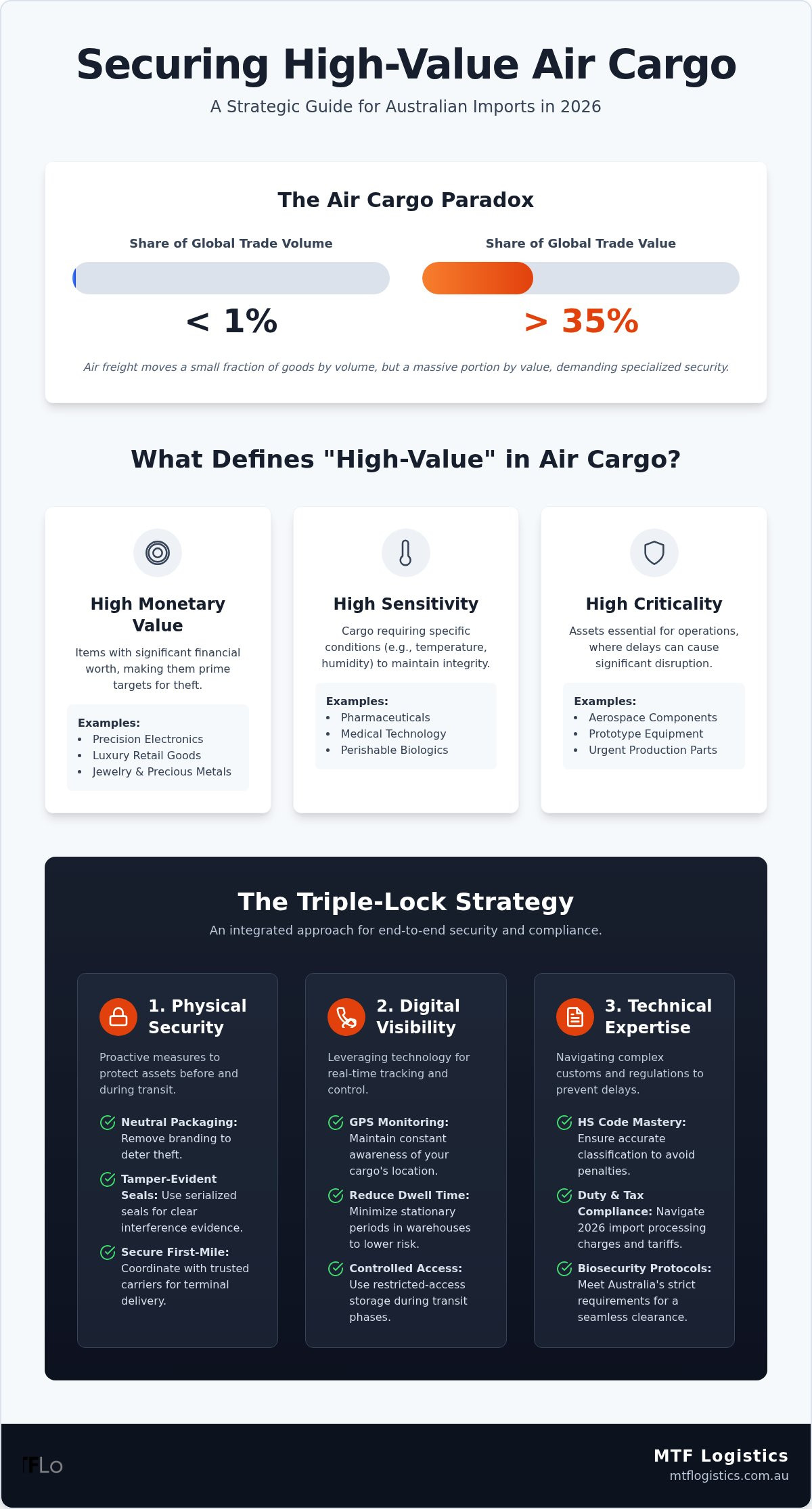
Air cargo represents less than 1% of global trade by volume, yet it accounts for more than 35% of its total value. When you are managing high-value air cargo Australia requires a level of precision that goes beyond standard freight forwarding. It demands a methodical approach to risk management and an intimate understanding of the 2026 regulatory environment.
It’s understandable to feel concerned about the potential for cargo pilferage or the complexity of Australian customs regulations. You want to ensure your time-sensitive assets move through a secure pipeline without the frustration of unpredictable transit times or unexpected border delays. A steady hand in logistics means replacing these anxieties with a transparent, data-driven plan that prioritizes the safety and integrity of your shipment.
This guide provides the framework to manage, secure, and clear your cargo with professional precision and full compliance. We’ll examine a “Triple-Lock” strategy that integrates physical security, real-time digital visibility, and the technical expertise required to navigate current Import Processing Charges and biosecurity protocols for a seamless, end-to-end journey.
In the Australian logistics sector, high-value air cargo isn’t just a label for expensive items. It’s a specialized handling category for assets that are critical to business operations or highly sensitive to transit conditions. For 2026, the demand for high-value air cargo Australia services continues to grow as national supply chains prioritize resilience over simple cost-cutting. This shift reflects a broader trend where the security of the asset is as important as the speed of the delivery.
Common categories that fall under this umbrella include precision electronics, pharmaceuticals, luxury retail, and aerospace components. These items share a common trait: they require more than standard logistics. They need a steady hand to manage the specific risks associated with their transport. Air freight is the preferred mode because it minimizes the number of touchpoints during the journey. Fewer hand-offs mean fewer opportunities for damage or loss. To understand the foundational mechanics of this transport mode, one might ask, What is Air Cargo? At its core, it’s a method that provides superior speed-to-market, which is essential for products with short lifecycles or high depreciation rates.
While monetary value is a primary driver, sensitivity often dictates the actual handling protocol. Fragility and monetary worth don’t always overlap perfectly. For example, pharmaceuticals often require strict temperature-controlled environments to maintain efficacy. Even if the individual units aren’t priced like luxury jewelry, their business importance is immense. Identifying “theft-attractive” cargo, such as compact electronics or high-end apparel, requires specific risk mitigation strategies. These strategies differ from those used for bulky industrial parts, focusing more on covert transit and tamper-evident measures.
Speed is a hallmark of air shipping, but for premium goods, security is the true priority. Every hour spent in “dwell time” within a warehouse increases the risk profile of the shipment. Sophisticated international freight forwarding strategies focus on reducing these stationary periods through proactive documentation and pre-clearing. High-value air cargo is a combination of monetary worth and time-critical necessity. By prioritizing secure, end-to-end management, companies ensure that their high-value air cargo Australia reaches its destination without the vulnerabilities associated with extended storage.
Preparation is the most critical phase in the logistics lifecycle. It’s the stage where you have the most control over the shipment’s safety before it enters the global network. For high-value air cargo Australia operations, this means moving beyond standard boxing. You need a systematic approach that addresses both physical protection and tactical anonymity to ensure your assets remain secure throughout the journey.
Follow these essential steps for preparation:
For precision instrumentation or medical technology, standard foam is no longer sufficient. Modern standards involve shock-absorbent materials that can withstand the unique vibrations of air transit. Vacuum sealing and moisture protection are also vital for long-haul routes where temperature fluctuations can cause condensation. However, the most effective security measure is often the simplest. Neutral packaging is the #1 defense against theft because it removes the visual incentive for pilferage by masking the true nature of the contents. By following these best practices for preparing high-value shipments, you significantly reduce the risk of targeted interference.
Documentation must be flawless to prevent dwell time. A discrepancy between the commercial invoice and the AWB can lead to ground delays that expose your cargo to unnecessary risk. This is particularly true for air freight Australia shipments, where customs authorities require exact data for high-value declarations. Pre-alerting receiving agents is another mandatory step. This ensures that a secure vehicle is waiting at the terminal the moment the aircraft is unloaded. If you’re looking for a partner to manage these complexities, our team can help you build a secure logistics plan that prioritizes asset integrity from the factory floor.
Securing high-value air cargo Australia relies on a multi-layered defense that begins the moment a shipment enters the terminal. While physical preparation addresses the outer defenses, the internal security protocols during “dwell time” determine the actual risk profile. Dwell time refers to the period your cargo remains stationary in a warehouse. Statistics from global logistics monitors suggest that most cargo interference occurs when assets are at rest rather than in flight. To mitigate this, we prioritize restricted access facilities where only vetted personnel can handle premium freight, keeping stationary periods to an absolute minimum.
A robust chain of custody is the backbone of secure shipping. This involves a documented history of every individual who takes possession of the cargo, from the initial pickup to the final delivery. It isn’t just about a signature on a manifest. It’s about piece-level tracking that ensures every component of a shipment is accounted for at every transition point. This methodical approach provides a clear audit trail, which is essential for both regulatory compliance and internal loss prevention strategies.
In 2026, real-time visibility is a standard requirement for premium logistics. We utilize Internet of Things (IoT) sensors to provide data that goes far beyond simple location tracking. For sensitive medical cargo or precision electronics, these sensors monitor light exposure, tilt, and temperature. A sudden light spike might indicate a package has been opened prematurely, while tilt sensors detect if delicate instrumentation has been mishandled. Real-time exception reporting ensures that if a milestone is missed or a sensor is triggered, an immediate alert is sent to the management team. Understanding how track and trace air freight technology is evolving toward IATA ONE Record standards and predictive IoT alerts can help you select the right monitoring framework for your premium shipments. This level of data-driven insight often leads to reduced insurance premiums because it demonstrates a proactive approach to risk management.
It’s a common misconception that standard carrier liability provides adequate protection for premium goods. Most carrier liability is calculated based on the weight of the shipment rather than its actual market value. For a high-value piece of aerospace technology, this weight-based payout would cover only a fraction of the replacement cost. Comprehensive “All Risk” insurance is the only way to ensure full financial recovery. This coverage protects against a wide range of external causes of loss or damage during international movements. If a loss occurs, the claims process requires specific documentation, including the commercial invoice, the Air Waybill, and the sensor data logs. Having these records organized and ready ensures that the resolution process is efficient and professional.
While speed is the primary driver for air shipping, the border process is where many high-value air cargo Australia shipments face their greatest challenges. Clearance isn’t just a formality; it’s a complex regulatory gate. For goods with a declared value exceeding $1,000, a formal Import Declaration is mandatory. This triggers specific Import Processing Charges (IPCs), which in 2026 are $50.00 for consignments up to $10,000 and $152.00 for those above that threshold. Managing these entries with precision ensures your assets move through the terminal without the risks associated with ground delays.
A professional customs broker Australia acts as your advocate at the border, resolving potential issues before they become delays. This methodical approach is essential for commercial entries where GST and duty calculations must be flawless. By integrating customs brokerage with your air freight plan, you create a seamless pipeline that avoids the volatility of the modern market.
Incorrect classification is a leading cause of Australian Border Force (ABF) audits. When you’re dealing with sophisticated electronics or aerospace components, the distinction between one code and another can represent thousands of dollars in duty. Utilizing Free Trade Agreements (FTAs) can significantly reduce these costs, but only if the documentation is exactly right. Customs Value (CV) in Australia is the price actually paid for the goods, converted to AUD, excluding the costs of overseas freight and insurance. Getting this calculation right is the first step in avoiding overpayment or penalties.
High-value status doesn’t grant an exemption from biosecurity inspections. In fact, sensitive pharmaceutical or perishable air cargo often faces stricter scrutiny from the Department of Agriculture, Fisheries and Forestry (DAFF). Packaging materials must meet ISPM 15 standards, particularly if wooden pallets are used for stabilization. For 2026, the biosecurity charge for an air cargo Full Import Declaration is $48.00. Participating in ‘Trusted Trader’ programs can reduce border friction, but the most reliable way to ensure compliance is through pre-clearing cargo before it even touches the tarmac.
Our team specializes in managing these technical requirements so your shipment remains on schedule and fully compliant. If you need expert assistance with your next entry, contact our customs team for a secure clearance strategy.
Managing high-value air cargo Australia requires a partner that doesn’t just move boxes but understands the technical and regulatory framework of 2026. In a global market characterized by volatility, MTF Logistics provides the steady hand necessary to navigate complex supply chains. We focus on end-to-end management, overseeing every phase of the journey from the factory floor to the Australian doorstep. This comprehensive oversight ensures that the security protocols and documentation standards discussed in previous sections are applied consistently, leaving no room for the errors that often lead to delays or loss.
Our approach is built on the integration of customs expertise and air freight precision. Since our founding in 2014, we’ve refined a methodical process that prioritizes asset integrity. We provide scalable solutions that cater to both growing SMEs and large-scale industrial projects. Whether you’re shipping a single piece of precision medical technology or managing a recurring flow of aerospace components, the level of professional attention remains the same. It’s about providing a sense of organized expertise that alleviates the stress of international trade.
One of the most effective ways to secure premium cargo is to reduce the number of touchpoints. MTF Logistics achieves this by coordinating both the international transport and the customs clearance. By removing the need for third-party handovers between the carrier and the broker, we minimize the “dwell time” where cargo is most vulnerable. Clients benefit from a single point of contact, ensuring clarity and transparency throughout the shipment’s lifecycle. We’ve successfully managed projects involving highly sensitive medical devices and industrial equipment, where our ability to pre-clear cargo meant the assets moved directly from the tarmac to a secure vehicle without hesitation.
Moving premium assets shouldn’t feel like a gamble. To begin building a secure logistics plan, you’ll need to provide detailed cargo data, including precise weights, dimensions, and HS Code classifications. A professional logistics assessment allows us to identify potential risks early, from packaging vulnerabilities to biosecurity requirements. We’ll work with you to draft a comprehensive quote that includes both the air freight costs and the necessary customs entries, providing a clear view of your total landed cost. When you’re ready to secure your supply chain with a partner that values accuracy and stability, Contact MTF Logistics for a tailored air shipping solution.
Managing high-value air cargo Australia requires more than just speed. It demands a methodical integration of physical protection and regulatory precision. By prioritizing neutral packaging, real-time IoT monitoring, and proactive customs clearance, you can effectively eliminate the vulnerabilities that often lead to terminal delays. These strategies ensure that your most sensitive assets remain secure from the moment they leave the factory floor until they reach their final destination.
MTF Logistics provides the steady hand needed to manage these global complexities. Our national Australian logistics coverage ensures your assets are protected across all major hubs, while our professional customs brokerage integration prevents the border friction that creates unnecessary dwell time. We specialize in the specialized handling of pharmaceuticals and industrial cargo, providing the technical expertise required for high-stakes movements. A reliable partner makes the entire process feel effortless and transparent.
You don’t have to navigate these challenges alone. It’s time to replace logistical uncertainty with organized expertise and data-driven visibility. Secure your high-value cargo with MTF Logistics today and gain the clarity your business deserves. We look forward to facilitating your next successful shipment with precision and care.
Officially, the Australian Border Force defines high-value cargo as any goods with a declared value exceeding AUD 1,000. Beyond this financial threshold, items require a formal Import Declaration and are subject to specific duties and taxes. Logistically, this category also includes “theft-attractive” assets like precision electronics, pharmaceuticals, and luxury retail goods. In 2026, business-critical components where the cost of a delay exceeds the shipping price are also managed under high-value protocols.
Air shipping costs are determined by “chargeable weight,” which is the higher of the actual weight or the volumetric weight of the shipment. For premium assets, the final cost also includes specialized handling fees, security surcharges, and comprehensive insurance premiums. In 2026, many carriers have also integrated “green surcharges” for sustainable aviation fuel. We recommend a professional logistics assessment to provide a precise quote that accounts for these technical requirements and security measures.
Air freight is generally considered the safer option for premium items due to significantly reduced transit times and fewer physical touchpoints. Shorter journeys mean less time spent in the “dwell phase” at terminals, which is where most cargo interference occurs. While sea freight is effective for bulk commodities, the controlled environment of an aircraft and the enhanced security monitoring at air terminals provide a more secure pipeline for sensitive pharmaceuticals and high-end technology.
For high-value air cargo Australia entries, you must provide a commercial invoice, a detailed packing list, and the Air Waybill. Since these goods exceed the $1,000 threshold, a formal Import Declaration (N10) must be lodged with the Australian Border Force. Depending on the nature of the goods, you may also need certificates of origin, biosecurity permits, or specific manufacturer declarations to ensure full compliance with 2026 Australian import regulations.
Standard carrier liability is typically insufficient for luxury or medical cargo because it is calculated based on weight rather than the actual market value of the goods. We recommend “All Risk” insurance to ensure full financial recovery in the event of loss or damage. This coverage is essential for high-value movements, as it protects against a wider range of external risks during transit, providing the financial stability required for premium commercial operations.
Real-time visibility is achieved through integrated IoT sensors that provide data beyond simple location updates. These devices monitor GPS coordinates alongside environmental factors such as temperature, light exposure, and tilt. This information is funneled into a centralized tracking platform, allowing you to oversee the shipment from the origin factory to the Australian doorstep. For a deeper understanding of how the industry is advancing these capabilities, our 2026 strategic analysis of track and trace air freight outlines the key trends shaping real-time shipment visibility. This level of transparency ensures that any exceptions or missed milestones are identified and addressed by our management team immediately.
Most delays result from incorrect HS Code classification, missing documentation, or non-compliance with biosecurity standards. In 2026, the Australian Border Force has increased its focus on data accuracy for electronic lodgments. Even a minor discrepancy between the commercial invoice and the Air Waybill can trigger a manual audit. Working with a customs broker to pre-clear high-value air cargo Australia is the most reliable way to prevent these stationary periods and ensure a seamless terminal exit.
MTF Logistics provides specialized handling for dangerous goods, including pharmaceuticals and industrial chemicals that require IATA-literate management. Transporting these materials by air involves strict adherence to international safety standards regarding packaging, labeling, and documentation. Our team manages the end-to-end facilitation of these sensitive shipments, ensuring they meet all regulatory requirements while maintaining the high level of security and precision expected for premium air freight projects across our national network.


 Email
Email 1300 710 683
 Tariff Lookup
 HS Code Lookup
 Newsletter Signup