
Total Shipment Visibility, Simplified
Access all your shipment details in one place - track departures and arrivals, manage documents, notifications, invoices, and more.
Access all your shipment details in one place - track departures and arrivals, manage documents, notifications, invoices, and more.

A single shipment delay isn’t just a logistical hiccup; it’s a strategic failure that erodes your bottom line. In 2026, international freight forwarding is no longer just a transportation service. It’s a comprehensive risk-management framework that determines whether your supply chain remains resilient or collapses under the weight of new regulatory shifts. You’ve likely felt the frustration of unpredictable transit times or been blindsided by hidden customs fees that weren’t in the initial quote. Managing multiple vendors while keeping up with the suspension of the U.S. de minimis exemption and new EU duty structures creates an exhausting administrative burden.
This strategic guide provides the clarity you need to master these complexities and regain control over your global operations. We’ll explore integrated multimodal transport strategies, technical customs compliance, and the methodical processes required to ensure predictable costs in a volatile market. By the end of this article, you’ll have a roadmap for a streamlined, compliant supply chain that functions with organized expertise and calm confidence. We’ll guide you through the transition from reactive shipping to a proactive, end-to-end logistics strategy.
In 2026, international freight forwarding is defined as the strategic orchestration of global cargo movement. It’s far more than a simple transportation service; it’s a sophisticated risk-management framework. A professional freight forwarder acts as the critical intermediary between your business and various carrier services, managing the intricate handoffs between sea, air, and land. They provide the industry-literate expertise required to navigate a landscape where regulatory shifts are constant and supply chain disruptions are the norm. They don’t just book space. They architect the most efficient path for your goods across borders.
This year has seen a definitive shift toward total tech integration and real-time visibility. Logistics in 2026 relies on data-driven insights to optimize routes and predict delays before they occur. Most businesses outsource international freight forwarding because it provides immediate access to an established global network and specialized knowledge. This partnership mitigates risk by ensuring every shipment complies with the latest international standards. It’s a pragmatic approach that allows you to focus on your core operations while experts handle the complexities of global trade with a steady hand.
Modern forwarders perform several essential tasks that keep global commerce moving. They negotiate competitive freight rates and secure essential space with sea and air carriers, leveraging their volume to secure better terms than an individual shipper could achieve. Consolidation is another vital function. By combining smaller consignments into larger shipments, they optimize costs and improve efficiency for businesses of all sizes. They also manage the complex integration of “last mile” transport and warehouse coordination, ensuring a seamless transition from the port or airport to the final delivery point.
A strategic logistics partner provides a sense of reliability through organized expertise. They alleviate the stress of international trade by acting as a reliable guide in a volatile market. Whether it’s navigating port congestion or reacting to sudden geopolitical shifts, proactive planning ensures your supply chain remains resilient. By integrating customs brokerage directly with freight forwarding, these partners offer end-to-end visibility. This transparency fosters mutual success, as you can track every milestone and anticipate costs with precision, rather than reacting to surprises after the fact. It’s about making difficult tasks feel effortless through methodical management.
Selecting the right mode for international freight forwarding requires a methodical evaluation of urgency, budget, and cargo characteristics. In 2026, freight rates have stabilized but remain significantly higher than pre-pandemic averages. Standard air freight averages between $2.50 and $6.00 per kilogram, while ocean freight can be as low as $0.03 per kilogram. The “pivot point” is the critical weight threshold where the speed of air begins to justify the higher cost, or the volume of sea makes the transit time acceptable. Generally, shipments under 100 kilograms are often more efficient via air, while anything exceeding 500 kilograms almost always favors sea freight.
Sustainability has become a core pillar of strategic mode selection. Many enterprises now prioritize carbon-efficient shipping routes to meet 2026 sustainability reporting requirements. Multimodal solutions, such as combining sea and air transport, offer a middle ground. These strategies allow you to leverage the cost-efficiency of sea for the longest leg of the journey while using air to bypass port congestion at the destination. Organizations like the International Federation of Freight Forwarders Associations (FIATA) provide the global standards that ensure these complex transitions remain compliant and efficient.
Sea freight remains the backbone of global trade, carrying 80-90% of international freight by volume. When choosing sea freight services, businesses must decide between Full Container Load (FCL) and Less than Container Load (LCL). FCL offers more security and faster transit as your goods occupy the entire container, whereas LCL allows you to share space and costs with other shippers. This mode is ideal for bulk commodities, oversized machinery, and non-urgent inventory where transit times of 20 to 45 days are manageable.
For time-critical shipments, air freight is the only viable option. Our guide on air freight Australia explores how to manage high-value cargo with precision. Air shipping is essential for maintaining lean inventory models, which reduce warehouse holding costs and improve cash flow. With express rates ranging from $5.00 to $8.50 per kilogram in 2026, it is best reserved for pharmaceuticals, electronics, or urgent components that prevent production downtime. Managing international freight forwarding through air ensures your supply chain remains responsive to market shifts. Planning your next shipment requires a steady hand; consider reviewing our sea freight services to see how we manage volume with organized expertise.
Customs clearance acts as the critical gateway of international trade. It is the definitive point where logistical planning meets regulatory reality. In 2026, treating compliance as a mere legal obligation is a strategic mistake. It must be viewed as a core financial strategy. Precise management of duties and taxes ensures that your landed cost remains predictable and your profit margins stay protected. Incorrect classification of goods doesn’t just cause delays; it triggers avoidable expenses and potential fines. For those targeting the Australian market, biosecurity and AQIS requirements are particularly stringent. These regulations protect the local ecosystem. Non-compliance can result in immediate cargo seizure or expensive mandatory treatments that erode your project’s viability.
Integrating international freight forwarding with expert customs clearance creates a seamless flow. This integration allows for the proactive identification of potential hurdles before the cargo even leaves the origin port. It’s about maintaining control over a process that can otherwise feel unpredictable and opaque. By aligning your documentation with current standards, you ensure that your supply chain remains a steady, reliable asset.
A professional customs broker provides the organized expertise needed to navigate border inspections with calm confidence. Their role is to act as a shield against the administrative friction that often accompanies international trade. By consulting our customs clearance Australia guide for 2026, you can gain deeper insights into the specific local requirements currently in force. Brokers don’t just file paperwork. They proactively manage tariff concessions and duty drawbacks. These tools allow businesses to reclaim paid duties or apply for lower rates on specific goods, directly improving the bottom line. This methodical approach ensures that you aren’t just compliant, but also financially optimized.
Success in global logistics is built on a “Paper Trail of Success.” This includes the Bill of Lading, Commercial Invoice, and Certificate of Origin. Every document must be accurate and consistent to prevent red flags during the clearance process. In 2026, accuracy in HS code classification remains your #1 defense against customs penalties. A single digit error can lead to a formal entry rejection or an audit by border authorities. Managing international trade compliance rules requires a detail-oriented mindset. By ensuring that every piece of documentation is industry-literate and precise, you facilitate smooth border transitions. This reduces the stress of global trade and allows your international freight forwarding strategy to function as a competitive advantage rather than a source of administrative burden.
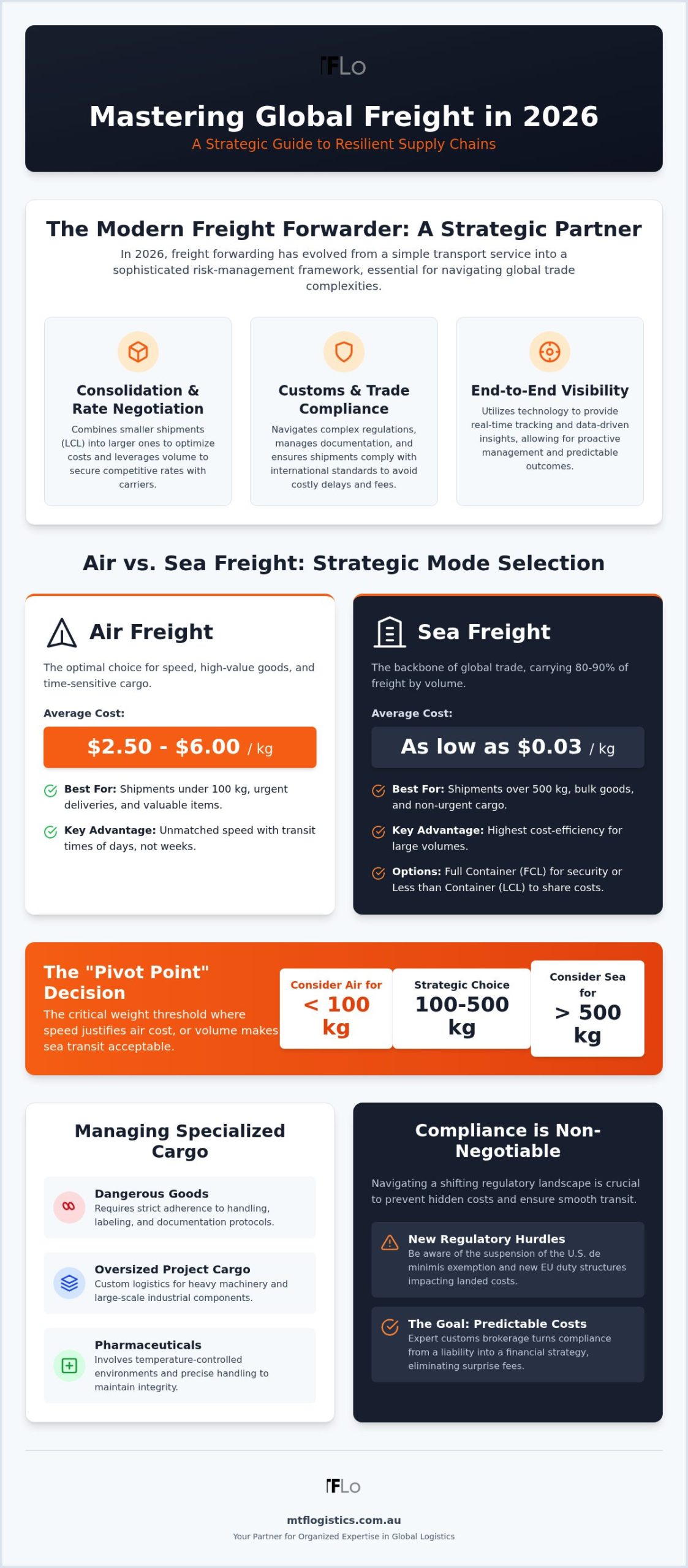
Specialized logistics addresses the movement of goods that fall outside standard 20 or 40-foot container parameters. This isn’t just about physical dimensions; it’s about the unique environmental, safety, and regulatory requirements that sensitive cargo demands. In 2026, international freight forwarding for these items requires a higher level of technical precision than general freight. Whether you’re moving heavy industrial components or temperature-sensitive vaccines, the margin for error is effectively zero. Managing these shipments requires organized expertise and a methodical approach to risk mitigation that prioritizes stability and compliance at every stage of the journey.
Safety protocols for dangerous goods handling are a critical component of this service. These shipments require precise labeling, specialized packaging, and exhaustive documentation to prevent incidents during transit. By following international safety standards, a professional forwarder ensures that hazardous materials are facilitated through the supply chain without compromising the safety of the crew or the environment. This detail-oriented management provides a steady hand in a market where regulatory oversight is increasingly rigorous.
Project cargo involves the strategic orchestration of oversized infrastructure, typically for the mining, energy, or construction sectors. This process goes far beyond simple transport. It begins with comprehensive route surveys to identify physical obstacles like low-clearance bridges or weight-restricted roads before the cargo even leaves the origin. Feasibility studies are essential to confirm that the chosen transport mode can support heavy-lift freight and oversized dimensions. A reliable partner manages the end-to-end import transport project, coordinating specialized equipment and multiple stakeholders to ensure seamless delivery. It’s a pragmatic process that values careful planning over high-pressure urgency.
Maintaining cold chain integrity is essential for pharmaceuticals and medical freight. In 2026, real-time temperature monitoring has become a standard requirement to ensure these high-value shipments remain viable throughout their transit. Perishable logistics also face strict biosecurity compliance, particularly for agricultural and food imports. Meeting these standards prevents costly border delays and protects the local ecosystem from potential contamination. The garment industry presents its own set of challenges, requiring high-volume logistics that can scale rapidly to meet seasonal demands. Each of these sectors requires a logistics partner who understands the granular details of their specific industry and can provide end-to-end visibility. If your business handles complex or sensitive shipments, contact us for expert Project Logistics management.
Choosing an international freight forwarding partner in 2026 is a high-stakes decision that dictates the resilience of your entire supply chain. Many businesses fall into the trap of selecting the lowest quote, only to face hidden surcharges and administrative delays later. In logistics, the “cheapest” option often becomes the “most expensive” when documentation errors lead to customs penalties or missed delivery windows. You need a partner that provides a steady hand, ensuring that complex global processes remain under control regardless of external market volatility. This requires a shift from viewing logistics as a commodity to seeing it as a strategic partnership.
A partner with a comprehensive national network is essential for consistent service across the country. Unlike smaller agencies restricted to specific regional hubs, a provider with national coverage ensures that your cargo receives the same level of organized expertise at every entry point. This geographic reach simplifies your internal management, as you rely on a single, reliable point of contact for end-to-end visibility. It eliminates the need to manage multiple vendors, reducing your administrative burden and ensuring that your standards are maintained across all trade lanes.
When evaluating potential partners, prioritize their technological capabilities. In 2026, real-time track and trace and data-driven insights are mandatory for maintaining a lean supply chain. These tools allow you to predict transit times with accuracy and manage inventory levels proactively. You should also assess their industry-specific expertise. Does the provider understand the technical requirements of dangerous goods handling or the seasonal pressures of the garment industry? Finally, consider the value of integrated services. A partner that combines customs brokerage with freight forwarding eliminates the friction between transport and compliance, creating a seamless flow for your goods.
MTF Logistics acts as an authoritative expert with a deep-seated commitment to transparency. Our approach is rooted in pragmatic, detail-oriented service that makes difficult tasks feel effortless for the client. Founded in 2014, our established national presence ensures that every shipment is managed with the quiet authority of a seasoned professional. We prioritize clarity and mutual success, acting as a supportive partner rather than just another service provider. By integrating modern technical tools with traditional industry knowledge, we provide the stability your business needs in an unpredictable global market. We invite you to contact MTF Logistics for a strategic freight consultation to see how our organized expertise can streamline your supply chain.
Mastering global trade in 2026 requires more than just moving cargo. It demands a methodical approach to risk management and a deep understanding of shifting regulatory landscapes. By identifying the critical pivot point between air and sea freight and treating customs compliance as a core financial strategy, you protect your margins and ensure predictable transit times. Specialized cargo, from pharmaceuticals to oversized industrial infrastructure, further necessitates a partner who operates with organized expertise and calm confidence.
Since 2014, we’ve provided the steady hand needed to navigate volatile global markets. Our expert national customs brokerage and specialized project logistics team ensure that your operations remain compliant and efficient across every trade lane. Don’t let the administrative burden of global trade hinder your growth. Simplify your global supply chain with MTF Logistics and gain the visibility your business deserves. With a reliable guide by your side, even the most complex international freight forwarding tasks become effortless.
A freight forwarder organizes the physical movement and logistics of your cargo across various transport modes. A customs broker focuses specifically on the legal entry of goods into a country, managing duties and compliance. While they serve separate functions, a modern international freight forwarding partner often integrates both to provide a seamless end-to-end experience. This integration prevents communication gaps between the transport leg and the border clearance phase, ensuring cargo moves without administrative friction.
Costs are determined by a combination of base freight rates, fuel surcharges, and port handling fees. In 2026, surcharges can account for 15% to 28% of the total shipping invoice, depending on the route and carrier. Factors such as cargo weight, dimensions, and the chosen transport mode also influence the final price. It’s essential to request a comprehensive quote that includes customs brokerage and documentation fees to avoid hidden costs that often arise with budget providers.
Sea freight typically takes between 20 and 45 days depending on the trade lane and port congestion. In contrast, air freight offers much faster transit times, usually ranging from 3 to 10 days for standard services. While sea freight is the backbone of high-volume trade, air freight is the preferred choice for time-sensitive or high-value goods that require rapid replenishment to maintain lean inventory levels and prevent production downtime across your supply chain.
Standard international shipping requires a consistent set of documents to ensure smooth border transitions. The most critical include the Bill of Lading, Commercial Invoice, Packing List, and Certificate of Origin. For specific industries, you may also need permits for dangerous goods or health certificates for perishables. Accurate documentation is your primary defense against customs delays, as even minor discrepancies can lead to formal entry rejections or mandatory inspections that increase your total landed cost.
Yes, specialized logistics teams handle cargo that falls outside standard container parameters. This includes dangerous goods, which require strict adherence to safety protocols and precise labeling, as well as oversized project cargo for industrial infrastructure. Managing these shipments involves conducting route surveys and feasibility studies to ensure the infrastructure can support heavy-lift freight. It is a methodical process that prioritizes safety and regulatory compliance over high-pressure speed, ensuring a steady hand throughout the journey.
The Harmonized System (HS) code is a standardized numerical method of classifying traded products. It’s vital because it determines the specific duties and taxes applied to your shipment at the border. In 2026, incorrect classification remains a leading cause of customs penalties and audits. Using the correct code ensures that you aren’t overpaying on duties while maintaining full compliance with international trade laws, protecting your business from avoidable financial losses and administrative setbacks.
Shipments are tracked through integrated digital platforms that provide end-to-end visibility. These systems use data-driven insights to offer real-time updates on the cargo’s location and estimated arrival time. This transparency allows businesses to manage their supply chains proactively rather than reacting to delays after they occur. Access to this level of detail is a standard requirement for modern international freight forwarding, ensuring you remain in control of your global operations at every milestone.
A freight forwarder acts as a strategic partner, leveraging their global network and volume to secure better rates and space than an individual shipper could. They manage the entire orchestration of the move, including multimodal transitions and customs brokerage, which carriers typically don’t provide. This organized expertise reduces your administrative burden and mitigates the risks associated with global volatility, making the complex process of international trade feel effortless for your internal team.


 Email
Email 1300 710 683
 Tariff Lookup
 HS Code Lookup
 Newsletter Signup