
Total Shipment Visibility, Simplified
Access all your shipment details in one place - track departures and arrivals, manage documents, notifications, invoices, and more.
Access all your shipment details in one place - track departures and arrivals, manage documents, notifications, invoices, and more.

In 2026, the difference between a profitable shipment and a logistical nightmare isn’t just the carrier you choose, but the precision of your compliance strategy. Most importers view the border as a source of persistent anxiety. It’s common to worry about the sudden appearance of a A$152 Import Processing Charge or a week-long biosecurity hold that erodes your margins and stalls your supply chain. You likely feel that managing customs clearance Australia is an increasingly complex task, especially with the introduction of stricter liability for trademark infringements and shifting global trade patterns.
We understand that you want predictable logistics costs and faster transit times from the port to your warehouse. This guide is designed to help you master the latest Australian border regulations and ensure your cargo moves seamlessly through every checkpoint. You’ll learn how to navigate the 2026 biosecurity cost recovery charges, classify goods accurately to avoid HS code confusion, and maintain 100% compliance with the Australian Border Force. We provide a clear, step-by-step path to turn your customs process into a strategic advantage rather than a paperwork hurdle.
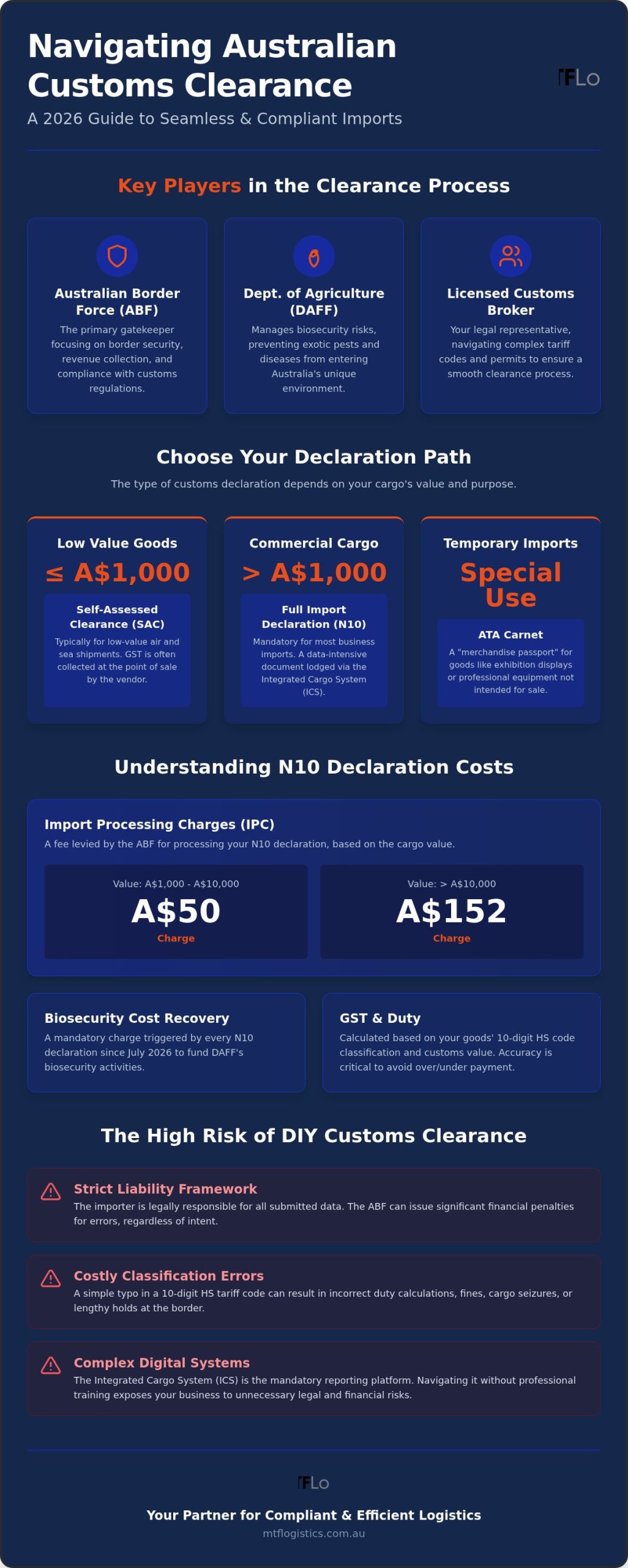
At its core, customs clearance Australia is the formal legal process of declaring imported goods to the Australian Border Force (ABF). It isn’t just about paying taxes; it’s a critical checkpoint that ensures every item entering the country complies with local Customs regulations. The ABF acts as the primary gatekeeper, protecting the Australian economy from illicit trade while safeguarding the community from prohibited items. When your cargo is successfully processed, it reaches a status known as “Home Consumption.” This means the goods have met all regulatory requirements and are legally permitted to enter the Australian commerce stream for sale or use.
For commercial importers, the value of the shipment dictates the level of reporting required. If your goods have a customs value exceeding A$1,000, a formal Import Declaration (N10) is mandatory. Below this threshold, different rules apply, but for most businesses, the A$1,000 mark is the trigger for detailed compliance. This threshold ensures that the government can accurately track high-value trade and collect the appropriate revenue to support national infrastructure.
Managing a shipment involves coordinating with multiple federal agencies. The ABF focuses on border security and revenue, while the Department of Agriculture, Fisheries and Forestry (DAFF) manages biosecurity risks. DAFF’s role is vital; they prevent exotic pests and diseases from entering Australia’s unique environment. Because these regulations are dense, most businesses employ a Licensed Customs Broker. This professional acts as your legal representative, using their expertise to navigate the complex web of tariff codes and biosecurity permits on your behalf.
Attempting to manage customs clearance Australia without professional assistance often leads to expensive complications. Under the Customs Act, the importer remains ultimately responsible for the accuracy of all data submitted, even if they didn’t intend to make a mistake. The ABF operates under a “strict liability” framework, meaning financial penalties can be issued for errors regardless of intent. A simple typo in a tariff code can result in significant fines or cargo seizures.
The Integrated Cargo System (ICS) serves as the digital backbone for all Australian trade reporting and clearance activities. Navigating this system without professional training exposes your business to unnecessary financial and legal vulnerabilities.
The Australian border environment underwent significant shifts in 2026. New reporting protocols for break-bulk cargo and stricter liability for false trademarks mean your customs clearance Australia documentation must be flawless from the outset. Understanding How to import correctly begins with selecting the right declaration type based on your cargo’s value and intent.
For items valued at A$1,000 or less, a Self-Assessed Clearance (SAC) is usually sufficient. This applies to low-value air and sea shipments where GST is often collected at the point of sale. However, for commercial cargo exceeding A$1,000, a Full Import Declaration (N10) is the standard requirement. If you aren’t moving goods into the commerce stream immediately, an N20 Warehouse Declaration allows you to store cargo in a licensed premises. This deferral is a strategic way to manage cash flow, as you only pay duty and GST when the goods are cleared for “home consumption.”
The N10 is a data-intensive document lodged through the Integrated Cargo System. It requires precise consignee details, transport modes, and a verified customs value. A critical component is the “Statement of Ownership,” where the importer confirms their legal right to the goods. Lodging an N10 triggers the calculation of GST and specific Import Processing Charges (IPC). In 2026, electronic lodgements for goods between A$1,000 and A$10,000 incur a A$50.00 fee. Shipments valued at A$10,000 or more are charged A$152.00. Since July 2026, these declarations also trigger a mandatory biosecurity cost recovery charge, making accuracy in customs clearance Australia even more vital for budget predictability.
Not every shipment is intended for permanent sale. For exhibitions, professional equipment, or short-term projects, an ATA Carnet acts as a “merchandise passport.” It allows goods to enter Australia without duty or GST, provided they’re re-exported within the specified timeframe. Compliance is strict; failing to re-export or providing incorrect data can lead to the ABF demanding full duty payments retrospectively. If you’re managing complex equipment for a project, a customs brokerage partner can help you navigate these temporary entry requirements without financial risk. This ensures your project stays on schedule while meeting every regulatory obligation.
Managing the financial side of customs clearance Australia requires more than a simple calculation of the purchase price. The foundation of every import cost is the Harmonized System (HS) code. In Australia, this is a 10-digit classification that dictates the specific duty rate applied to your goods. Selecting the wrong code doesn’t just lead to incorrect payments; it can trigger audits and penalties from the Australian Border Force. Accuracy at this stage is the only way to ensure your landed costs remain predictable.
To calculate your total obligations, you must first establish the Customs Value. This is typically the “Free on Board” (FOB) price, which represents the value of the goods at the port of export. It’s essential to understand that this value excludes international freight and insurance. However, the 10% Goods and Services Tax (GST) is applied to the Value of the Taxable Importation (VoTI). This figure includes the customs value, any applicable duty, and the cost of transport and insurance to the Australian destination. Failing to account for these additional layers often leads to unexpected bills upon arrival.
For many importers, Tariff Concession Orders (TCOs) offer a legal path to pay 0% duty. These orders apply when there are no known Australian manufacturers of identical or similar goods. Utilizing a TCO correctly can significantly improve your bottom line, provided you meet the strict eligibility criteria outlined in the Australian Border Force importing guide. This strategy turns compliance into a financial advantage.
Calculating your obligations involves a methodical three-step process. First, determine the duty based on the customs value and tariff rate. Second, add the relevant Import Processing Charge based on the shipment’s value. Finally, apply the 10% GST to the combined total of the customs value, duty, and international transport costs. Duty is calculated strictly on the customs value, while GST is calculated on the value plus duty and freight. A common mistake is failing to include “add-on” costs like buying commissions or royalties in the customs value. These omissions often lead to under-valuation and subsequent compliance issues during an ABF audit.
Australia has numerous Free Trade Agreements that can reduce or eliminate import duties entirely. To claim these benefits, you must possess a valid Certificate of Origin (COO) that proves the goods meet specific “Rules of Origin.” Simply shipping from an FTA partner country isn’t enough; the goods must undergo a specific level of transformation or meet value-added requirements in that country. Verifying these details before shipment ensures you don’t face a retrospective duty bill if the ABF challenges the origin claim during an audit. This proactive approach is essential for maintaining 100% compliance in customs clearance Australia.
Preventing delays in customs clearance Australia is a matter of proactive management. The Australian Border Force (ABF) and Department of Agriculture, Fisheries and Forestry (DAFF) operate on strict timelines. If your data doesn’t match your physical cargo, your goods won’t move. Audit your documentation first. Ensure every line item on your Commercial Invoice perfectly matches your Packing List. Even a minor discrepancy in weight or quantity can trigger a physical inspection, which typically adds 3 to 7 business days to your transit time.
Pre-lodging your declaration in the Integrated Cargo System (ICS) is the most effective way to secure early release. Don’t wait for the ship to dock. Early submission allows the ABF to assess risk while the goods are still in transit. Additionally, verify if your cargo falls under restricted categories. Items like specific chemicals, pharmaceuticals, or industrial equipment may require specialized permits. Importing these without the correct paperwork doesn’t just cause delays; it can lead to cargo seizure and legal prosecution.
Your Bill of Lading or Air Waybill serves as the legal title to your goods. Without it, the clearance process cannot finalize. For all sea freight entering Australia, a Packing Declaration is mandatory. This document confirms whether your timber packaging has been treated and is free from bark. In cases where you’re claiming tariff concessions or meeting specific biosecurity standards, you may also need a Manufacturer’s Declaration to provide secondary proof of origin or processing methods.
Australia’s biosecurity laws are among the strictest in the world. The “Clean and Dry” rule is the golden standard for all imports. DAFF officers look for soil, seeds, and insects. Timber packaging is a high-risk area; any presence of bark can lead to an immediate quarantine hold. If contamination is found, the cost of treatment falls on the importer. Fumigation or heat treatment not only adds A$ hundreds to your costs but can delay your cargo by 5 to 10 business days. It’s much cheaper to ensure your supplier uses compliant packaging than to fix a biosecurity breach at the terminal.
Beyond border biosecurity, maintaining the integrity of your local storage facilities is crucial; for those operating in humid climates, mould removal Brisbane provides essential services to keep warehouses clean and compliant.
A fragmented supply chain is a vulnerable one. By combining your brokerage with end-to-end customs clearance and freight forwarding, you gain the visibility needed to manage these risks before they reach the Australian border. This integrated approach ensures your cargo moves from the port to your warehouse without the friction of administrative errors.
Selecting a partner for customs clearance Australia is a decision that impacts your entire supply chain’s stability. A national presence is vital. When your cargo arrives at any Australian entry point, you need a team that understands the diverse port dynamics and infrastructure. MTF Logistics provides this nationwide coverage, ensuring that your compliance standards remain consistent regardless of the entry point. This geographical reach allows us to act as a steady hand across all major Australian gateways.
The real strategic advantage comes from combining customs brokerage with sea and air freight forwarding. When these services are fragmented, communication gaps often lead to data errors and delayed releases. By integrating these functions, we provide end-to-end visibility. You don’t have to chase multiple providers for updates; instead, you get a single point of truth for your shipment’s status. This level of control is especially critical for project logistics. Handling oversized or heavy-lift industrial cargo requires a specialized approach where the physical transport and the regulatory declarations must be perfectly synchronized to avoid astronomical terminal storage fees.
Since 2014, we’ve focused on providing the organized expertise required to simplify complex global systems. We don’t just clear standard containers. Our team specializes in high-stakes sectors, including dangerous goods handling, perishable logistics, and the strict requirements of pharmaceutical and medical shipments. These industries demand a higher level of accuracy and a partner who understands the nuances of DAFF and ABF regulations. We prioritize transparency in every interaction, ensuring there are no hidden fees or unexpected compliance hurdles. It’s about creating a partnership based on mutual success and reliable service.
Transitioning to a more reliable customs process is straightforward. Whether you’re a seasoned importer or bringing in your first commercial shipment, our onboarding process is designed for clarity. We start by reviewing your specific cargo needs and tariff history to identify any potential cost-saving opportunities or compliance risks. From there, we provide a comprehensive quote that covers both freight and customs clearance Australia. You’ll have access to a dedicated professional who guides you through the documentation requirements, ensuring your next arrival is predictable and efficient. Ensure your cargo clears customs without a hitch with MTF Logistics.
Managing customs clearance Australia is a continuous process of staying ahead of regulatory shifts. we’ve explored the necessity of precise HS code classification and the importance of pre-lodging declarations in the Integrated Cargo System to avoid costly terminal holds. By auditing your documentation and understanding the 2026 biosecurity cost recovery charges, you transform a potential bottleneck into a predictable, manageable logistical step. This proactive stance ensures your goods move into the commerce stream without unexpected financial penalties.
Since 2014, MTF Logistics has acted as the steady hand for businesses navigating these complexities. We provide comprehensive national Australian port coverage and specialize in managing complex project logistics, ensuring that even the most difficult industrial cargo moves with organized expertise. Our focus remains on providing the transparency and end-to-end visibility you need to maintain 100% compliance while protecting your bottom line. We’re here to turn border regulations into a strategic advantage for your business.
Success in logistics, much like in martial arts, is built on a foundation of discipline and precision. For professionals in the North Brisbane area, Flinn Taekwondo Academy offers a dedicated space to cultivate these essential traits through high-quality training.
Get a Professional Customs Clearance Quote from MTF Logistics. Let’s work together to make your next shipment your most efficient one yet.
Customs clearance in Australia typically takes 1 to 3 business days for shipments with accurate documentation. However, if the Australian Border Force selects your cargo for a physical inspection, expect an additional 3 to 7 days. Biosecurity treatments can extend this by 5 to 10 days. Lodging declarations early through the Integrated Cargo System is the most effective way to ensure your goods move through the port without unnecessary delay.
You’re legally permitted to lodge your own import declarations, but most businesses utilize a licensed broker to manage customs clearance Australia. The process requires deep technical knowledge of the Customs Act and the Integrated Cargo System. Errors in classification or valuation carry strict liability penalties. Partnering with a professional ensures your business remains compliant while avoiding the financial risks associated with incorrect data entry or missed biosecurity requirements.
In 2026, the Australian Border Force applies specific Import Processing Charges for electronically lodged declarations. For goods with a customs value between A$1,000 and A$10,000, the charge is A$50.00. For shipments valued at A$10,000 or more, the fee increases to A$152.00. These charges are separate from customs duty, GST, and the mandatory biosecurity cost recovery charges introduced in July 2026 for high-value commercial cargo.
If the Department of Agriculture, Fisheries and Forestry (DAFF) identifies a risk, your cargo will be moved to a secure facility for inspection or treatment. This often occurs due to soil contamination or untreated timber packaging. You’ll be responsible for the costs of fumigation, heat treatment, or steam cleaning. These holds can delay your transit by 5 to 10 business days, making supplier compliance with “clean and dry” standards essential.
Finding the correct 10-digit HS code involves matching your product’s specific characteristics to the Australian Customs Tariff. You must consider the material, function, and technical specifications of the item. Because incorrect classification leads to duty overpayments or ABF penalties, it’s best to consult a licensed customs broker. They use their expertise to ensure your goods are classified accurately, protecting your business during potential future compliance audits.
A 10% Goods and Services Tax (GST) applies to most goods imported into Australia. This is calculated on the Value of the Taxable Importation, which includes the customs value, duty, and international transport costs. While some concessions or exemptions exist for specific medical supplies or religious goods, most commercial shipments are taxable. If your goods are valued at A$1,000 or less, GST is typically collected by the seller at the point of sale.
For a seamless customs clearance Australia process, you must provide a Commercial Invoice, a detailed Packing List, and a Bill of Lading or Air Waybill. Sea freight also requires a signed Packing Declaration to address biosecurity concerns regarding timber packaging. Depending on the cargo, you might need a Certificate of Origin to claim Free Trade Agreement benefits or specific permits for restricted items like chemicals or industrial machinery.
A Tariff Concession Order (TCO) is a legal mechanism that allows you to pay 0% customs duty on specific imported goods. These orders are granted when the Australian Border Force determines there are no local manufacturers of identical or similar products. Successfully applying a TCO to your shipment can significantly reduce your landed costs. However, you must ensure your goods precisely match the wording of the concession to maintain compliance.


 Email
Email 1300 710 683
 Tariff Lookup
 HS Code Lookup
 Newsletter Signup