
Total Shipment Visibility, Simplified
Access all your shipment details in one place - track departures and arrivals, manage documents, notifications, invoices, and more.
Access all your shipment details in one place - track departures and arrivals, manage documents, notifications, invoices, and more.

Heavy lift logistics in Australia is an engineering challenge first and a transport task second. Moving oversized cargo across state lines often feels like a constant battle against shifting regulations and the looming fear of expensive wharf delays. You’ve likely experienced the stress of coordinating complex multi-state permits while trying to ensure your customs partner is perfectly synced with the physical haulage schedule. It’s a high-stakes environment where a single oversight in engineering planning or a miscalculated NHVR permit can lead to cargo damage or mounting port storage fees.
We understand that reliability is your primary objective in a volatile market. This guide provides a comprehensive logistical and regulatory framework to help you master these complexities for your 2026 projects. You’ll gain a clear understanding of the latest NHVR requirements, including the A$94 PBS vehicle access permit process and the HVSAPS system launched in early 2026. We’ll also demonstrate how to integrate customs clearance with physical transport to create a risk-mitigated logistics plan. From navigating updated DAFF biosecurity fees to managing infrastructure levies at the terminal, this guide ensures your project cargo moves with precision and transparency.
Heavy lift freight is defined by its refusal to fit into the standard boxes of global trade. In the Australian logistics sector, we categorize this as Out of Gauge (OOG) cargo. These are items that exceed the dimensions of a standard 20-foot or 40-foot container, requiring specialized handling, equipment, and stowage. While general freight relies on speed and volume, heavy lift demands a focus on engineering and regulatory precision. It’s a field where the margins for error are slim and the costs of a mistake are substantial.
The terminology can be confusing for those new to industrial logistics. Breakbulk refers to cargo stowed directly in a vessel’s hold rather than in a container. Project cargo is a broader term, encompassing the end-to-end movement of various components for a single site, such as a wind farm or a new mine. Heavy haulage is the final, critical leg where these massive components move by road. These operations often utilize a specialized Heavy-lift ship equipped with onboard cranes capable of lifting hundreds of tonnes, providing the physical capability to move what standard vessels cannot.
Industries like mining, renewables, and civil infrastructure drive the demand for these services across the country. Whether it’s moving modular bridge components or massive excavators, the complexity requires a specialized customs broker Brisbane partner. Unlike general freight, heavy lift imports often involve used machinery. This triggers intensive biosecurity inspections and complex tariff classifications that can stall a project if handled incorrectly. A steady hand is required to manage these regulatory hurdles alongside the physical transport task.
In Australia, cargo is typically classified as oversized once it exceeds a width of 2.5 metres or a height of 4.3 metres, though these limits can vary based on specific state regulations and route clearances. Weight is often the more restrictive constraint. When an item’s mass exceeds the standard axle load limits set by the National Heavy Vehicle Regulator (NHVR), it requires multi-axle trailers and specific road permits. Common examples include massive power turbines, 400-tonne excavators, and pre-fabricated structural modules. These items don’t just require a truck; they require a calculated transport plan that accounts for bridge capacities and overhead clearance.
A successful heavy lift project relies on a tightly integrated network of professionals. The freight forwarder manages the international sea and air legs, while a licensed customs broker Brisbane professional ensures that the industrial goods meet Australian Border Force requirements without costly delays. Port authorities and stevedores manage the physical transfer at the wharf, using specialized gear like reach stackers or heavy-lift cranes. Coordination between these parties is essential to avoid terminal storage fees, which can escalate rapidly for oversized cargo. Each stakeholder must operate with transparency to ensure the cargo moves safely from the wharf to its final destination.
Route surveys are the blueprint for a successful heavy lift project. They transform a theoretical transport task into a verified logistical path. Without a comprehensive survey, you risk encountering insurmountable physical barriers that lead to costly diversions or, worse, structural damage. Engineering for stability is equally vital. Calculating the center of gravity (COG) ensures that the cargo remains balanced during sea swells and road inclines. When these technical details are overlooked, the entire logistics chain is at risk. Integrating these engineering insights with your customs broker Brisbane team allows for a more cohesive documentation process, ensuring that permit dimensions match the physical reality of the load.
The process begins by identifying “pinch points” on Australian highways, such as narrow bridges, tight urban intersections, and low-clearance tunnels. For super-loads, this involves physical “dry runs” where a vehicle of similar dimensions traverses the route to confirm clearances. Seasonal impacts are a significant variable in Australia. In the north, the wet season can render unsealed roads impassable for heavy trailers, while summer heat in the interior can affect bitumen stability under high axle loads. Digital mapping provides a starting point, but physical verification remains the gold standard for high-value cargo.
Securing heavy lift items requires specialized equipment like flat rack containers or dedicated breakbulk vessel space. Engineering teams must assess crane capacity at major Australian ports to ensure the infrastructure can handle the lift. Lashing points are the primary safety mechanism for OOG sea freight, providing the designated structural anchors where chains or straps secure the load to the vessel or container. These points must be rated to withstand the dynamic forces experienced during transit. Accuracy here prevents shifts that could lead to catastrophic cargo loss.
Identifying physical constraints like bridge load ratings and overhead power lines is a non-negotiable step. For the largest loads, pilot escorts and police involvement are mandatory to manage traffic and lift power lines where necessary. This level of coordination is what distinguishes project logistics from standard freight. By working with a partner that offers integrated project logistics, you can ensure that the engineering requirements are perfectly aligned with your transport schedule and regulatory obligations. This methodical approach provides the steady hand needed to manage the complexities of moving oversized cargo across the continent.
The National Heavy Vehicle Regulator (NHVR) acts as the central authority for most of Australia, governing vehicles over 4.5 tonnes Gross Vehicle Mass. For project cargo, the regulator ensures that massive loads move through the road network without compromising public safety or infrastructure. Mismanaging this regulatory layer often results in demurrage at the port, as transport cannot commence until permits are finalized. Working with a customs broker Brisbane specialist allows you to synchronize the arrival of your vessel with road access approvals, creating a seamless transition from the wharf to the highway. This coordination is essential for maintaining the momentum of industrial projects.
Permits generally fall into three categories. Class 1 covers Oversize/Overmass (OSOM) vehicles, such as those carrying large construction machinery or mining equipment. Class 2 governs high-productivity vehicles like B-doubles, while Class 3 applies to vehicles that exceed standard limits but don’t fit into the OSOM category. Each class requires specific documentation and, in many cases, a structural assessment of the intended route. Failing to identify the correct permit class early in the planning phase can lead to significant delays at the border.
Applying for OSOM permits became more streamlined with the launch of the Heavy Vehicle Structural Assessment Permit System (HVSAPS) on January 12, 2026. A Performance-Based Standards (PBS) vehicle access permit application currently costs A$94. For multi-state journeys, the NHVR coordinates with state road authorities to provide a unified permit, though local considerations remain. Common rejections usually stem from inaccurate axle weight data or insufficient route descriptions. Precision in your initial application is the best way to avoid the 15-business-day minimum turnaround times often seen for complex loads in states like Victoria.
Under the Heavy Vehicle National Law (HVNL), the importer is considered a “party in the chain” and shares legal liability for safety. You aren’t just a bystander; you’re responsible for ensuring that the cargo is packed and loaded in a way that doesn’t cause a breach of mass or dimension limits. Key obligations include managing fatigue for drivers and ensuring lashing requirements are met. For a deeper look at your legal requirements beyond road transport, see our Customs Clearance Australia: 2026 Importer’s Guide. This shared liability makes it critical to choose partners who prioritize compliance as much as delivery speed, providing a steady hand throughout the transport process.
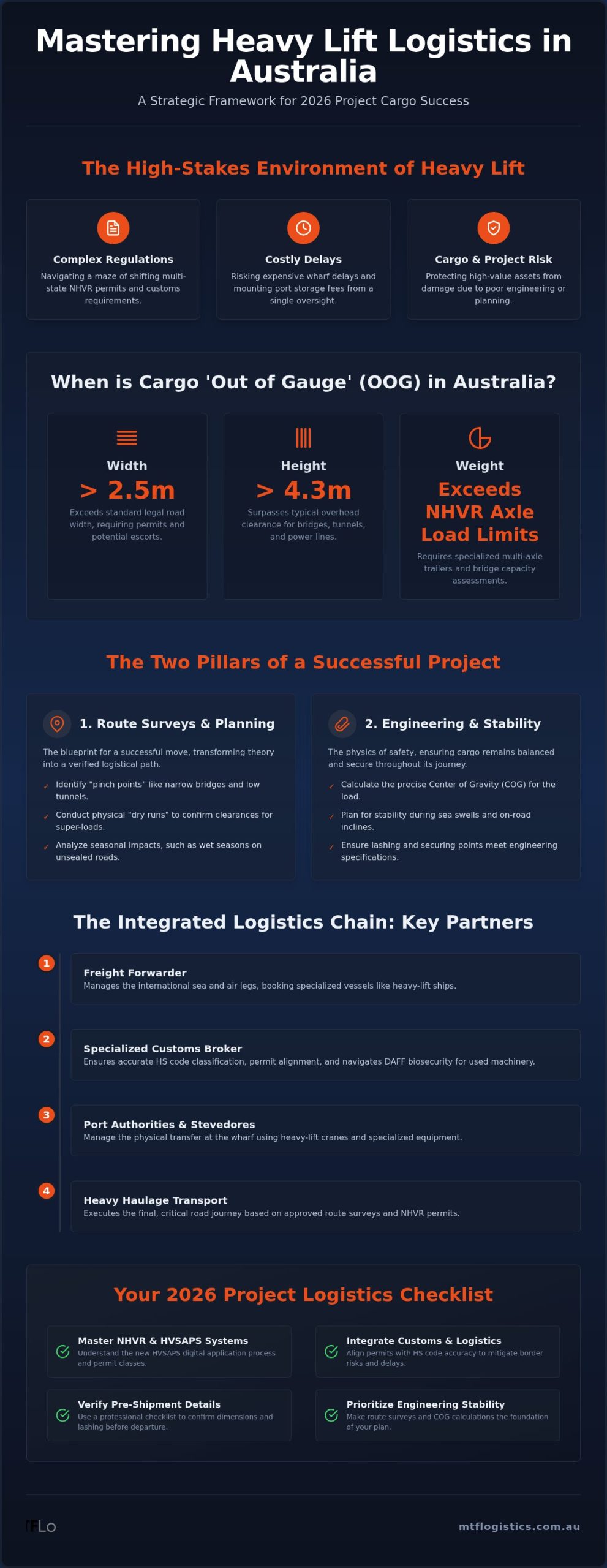
Executing a heavy lift project requires a sequence of verified milestones that begin long before the cargo reaches Australian waters. A methodical approach ensures that technical data remains consistent across all documentation. Discrepancies between the physical dimensions and the paperwork often trigger the very delays that blow project budgets. Success depends on the early verification of gross weights and exact lashing points to ensure the transport plan remains valid from the point of origin to the final site.
For large-scale industrial imports, the Harmonized System (HS) code is a critical regulatory key. Incorrect classification is a primary cause of border friction, often leading to intensive audits or the suspension of permits. Working with a specialized customs broker Brisbane team ensures that your machinery is classified with precision, accounting for the specific functions of complex modular components. HS codes determine the eligibility for specific duty concessions under Australian trade agreements, which can significantly reduce the financial burden on major infrastructure projects. The same precision-based classification approach that applies to industrial machinery is equally critical in other import categories — for instance, businesses managing customs clearance for clothing Australia face similarly complex HS code requirements and duty concession opportunities under Free Trade Agreements. For a deeper technical analysis of moving complex equipment, refer to our Heavy Haulage Logistics Australia: The 2026 Project Cargo Guide. This alignment between customs data and physical engineering is the only way to maintain a risk-mitigated logistics plan.
Most Australian ports operate with a strict three-day storage window for imported cargo. For oversized items, this timeframe is even more sensitive because they often require “direct delivery” from the hook to the trailer. This means the heavy haulage equipment must be positioned on the wharf the moment the stevedores begin the discharge process. Coordinating with terminal operators and ensuring the availability of specialized lifting gear is a high-stakes task. If the transport leg isn’t perfectly synchronized with the vessel’s arrival, you face escalating infrastructure levies and storage fees that can reach thousands of dollars per day.
The transition from the stevedore to the heavy haulage trailer is the point of highest risk. It’s the moment where engineering plans meet physical reality. Your customs broker Brisbane partner should have already secured the necessary pre-clearance to ensure the cargo doesn’t sit idle while paperwork is processed. To ensure your next shipment is ready for this transition, consider requesting a professional project logistics audit to identify potential bottlenecks in your current checklist. This proactive management keeps your project moving with the steady hand and transparency required for success in a volatile market.
MTF Logistics operates as a steady hand in a volatile global market. We don’t just move cargo; we manage the entire ecosystem of project logistics. By integrating our role as a customs broker Brisbane with physical transport engineering, we eliminate the friction points where most delays occur. This end-to-end visibility is powered by data-driven insights, allowing you to maintain control over even the most complex international movements. Our approach prioritizes stability and accuracy, ensuring that your industrial assets move through the supply chain without unnecessary friction.
Traditional logistics often separates customs and transport into silos, creating gaps in communication and accountability. We reduce this complexity by housing both functions under one roof. This ensures that the technical data used for your NHVR permits is identical to the data lodged with the Australian Border Force. Whether you’re exploring Reliable Sea Freight Services for Australian Business or managing a multi-modal air and road project, our team provides a single point of contact. We’ve managed complex industrial projects Australia-wide, ranging from used mining machinery requiring intensive biosecurity cleaning to modular infrastructure for the renewables sector.
Safety isn’t a checkbox; it’s a core engineering requirement. Our commitment to Australian safety standards ensures full compliance with the Heavy Vehicle National Law (HVNL) and the Chain of Responsibility (CoR) framework. We act as your reliable guide, identifying risks like wharf congestion or permit bottlenecks before they impact your timeline. Our specialized expertise extends to pharmaceuticals, dangerous goods, and oversized industrial freight, ensuring that every shipment meets the highest regulatory standards. This proactive communication style prevents delays, keeping your project on schedule and within budget. We understand the intricacies of the Australian market and the specific demands of heavy lift freight.
Choosing a partner who understands these complexities is essential for mitigating the risks of heavy lift freight. By aligning your customs brokerage needs with a team that understands the physical constraints of heavy haulage, you create a more resilient logistics plan. If you’re ready to simplify your next project and gain the visibility your stakeholders require, Contact MTF Logistics for a comprehensive project cargo consultation. We’ll work with you to develop a methodical, risk-mitigated logistics plan that delivers results through every stage of the journey.
The complexity of moving oversized cargo across Australia requires more than just heavy machinery; it demands a methodical integration of engineering and regulatory expertise. We’ve explored how comprehensive route surveys and strict NHVR compliance form the foundation of a successful transport plan. By aligning these technical requirements with a specialized customs broker Brisbane team, you can mitigate the risks of costly wharf delays and ensure your project remains on schedule. Precision at the border is just as critical as the physical haulage leg.
Since 2014, we’ve acted as a steady hand for businesses navigating the intricacies of international trade. As specialists in customs clearance and end-to-end project logistics, we prioritize transparency and precision in every shipment. Whether you’re importing mining equipment or renewable energy infrastructure, having a reliable guide makes difficult tasks feel effortless. It’s about maintaining control in a volatile global market through organized expertise.
Partner with MTF Logistics for your next heavy lift project to gain the visibility and control your stakeholders expect. We look forward to facilitating your next successful movement across the continent.
Heavy lift freight refers to cargo that exceeds the standard dimensions or weight limits of a 20-foot or 40-foot shipping container. In the Australian market, this is often called Out of Gauge (OOG) cargo. These items typically exceed 2.5 metres in width or 4.3 metres in height. Examples include massive mining excavators, wind turbine blades, and industrial boilers. These loads require specialized trailers and specific road permits to move safely across the national network.
Current turnaround times for National Heavy Vehicle Regulator (NHVR) permits depend on the complexity of the route and the load. For standard oversized and overmass (OSOM) applications, you should allow at least 15 business days. As of 2026, the launch of the HVSAPS system has streamlined structural assessments, but multi-state journeys still require coordination between various road authorities. Early application is the only way to avoid costly delays at the wharf.
A licensed customs broker Brisbane specialist is essential for heavy lift imports due to the high regulatory stakes. Industrial machinery often qualifies for specific duty concessions that require precise HS code classification. Without professional guidance, you risk biosecurity delays or significant financial penalties from the Australian Border Force. A broker ensures your documentation aligns perfectly with your physical transport permits, providing a steady hand throughout the complex clearance process.
A route survey is a detailed technical assessment of the path your cargo will take from the port to the site. It identifies physical constraints like low-clearance bridges, overhead power lines, and narrow intersections. For high-value project cargo, this often involves a physical “dry run” with a vehicle of similar dimensions. This survey is the foundation of your engineering plan, ensuring the load won’t encounter insurmountable barriers during its journey.
Australia maintains some of the world’s strictest biosecurity regulations, especially for used heavy machinery. The Department of Agriculture, Fisheries and Forestry (DAFF) requires these items to be free of soil, seeds, and organic matter. This often necessitates intensive offshore cleaning or onshore treatment at a bonded facility. Failing to meet these standards leads to expensive inspection fees and potential re-exportation orders, making pre-shipment cleaning a vital step in your logistics plan.
Total costs depend on the dimensions of the load, the distance travelled, and the required permits. You must account for wharfage, harbour dues, and infrastructure levies, which vary by port. For example, heavy vehicle escort services in some regions are charged at A$275 per hour per vehicle. While we don’t provide flat-rate pricing due to project complexity, we recommend a comprehensive audit to identify all regulatory and physical transport costs early in the planning phase.
Out of Gauge (OOG) shipping involves cargo that is secured to a flat rack or open-top container but exceeds standard dimensions. Breakbulk shipping involves cargo that is stowed directly in the hold of a vessel because it’s too large or heavy for any container type. Choosing between them depends on the cargo’s center of gravity, weight, and the availability of specialized heavy-lift ships at your chosen port of entry.
MTF Logistics provides specialized dangerous goods handling as a core part of our project logistics services. We manage the end-to-end movement of hazardous materials, ensuring they’re correctly classified, labeled, and stowed according to Australian safety standards. This expertise allows us to integrate the transport of dangerous components with your broader heavy lift project, providing a single point of contact and maintaining full visibility over the entire supply chain.


 Email
Email 1300 710 683
 Tariff Lookup
 HS Code Lookup
 Newsletter Signup