
Total Shipment Visibility, Simplified
Access all your shipment details in one place - track departures and arrivals, manage documents, notifications, invoices, and more.
Access all your shipment details in one place - track departures and arrivals, manage documents, notifications, invoices, and more.

Did you know that while China, Bangladesh, and Vietnam account for roughly 75% of apparel imports, many businesses still lose 5% of their profit margins to avoidable duty costs? Managing customs clearance for clothing Australia requires more than just filling out forms. It demands a precision-based approach to classification and compliance. You’ve likely felt the frustration of a shipment being held by the Australian Border Force due to a minor paperwork error or seen delicate garments arrive damaged because of poor handling. It’s a high-stakes environment where a single mistake can derail an entire seasonal launch.
We believe that reliability is the foundation of a successful fashion brand. This guide provides a clear roadmap for 2026 apparel import regulations, from navigating HS code classifications to utilizing Free Trade Agreements for 0% tariffs. You’ll learn how to lower your risk of penalties and implement efficient end-to-end garment logistics. We’ll cover the latest 2026 biosecurity fee adjustments, the $1,000 import declaration threshold, and the specialized handling methods that keep your inventory retail-ready from the moment it clears the border.
Garment logistics is the specialized management of apparel, footwear, and textiles through global supply chains. In Australia, this process is particularly complex because the market relies on international manufacturers for the vast majority of retail stock. To maintain healthy profit margins, businesses must master customs clearance for clothing Australia, ensuring every shipment meets strict compliance standards without incurring unnecessary delays or storage fees.
The Australian Border Force (ABF) serves as the primary regulator, overseeing the entry of goods and the collection of duties. Examining the History of Australian Textile Tariffs provides context for why we now see a standard 5% duty rate on most apparel imports. In 2026, we’re seeing an increased focus on sustainable sourcing documentation. Importers are now expected to provide greater transparency regarding the ethical origins and environmental impact of their textiles, which adds a new layer of administrative requirements to the standard clearance process.
Apparel is a sensitive commodity. Unlike general cargo, textiles are vulnerable to environmental factors that can ruin an entire shipment. During sea freight, moisture and humidity are constant threats that can lead to mildew and permanent fabric degradation. High-pressure stacking in containers can also cause deep creasing in delicate garments, requiring expensive post-import restoration. Efficient customs clearance for clothing Australia isn’t just about filing paperwork; it’s about protecting the physical integrity of the product so it arrives retail-ready. When clearance is delayed, fashion brands often miss critical seasonal windows, which can lead to significant revenue loss.
Importing garments involves a dual-layered regulatory approach. While the ABF manages tariffs and trade compliance, the Department of Agriculture, Fisheries and Forestry (DAFF) oversees biosecurity risks associated with natural fibers like wool, silk, and down. As an importer, you have a legal obligation to provide accurate data for every item of cargo, including precise material compositions. Errors in reporting can lead to significant penalties, shipment seizures, or long-term compliance audits. A licensed customs broker acts as your professional representative, translating complex regulations into actionable steps and ensuring your documentation meets the exact standards required by both the ABF and DAFF. This partnership provides the steady hand needed to navigate the intricacies of the 2026 global market.
The Harmonized System (HS) is the definitive language used in customs clearance for clothing Australia. It’s a numerical method of classifying every traded product, but for fashion importers, the system is remarkably granular. Under the Australian Customs Tariff Act, a garment’s classification depends heavily on its material composition and construction. For instance, a 100% cotton blouse carries a different code than one made from a synthetic blend. This distinction is vital because while the general duty rate is 5% for most apparel in 2026, many shipments qualify for 0% duty through Free Trade Agreements (FTAs) with partners like China, Vietnam, or India. Accessing these preferential rates requires your HS codes to be beyond reproach.
Misclassification is a leading cause of border delays and unexpected costs. The most frequent error involves confusing knitted or crocheted items, which fall under Chapter 61, with woven garments in Chapter 62. While they might look similar, the manufacturing process dictates the legal code. Another challenge arises with sets. If you’re importing a matching pyjama set or a suit, it may be classified as a single unit or as separate components depending on how it’s packaged and invoiced. Finalizing your HS code classification before the goods leave the factory ensures you don’t face penalties or audits from the Australian Border Force later.
Calculating the total cost of importation requires precise data and an understanding of the formula used by authorities. The process begins with the Customs Value (CV), which is the Free on Board (FOB) price paid for the goods. In 2026, the general duty rate remains 5% of this CV unless an FTA applies. Once the duty is determined, you must also account for the 10% Goods and Services Tax (GST). This tax is applied to the “value of the taxable importation,” which includes the CV, the duty, and the costs of international transport and insurance. You can find a detailed breakdown in our guide on Understanding Import Duty and Tax Calculations. Managing these variables effectively is a core part of professional customs brokerage and logistics, providing the transparency needed to protect your margins.
While duty rates and HS codes manage the financial side of your shipment, biosecurity protocols protect Australia’s borders from biological threats. The Department of Agriculture, Fisheries and Forestry (DAFF) monitors clothing because natural fibers can harbor pests or diseases that threaten local ecosystems. For professional customs clearance for clothing Australia, you must identify materials like silk, wool, and down feathers early in the procurement phase. These items, along with untreated leather components, are categorized as high-risk. If a shipment lacks the necessary treatment certificates or documentation, it faces immediate inspection. Since July 1, 2026, biosecurity and imported food regulatory charges have increased by 3.8%, making delays even more costly for your bottom line. Non-compliance often leads to expensive fumigation costs, total seizure of the goods, or forced re-exportation at the importer’s expense.
Leather goods and hides are subject to specific entry conditions. Untreated or “raw” leather poses a higher risk than fully tanned commercial products, often requiring specific tanning declarations or evidence of processing. For commercial importers of second-hand clothing, the requirements are even more stringent to prevent the introduction of pathogens. You’ll need to provide proof of professional laundering or disinfection for every unit in the consignment. You can review the full list of protocols in our guide on AQIS import requirements Australia. This proactive approach helps maintain a steady flow of inventory without the friction of border holds, ensuring your supply chain remains resilient.
Compliance extends beyond biosecurity to the physical labels on your garments. The Australian Consumer Law (ACL) mandates clear labelling for fiber content and care instructions. These labels must be permanently attached and legible for the life of the garment. “Made in” claims are scrutinized by the ABF; inaccurate country-of-origin markings can result in significant penalties or the required removal of labels before the goods are released. In 2026, the trade description for textiles must include a true description of the goods, the name of the country where they were made, and the percentage of fiber by weight in descending order. Ensuring these details are correct at the point of manufacture is the most effective way to facilitate a seamless customs clearance for clothing Australia process.
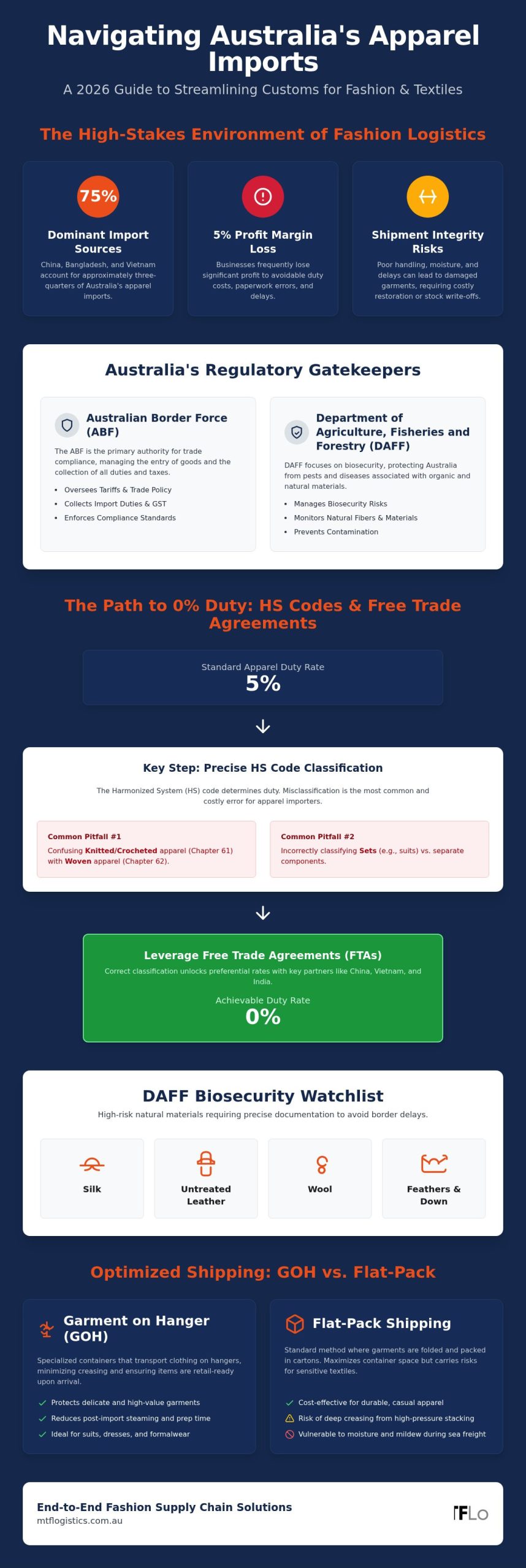
Selecting the appropriate shipping method is a strategic decision that influences both your lead times and your bottom line. While sea freight remains the backbone of bulk apparel imports, the choice between flat-pack and Garment on Hanger (GOH) configurations determines how quickly your stock moves from the port to the shop floor. This decision also impacts the speed of customs clearance for clothing Australia; well-organized containers with clear, itemized packing lists facilitate faster inspections by the Australian Border Force. When your documentation perfectly mirrors the physical layout of the container, you reduce the likelihood of the manual “tailgate” inspections that often cause bottlenecks at major Australian ports.
Air freight is often the preferred choice for high-value samples, capsule collections, or urgent seasonal replenishments. It minimizes the time garments spend in transit, which effectively eliminates the risk of moisture damage and mildew that can occur during long sea voyages. For lightweight items like silk dresses or high-end lingerie, the cost difference between air and sea is frequently offset by the reduction in inventory holding costs and the ability to respond to volatile market trends in real-time. Heavier items like wool winter coats or leather boots typically remain in sea freight to maintain margins. You can explore our Air Freight Australia guide for more strategic insights into managing 2026 shipping cycles effectively.
The primary advantage of GOH is that garments are transported on specialized internal racking systems rather than in compressed boxes. This “retail-ready” approach allows stock to move directly from the shipping container to the retail floor, bypassing the need for labor-intensive steaming, ironing, or refurbishment at the destination warehouse. GOH containers use either a “string” or “bar” system to keep garments suspended, which is essential for structured items like tailored suits, evening gowns, or delicate pleated fabrics that would be ruined by traditional packing methods.
In contrast, flat-pack shipping maximizes container space, making it the most cost-effective method for high-volume basic items like T-shirts, denim, and cotton knitwear. While this method lowers the per-unit shipping cost, it increases the labor requirements once the goods arrive in Australia. The increased density of flat-pack shipments also requires a meticulous approach to documentation to ensure a smooth customs clearance for clothing Australia. If your manifest doesn’t clearly delineate the contents of every carton, you risk the administrative delays and biosecurity hold-ups mentioned in previous sections. For tailored support in optimizing your transport configurations, explore our specialized garment industry logistics offerings.
MTF Logistics provides the steady hand required to manage the volatility of the 2026 fashion market. By integrating our specialized garment industry logistics with customs clearance, we eliminate the communication gaps that frequently lead to shipment holds. When a single partner manages your cargo from the factory floor to the Australian warehouse, you gain end-to-end visibility that standard forwarders simply cannot provide. This unified approach ensures that the specific requirements for customs clearance for clothing Australia, such as material-specific biosecurity declarations and preferential tariff claims, are addressed long before the vessel arrives at the port. We focus on facilitator roles, resolving the complex administrative hurdles that often eat into retail margins.
Our expertise is rooted in over a decade of industry service, having been founded in 2014 as a privately owned Australian provider. We understand that a silk-blend knit requires a different classification strategy than a 100% synthetic woven garment; we apply this technical knowledge to protect your margins from incorrect duty applications. With national coverage across all major Australian ports, we ensure that your compliance standards remain consistent regardless of the point of entry. Whether you’re utilizing GOH containers for high-end retail or maximizing density with flat-packs, our team provides the precision needed for accurate HS code classification. You can explore our full range of professional brokerage services in our Customs Clearance Australia guide.
Positioning your business for growth in 2026 starts with a proactive compliance audit. Before your first shipment leaves the supplier, it’s essential to verify that your commercial invoices contain the granular data required for a seamless Integrated Cargo System (ICS) lodgement. This includes precise fiber weights, country-of-origin proof for FTA eligibility, and any required biosecurity treatment certificates. Providing this data early allows us to facilitate pre-clearance for your goods, often before they even reach Australian waters. This methodical preparation reduces the risk of the unexpected duty costs and ABF penalties discussed earlier in this guide. To simplify your customs clearance for clothing Australia and secure your supply chain, consult with an MTF Logistics specialist for your next shipment.
Success in the Australian fashion market depends on a meticulous approach to compliance and logistics. We’ve explored how precise HS code classification protects your margins and why specialized shipping methods like Garment on Hanger (GOH) keep your inventory retail-ready. Managing biosecurity requirements for natural fibers remains a critical step in avoiding border delays and protecting your brand’s reputation. Achieving seamless customs clearance for clothing Australia is ultimately a matter of proactive documentation and industry-literate management.
With over a decade of Australian logistics expertise and specialized garment handling capabilities, MTF Logistics provides the steady hand your brand needs in a volatile global market. Our seamless national customs brokerage network ensures your shipments move through the border without friction or unexpected costs. Partner with MTF Logistics for Expert Garment Customs Clearance to streamline your operations from the factory floor to the warehouse. You’re now equipped to turn complex import regulations into a sustainable competitive advantage for your business.
You don’t need a specific import license for apparel, but you must have an Australian Business Number (ABN). For any shipment valued over $1,000, you’re legally required to file a formal import declaration. This process is where customs clearance for clothing Australia becomes critical. Using a licensed customs broker ensures your data is lodged correctly within the Integrated Cargo System, preventing administrative holds and potential penalties for non-compliance.
The standard customs duty rate for most clothing categories in 2026 is 5% of the Free on Board (FOB) value. In addition to this duty, a 10% Goods and Services Tax (GST) is applied to the total value of the taxable importation. This taxable value includes the customs value, the duty amount, and the costs of international transport and insurance. Many importers reduce this 5% rate to 0% by leveraging specific Free Trade Agreements.
Successful customs clearance for clothing Australia requires a comprehensive set of documents. You must provide a commercial invoice, a detailed packing list, and a Bill of Lading or Airway Bill. If your shipment contains natural fibers or leather, you may also need biosecurity certificates or treatment declarations. For shipments claiming preferential tariff rates, a valid Certificate of Origin or a Declaration of Origin is mandatory to prove the goods meet specific FTA rules.
You can’t avoid GST on commercial clothing imports regardless of the shipment value. While goods valued under $1,000 don’t require a formal import declaration, GST is still collected at the point of sale for most international e-commerce transactions. For commercial consignments over $1,000, the 10% GST is calculated on the value of the taxable importation and must be paid before the Australian Border Force releases your goods into the country.
The standard timeframe for customs clearance for clothing Australia is typically between 24 and 48 hours, provided all documentation is accurate and lodged in advance. However, if the Department of Agriculture, Fisheries and Forestry (DAFF) flags your shipment for a biosecurity inspection, the process can take an additional three to five business days. Ensuring your packing declarations are correct is the most effective way to minimize these potential delays.
Incorrect classification leads to immediate financial and legal risks. If the Australian Border Force discovers your HS codes are wrong, you may face significant fines, shipment seizures, or long-term compliance audits. You might also overpay duties or lose eligibility for Free Trade Agreement benefits. We recommend verifying your classifications before the goods leave the factory floor to ensure your landed costs remain predictable and your supply chain stays moving.
There are no specific bans on organic or recycled textiles, but they must still meet Australia’s strict biosecurity and labelling standards. DAFF is particularly interested in any natural fibers like organic cotton, wool, or silk that could harbor pests. Recycled textiles must also carry accurate trade descriptions that clearly state the fiber composition by weight. This transparency ensures your shipment complies with both the Australian Consumer Law and border protection requirements.
Free Trade Agreements (FTAs) are a powerful tool for reducing your landed costs. If your garments are manufactured in a partner country like China, Vietnam, or Indonesia, you can often eliminate the 5% duty entirely. To qualify for a 0% tariff, your goods must meet strict Rules of Origin and be supported by the correct documentation. We help importers navigate these agreements to ensure they capture every available saving while remaining fully compliant.


 Email
Email 1300 710 683
 Tariff Lookup
 HS Code Lookup
 Newsletter Signup