
Total Shipment Visibility, Simplified
Access all your shipment details in one place - track departures and arrivals, manage documents, notifications, invoices, and more.
Access all your shipment details in one place - track departures and arrivals, manage documents, notifications, invoices, and more.

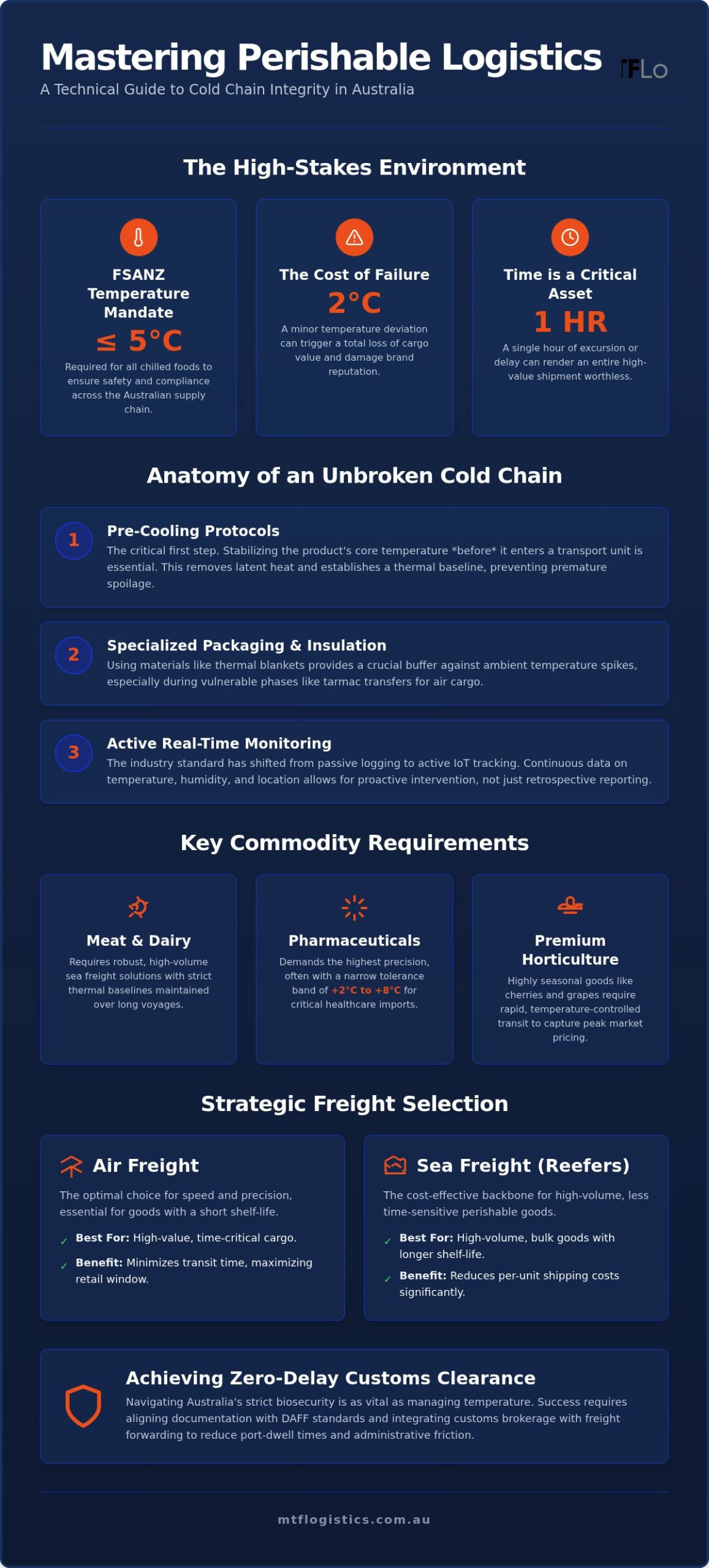
A single hour of temperature excursion or a minor documentation error can render an entire container of high-value seafood or pharmaceuticals worthless before it even clears the wharf. Managing perishable goods logistics Australia wide requires more than just a refrigerated container; it demands a synchronized dance between precise thermal control and rigorous regulatory compliance. You likely know that the stakes have never been higher, especially with the 2026 biosecurity fee indexation and the strict FSANZ mandate to maintain chilled foods at or below 5°C.
It’s exhausting to balance the risk of cargo spoilage with the complexity of DAFF’s evolving diagnostic service charges. This article provides a clear roadmap to achieving 100% cold chain visibility and zero-delay customs clearance. We’ll explore the strategic balance between air and sea freight, examine the current regulatory landscape, and share expert strategies for maintaining integrity from the point of origin to the final destination. By the end of this guide, you’ll have the technical insights needed to manage high-stakes shipments with absolute confidence.
Perishable logistics is the time-critical management of temperature-sensitive assets. It’s a discipline where every minute and every degree Celsius is a measurable variable. In the context of perishable goods logistics Australia, these variables are amplified by the harsh reality of the local climate and the vast distances between production hubs and international gateways. Establishing an unbroken cold chain is the baseline requirement; however, the geographical isolation of the Australian continent necessitates a more sophisticated approach than simple refrigeration. Logistics here is about protecting the biological and chemical integrity of the cargo from point of origin to final delivery.
The 2026 supply chain landscape has moved beyond the traditional ‘ship and pray’ methods. Stakeholders now demand real-time visibility and data-driven assurance. This shift is driven by the need to manage diverse sectors, ranging from premium seafood exports destined for Asian markets to critical pharmaceutical imports that sustain the national healthcare system. In 2026, the integration of IoT sensors and cloud-based monitoring has become standard. These tools allow for proactive intervention rather than retrospective reporting, which is essential for mitigating the risks associated with extended Australian transit times.
Financial losses in this sector are rarely linear. A seemingly minor 2-degree temperature deviation can trigger a total loss of cargo value, especially in sensitive biologicals or high-end proteins. Beyond the immediate invoice value, there is a profound reputation risk. Australian exporters compete on a premium for quality; a single compromised shipment can damage long-term trade relationships and the broader ‘Brand Australia’ image. Every delay also accelerates the shelf-life clock. Logistics effectively eats into the retail window, reducing the time a product has to reach the consumer in peak condition. This pressure makes precision non-negotiable.
Meat and dairy exports remain the backbone of the industry, requiring robust, high-volume solutions that maintain strict thermal baselines over long sea voyages. Conversely, the precision required for pharmaceutical logistics Australia is even more stringent, often involving narrow tolerance bands of +2°C to +8°C. We are also seeing significant growth in premium horticulture. Fruits like cherries and table grapes are highly seasonal and demand rapid, temperature-controlled transit to capture peak market pricing. Managing these diverse requirements requires a steady hand and a deep understanding of both the physical and regulatory environments that define the Australian market.
Success in perishable goods logistics Australia begins long before the cargo reaches the port. It starts with pre-cooling. This process establishes a thermal baseline, ensuring the product’s core temperature is stabilized before it enters a transport unit. Without this step, even the most advanced refrigerated containers will struggle to remove latent heat, leading to premature spoilage. For air cargo, where transit is faster but environmental exposure is higher, the selection of specialized packaging and thermal blankets is essential. These materials provide a critical buffer against ambient temperature spikes during tarmac transfers or loading cycles.
By 2026, the industry has shifted decisively from passive data logging to active real-time tracking. It’s no longer enough to download a report after the cargo arrives. Active monitoring systems now provide continuous data on temperature, humidity, and location. This allows for immediate intervention if a refrigerated unit fails or a delay occurs. Adhering to strict Australian import requirements is only half the battle; the physical environment must be equally managed. Working with an experienced partner like MTF Logistics ensures these technical details are managed before the cargo ever leaves the facility.
Different commodities demand distinct thermal profiles. Chilled goods must remain at or below 5°C, while frozen items require a consistent -18°C or lower. Certain biologicals or specialty meats may even require deep-freeze environments. Humidity control is another vital factor, particularly for fresh produce and flora, where dry air can lead to wilting and loss of mass. The ‘broken link’ often occurs during cross-docking or terminal transfers. These transition points are high-risk zones where cargo is most vulnerable to ambient air, making rapid, disciplined handling a priority for anyone managing perishable goods logistics Australia wide.
IoT sensors now provide a comprehensive digital audit trail. This data integrity is vital for regulatory compliance and insurance purposes, as it proves the cargo remained within its specified range. Sharing this data between the forwarder and the client fosters a culture of transparency and mutual success. Cold chain visibility is the ability to intervene before spoilage occurs. It’s the steady hand that turns a potential disaster into a managed resolution, ensuring that data serves as a protective shield for your assets.
Choosing between air and sea transport is a strategic decision dictated by the biological reality of the cargo. In the context of perishable goods logistics Australia, the primary variable is the “shelf-life clock.” A product with a 10-day window cannot survive a 20-day sea voyage, making air transport the only viable path. Conversely, bulk frozen commodities with months of stability are better suited for the cost-efficiencies of ocean transit. The objective is to align the transit time with the product’s peak market value while managing the total landed cost.
Many modern exporters in 2026 now utilize “Hybrid Logistics.” This approach involves splitting a shipment: a small portion is sent via air to capture immediate market demand and high pricing, while the bulk of the inventory follows via sea freight. This strategy balances the need for speed with the necessity of cost control. It ensures a steady pipeline of inventory without over-investing in high-cost transport for goods that don’t strictly require it.
Air freight is the gold standard for premium perishables like live seafood or high-potency pharmaceuticals. When analyzing air freight rates Australia, businesses must consider the reduced risk of spoilage and the ability to respond to market fluctuations in real time. Protecting this cargo requires precise Unit Load Device (ULD) selection and thermal blankets. The most dangerous phase of air transit is the ground handling period. Cargo must be moved from the warehouse to the aircraft hold with minimal exposure to tarmac heat, a process that requires disciplined coordination and rapid execution.
Sea freight has evolved beyond simple refrigeration through the adoption of Controlled Atmosphere (CA) technology. These containers don’t just manage temperature; they regulate oxygen and carbon dioxide levels to slow the ripening of fruits and vegetables. This innovation allows exporters to use reliable sea freight services for long-haul routes that were previously only accessible by air. Whether using Full Container Load (FCL) for maximum stability or LCL for smaller batches, shippers must ensure their documentation meets all Australian biosecurity import conditions. Accurate paperwork is just as critical as the reefer’s power supply in preventing port-dwell delays that can compromise an entire shipment.
The Department of Agriculture, Fisheries and Forestry (DAFF) maintains some of the world’s most stringent biosecurity protocols. For professionals managing perishable goods logistics Australia, these regulations are not merely administrative hurdles; they are critical operational variables. The BICON (Biosecurity Import Conditions) system serves as the definitive database for determining if a specific commodity requires an import permit or specialized treatments. In 2026, the complexity has increased with the 3.8% indexation of biosecurity cost recovery charges that took effect on July 1. These fees, combined with the phased introduction of fixed diagnostic service charges starting November 1, 2026, mean that any delay at the border now carries a higher financial penalty than ever before.
Documentation accuracy is the primary factor in preventing perishable delays. A single digit error on a Phytosanitary certificate or a mismatch in a bill of lading can trigger a mandatory quarantine hold. This is where the physical cold chain meets the regulatory paper trail. Precision is the only solution. If the paperwork isn’t perfect, the most advanced reefer container in the world won’t prevent your cargo from sitting on a hot wharf while the clock runs down on its shelf life.
An expert customs broker acts as the primary defense against “port-dwell” time. By utilizing pre-lodgement protocols, brokers can submit documentation to DAFF and the Australian Border Force before the vessel or aircraft even arrives. This often results in “clearance on arrival,” allowing the cargo to move immediately from the terminal to a temperature-controlled facility. Correct HS Code classification is vital; an incorrect code can misidentify a product as a high-risk biosecurity threat, leading to unnecessary delays. For a deeper look at these requirements, consult our customs clearance Australia guide for updated compliance standards.
Physical inspections are a reality of the Imported Food Inspection Scheme (IFIS). While “surveillance foods” face a random 5% inspection rate, “risk foods” are subject to 100% inspection. During these checks, DAFF officers verify that the cargo matches the documentation and shows no signs of pests or disease. Minimizing dwell time during this phase requires having all export documentation from the origin country perfectly aligned with Australian standards. If you need a partner to manage these high-stakes regulatory requirements, our team provides the integrated customs and logistics support necessary to keep your supply chain moving.
Managing high-stakes cargo requires a partner that understands the precise intersection of thermal science and regulatory law. MTF Logistics provides an integrated framework specifically designed for perishable goods logistics Australia. By housing customs brokerage and freight forwarding under one roof, we eliminate the communication gaps that often lead to port-dwell delays. This unified approach ensures that as soon as a thermal alert or biosecurity update occurs, the team responsible for the physical movement and the team managing the legal clearance are already working on a synchronized resolution. It’s a method that replaces fragmented service with a single point of accountability.
Since our establishment in 2014, we’ve developed the specialized expertise required to manage complex Australian logistics projects. We understand that a successful shipment isn’t just about moving a container; it’s about protecting the commercial value of the assets inside. We manage the entire lifecycle of the shipment, from the initial pre-cooling phase to the final temperature-controlled delivery. Our national reach ensures that regardless of the gateway used, your cargo receives the same level of rigorous oversight and end-to-end visibility. This level of control is essential for maintaining the integrity of sensitive products like seafood, meat, and pharmaceuticals.
The volatility of international trade often creates unnecessary stress for exporters and importers. We act as a steady hand in this market, providing a composed and professional communication channel that prioritizes clarity over high-pressure sales tactics. Our focus is on alleviating the administrative burden of international trade so you can focus on your core business operations. We’ve built our reputation on a foundation of reliability and organized expertise. MTF’s commitment to data-driven insights and transparency means you always have access to the real-time status of your temperature-sensitive assets through a comprehensive digital audit trail.
Developing a successful strategy for the 2026 logistics environment requires early-stage consultation. We recommend engaging with our specialists during the planning phase to ensure your packaging, freight mode, and documentation are optimized for current biosecurity standards. This proactive approach helps identify potential bottlenecks before they impact your bottom line. To request a tailored quote for your specific temperature-sensitive cargo, reach out to our team for a comprehensive analysis of your requirements. Consulting with a specialist now ensures your supply chain is resilient enough to handle the high stakes of the Australian market while maintaining total cold chain integrity.
Navigating the complexities of the Australian supply chain requires a dual focus on thermal stability and regulatory precision. You’ve seen how pre-cooling and real-time monitoring act as the first line of defense against spoilage. Simultaneously, mastering DAFF requirements and BICON conditions ensures that your cargo doesn’t stall at the border. These elements combined form the foundation of successful perishable goods logistics Australia operations, turning a high-risk process into a manageable strategic advantage.
Partnering with a steady hand makes the difference between a volatile shipment and a predictable delivery. MTF Logistics has been Australian owned and operated since 2014, offering the stability of a national logistics network across all major Australian hubs. Our customs clearance service is specifically designed to reduce port-dwell times and simplify the most complex biosecurity hurdles. Secure your perishable supply chain with MTF Logistics today to ensure your temperature-sensitive assets arrive in peak condition. We’re ready to help you navigate the evolving global market with absolute confidence.
Equipment failure, prolonged tarmac exposure during air transit, and administrative delays are the primary causes of failure. In Australia, the vast distances between regional production hubs and international ports increase the risk of a “broken link” in the cold chain. Even a minor documentation error at the border can lead to a quarantine hold. These delays often result in the product exceeding its safe thermal window, leading to total cargo loss.
Air freight typically incurs higher operational costs due to speed and specialized handling requirements. It’s the preferred choice for high-value items with short shelf lives, such as live seafood. Sea freight offers a more cost-effective solution for bulk shipments of frozen or shelf-stable perishables. While sea freight rates are lower, the extended transit time requires advanced Controlled Atmosphere (CA) technology to maintain product integrity over several weeks at sea.
Engaging a customs broker is highly recommended for managing perishable goods logistics Australia wide. The complexity of DAFF and IFIS regulations makes the risk of a self-lodgement error extremely high. A broker ensures that HS Code classification and biosecurity documentation are accurate, facilitating fast-tracked clearance. This professional oversight reduces “port-dwell” time, which is the single most critical factor in preventing the spoilage of temperature-sensitive food shipments.
A reefer container is a specialized refrigerated unit equipped with an integrated cooling system and high-grade insulation. Unlike standard dry containers, reefers can maintain a precise temperature range, from chilled to deep-freeze, throughout the entire journey. They also allow for the regulation of humidity and gas composition. This controlled environment is essential for preventing the biological degradation of fresh produce, meats, and pharmaceuticals during long-haul sea or road transport.
Biosecurity protocols can significantly extend the time a shipment spends at the border. If a commodity is flagged as “risk food” under the Imported Food Inspection Scheme, it must undergo a 100% physical inspection. These checks depend on the availability of DAFF officers and the speed of diagnostic testing. Strategic logistics planning must account for these potential holds by ensuring all origin-country certificates are pre-verified and perfectly aligned with Australian BICON standards.
Modern perishable goods logistics Australia services utilize active IoT sensors to provide real-time temperature tracking. These devices transmit continuous data on thermal conditions, humidity, and location via cellular or satellite networks. This visibility allows for immediate intervention if a deviation occurs, such as a power failure in a reefer unit. Clients receive a comprehensive digital audit trail, which serves as vital evidence for compliance, insurance, and quality assurance purposes.
Exporting meat or seafood requires a combination of Australian government health certificates and destination-specific documentation. Exporters must provide a Certificate of Origin, a Bill of Lading, and often a Halal certificate where applicable. DAFF must inspect and certify that the products meet the sanitary standards of the importing nation. Accuracy is paramount; any discrepancy between the physical cargo and the export permit can lead to rejection at the destination port.
Pharmaceutical imports in 2026 must adhere to the Therapeutic Goods Administration (TGA) Good Distribution Practice (GDP) guidelines. These require strict thermal mapping and a validated cold chain, usually between +2°C and +8°C. Additionally, importers must account for the new fixed-fee structure for diagnostic activities introduced on November 1, 2026. Ensuring your documentation includes precise batch numbers and manufacturing dates is essential for avoiding holds that could compromise life-saving medical supplies.


 Email
Email 1300 710 683
 Tariff Lookup
 HS Code Lookup
 Newsletter Signup