
Total Shipment Visibility, Simplified
Access all your shipment details in one place - track departures and arrivals, manage documents, notifications, invoices, and more.
Access all your shipment details in one place - track departures and arrivals, manage documents, notifications, invoices, and more.

Did you know that fuel surcharges can now account for up to 40% of your total shipping invoice? For businesses managing international supply chains, understanding air freight rates Australia in 2026 requires more than just looking at a base price per kilogram. The market is currently defined by shifting biosecurity charges and terminal handling fees that rose by nearly 5% earlier this year.
It’s frustrating when the complexity of volumetric weight calculations or unexpected customs delays makes your logistics budget feel like guesswork. You likely feel the pressure of balancing urgent delivery needs with the reality of a volatile global market. We believe that transparency and organized expertise are the only ways to regain control over your shipping costs.
This guide will help you master the intricacies of air cargo pricing and optimize your international spend with professional logistics insights. We examine the specific factors driving the 2026 market, from the 166.67 kg volumetric standard to the latest regulatory adjustments. You’ll gain the clarity needed to achieve predictable budgets, faster transit times, and seamless customs clearance.
The cost of moving goods through the air cargo industry is rarely static. It functions as a reflection of global supply and demand, influenced by everything from geopolitical stability to the availability of belly space in passenger aircraft. Understanding the primary drivers behind air freight rates Australia helps you move from reactive shipping to proactive planning. You can’t control the market, but you can certainly prepare for its shifts.
Market demand follows a predictable but intense seasonal rhythm. The final quarter of the year typically sees a surge in volume as retailers prepare for holiday inventory. Similarly, the weeks leading up to the Lunar New Year often trigger capacity crunches that can drive rates up by 20% to 40%. During these windows, securing space becomes as critical as the price itself. Planning your shipments well in advance of these peaks is the most effective way to maintain budget stability.
Carrier capacity is heavily dictated by the frequency of international passenger flights. Since a significant portion of cargo travels in the hold of passenger planes, any reduction in flight schedules directly constricts supply and inflates costs. International trade agreements also play a role; they dictate the volume of flow across specific corridors, such as the growing Asia-Pacific lanes which saw an 8.0% growth in early 2026. This growth often leads to tighter competition for available pallets.
Fuel remains one of the most volatile variables in your logistics budget. The Fuel Surcharge (BAF) is tied to global oil indices and can constitute up to 40% of your total invoice. These monthly adjustments mean that a quote provided in January might look quite different by March. We recommend monitoring these indices closely to avoid surprises in your landed cost calculations. It’s about maintaining visibility over every cost component.
The nature of your cargo significantly impacts the final rate. Standard commercial goods are the baseline, but specialized items require additional resources and handling expertise. For instance, Dangerous Goods Handling involves strict regulatory compliance and specialized storage, which naturally attracts a premium. This reflects the increased risk and the specialized training required for the ground crew.
Perishable goods and pharmaceuticals also require temperature-controlled environments and expedited handling to maintain product integrity. These shipments often bypass standard consolidation to ensure faster transit, which reflects in the pricing structure. For a deeper understanding of the regulatory and thermal control requirements involved, our guide on perishable goods logistics Australia explores the full complexity of cold chain management in 2026. Additionally, security screening requirements for all Australian exports add a mandatory layer of cost known as the Security Surcharge (SSC). By understanding these specific requirements, you can better estimate how they influence air freight rates Australia for your specific cargo type.
Airlines operate with two finite resources: weight capacity and physical space. Because a ton of feathers occupies significantly more room than a ton of steel, the logistics industry uses a standardized method to ensure fair pricing. Understanding how these calculations affect air freight rates Australia is essential for maintaining an accurate shipping budget. The process involves four distinct steps that move from simple weighing to applying industry-standard formulas.
To find the volumetric weight of your shipment, you must use the standard IATA formula: (Length x Width x Height in centimetres) / 6000. This calculation aligns with IATA’s rules on chargeable weight, which establish 167 kg per cubic metre as the global benchmark. If you’re working with multiple cartons of different sizes, you’ll need to calculate each individually before totaling the results. If you find these calculations complex, partnering with a provider for expert air freight solutions can help ensure your documentation is always precise.
Since space is a primary cost driver, reducing “dead air” inside your packaging is the most direct way to lower your total spend. Oversized boxes filled with packing peanuts or air cushions often trigger higher volumetric charges without adding any value to the shipment. We recommend using custom-fit cartons that provide adequate protection while minimizing external dimensions. While palletisation is excellent for safety and speed of handling, the added height of the pallet itself can sometimes push a shipment into a higher weight bracket. Always weigh the protection benefits of a pallet against the potential increase in volumetric weight to find the most cost-effective balance for your specific inventory.
The base rate you receive from a carrier is rarely the final amount on your invoice. For many shippers, the secondary fees can account for a significant portion of the total spend, sometimes even doubling the initial cost per kilogram. Managing air freight rates Australia effectively requires a granular understanding of these surcharges and why they exist. By identifying these costs early, you can build more accurate landed cost models and avoid the “invoice shock” that often plagues international trade.
The Fuel Surcharge (FSC) is the most prominent variable in your logistics budget. Calculated as a percentage of the base rate, it fluctuates monthly based on global oil prices. As of 2026, fuel surcharges often constitute between 20% and 40% of the total air freight cost. Similarly, the Security Surcharge (SSC) is a mandatory fee that covers the cost of screening cargo at the airport. Every kilogram of export cargo must undergo rigorous security checks to comply with international aviation standards, making this a non-negotiable component of your pricing.
Terminal Handling Charges (THC) and documentation fees cover the physical and administrative labor involved in moving your goods. Terminal fees have seen an increase of approximately 2% to 4.5% as of July 2026, reflecting higher operational costs at major Australian gateways. You should also account for the Air Waybill (AWB) fee, which is a flat charge for the issuance of the legal contract of carriage between the shipper and the airline.
Beyond the airline fees, government-mandated charges play a critical role in your final expenditure. Professional Customs Clearance Australia services are essential for managing these complexities. You must account for biosecurity and Department of Agriculture, Fisheries and Forestry (DAFF) inspection fees, which increased by approximately AUD 2 to 3 per transaction in mid-2026. For high-value commercial shipments, Duty and GST remain the most significant regulatory costs, calculated based on the customs value of the goods plus the cost of international transport and insurance.
Storage fees are perhaps the most avoidable ancillary cost. Airlines typically provide a very short “free period” at the terminal, often just 24 to 48 hours, before expensive storage rates apply. We recommend prioritizing pre-clearance to ensure your cargo moves immediately upon arrival. Additionally, if your cargo requires specialized equipment for oversized dimensions or heavy-lift handling, expect to see “crane fees” or “forklift surcharges” on your quote. These airline-specific terminal fees vary significantly between carriers, so it’s vital to confirm these details before your cargo reaches the tarmac.
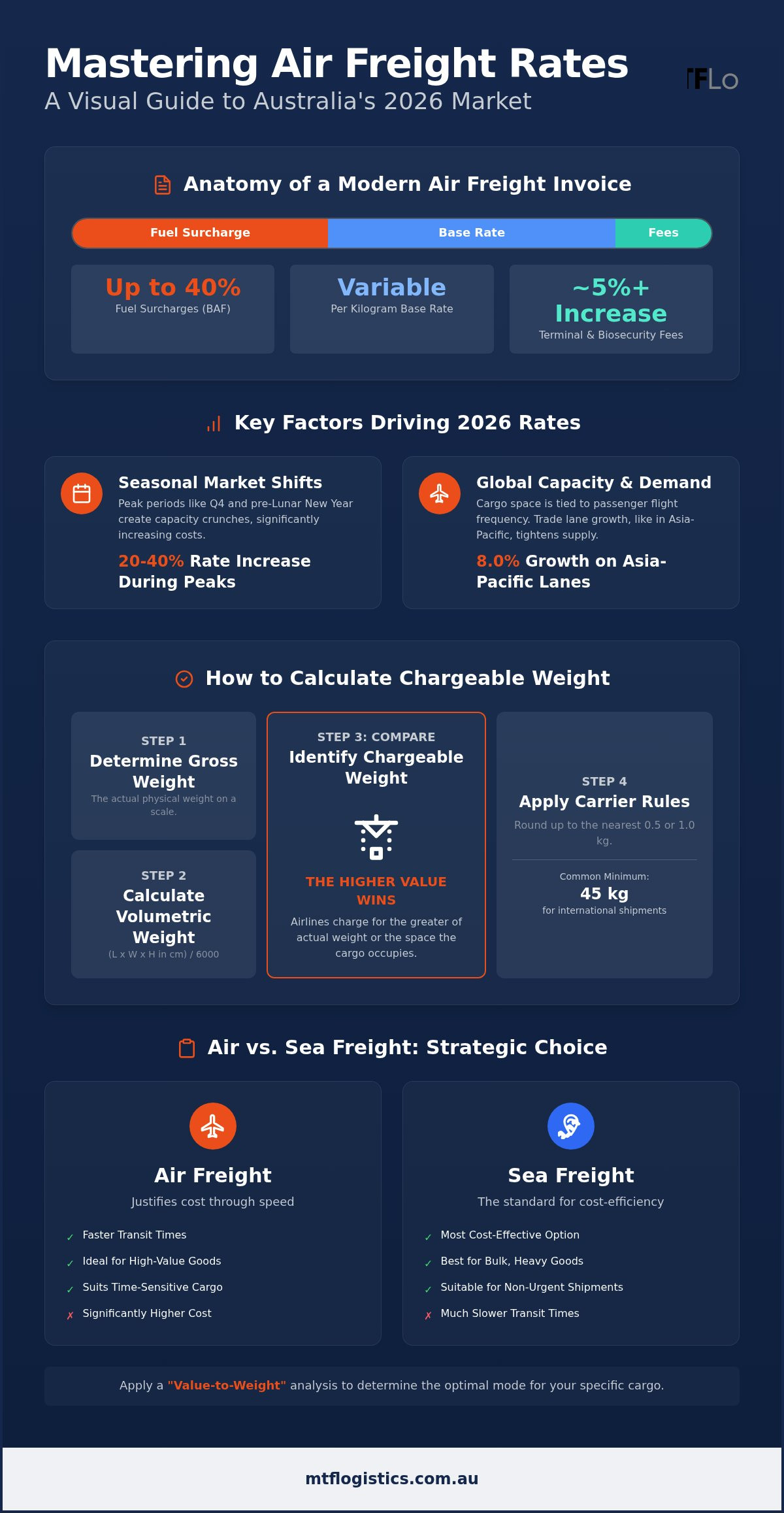
Choosing the right transport mode isn’t a simple binary of speed versus cost. While air cargo is roughly 20 to 40 times faster than ocean transport, the financial investment is typically 8 to 12 times higher per kilogram. For many Australian importers, the break-even point for choosing air over sea typically sits around the 500 kg mark. Beyond weight, you must analyze the “Value-to-Weight” ratio of your inventory. If the cost of air freight represents a small percentage of the product’s total value, the speed becomes a strategic advantage rather than a burden.
Inventory carrying costs are often overlooked in these calculations. When your goods are in transit on a vessel for several weeks, your capital is effectively frozen. Faster transit times allow for quicker inventory turnover and improved cash flow, which can often offset the higher air freight rates Australia. Reliability also plays a critical role; while ocean lanes have faced significant volatility in 2026, air schedules maintain a much higher level of integrity, ensuring your supply chain remains predictable.
Environmental considerations have also become a standard part of the 2026 logistics framework. Most major carriers now offer integrated carbon offset options, allowing businesses to mitigate the higher emissions profile associated with air transport. This transparency helps you align your shipping choices with corporate sustainability goals without sacrificing the speed your customers expect.
Certain scenarios demand the immediate transit that only air can provide. For instance, transporting urgent breakdown parts for Project Logistics Australia can prevent thousands of dollars in operational downtime. It’s also the industry standard for high-value electronics or pharmaceuticals where short shelf lives or high market demand make sea transit impossible. Businesses managing perishable goods logistics Australia wide will find that air freight is often the only viable option for maintaining cold chain integrity across long-haul international routes. During periods of peak sea freight congestion, air remains the most reliable tool for mitigating supply chain disruptions and meeting strict contract deadlines.
Multi-modal transport offers a pragmatic middle ground for businesses seeking to balance speed and budget. By utilizing sea-air logistics, you can combine the cost-effectiveness of ocean transit with the speed of air delivery. This hybrid approach typically involves shipping by sea to strategic regional transshipment hubs before moving the cargo to its final destination via air. This method can significantly reduce air freight rates Australia compared to a pure air solution while still offering a much faster lead time than traditional sea freight. If you’re looking to optimize your transit times, we can provide a comprehensive air freight analysis to determine the most efficient path for your cargo.
Managing international trade requires more than just finding the lowest air freight rates Australia. It demands a partner who understands the friction points within the supply chain and knows how to resolve them before they impact your bottom line. Founded in 2014, MTF Logistics has spent over a decade acting as a steady hand for Australian businesses navigating the complexities of global logistics. We don’t just move cargo; we manage the entire end-to-end process to ensure your goods arrive on time and within budget.
While many providers separate freight forwarding from customs brokerage, we maintain that these functions are inextricably linked. By integrating our Air Freight Australia services with integrated customs clearance, we eliminate the communication gaps that often lead to storage fees and biosecurity delays. This integrated approach provides you with a single point of accountability and a clearer view of your total landed costs, which is essential for maintaining predictable shipping budgets.
Our capabilities extend beyond standard commercial goods. We provide specialized management for complex industrial projects, dangerous goods, and perishable cargo. Every shipment is backed by real-time tracking and end-to-end visibility, giving you peace of mind that your inventory is being handled with organized expertise. We believe that transparency and data-driven insights are the only ways to stay in control of your global operations.
The 2026 market has been characterized by shifting fuel surcharges and increased regulatory fees that directly impact air freight rates Australia. In this environment, transparency isn’t just a value; it’s a requirement for financial stability. We’re committed to providing clear, solution-oriented guidance that helps you manage volatile rates without compromising on service quality. Whether you’re moving temperature-controlled pharmaceuticals or heavy-lift machinery, our team applies a methodical approach to mitigate risks and streamline transit times.
Achieving predictable shipping budgets starts with a comprehensive quote. When requesting pricing, provide detailed dimensions and weights to ensure the accuracy of your volumetric calculations. Preparing your export documentation early is also vital for seamless transit through Australian customs. We recommend consulting with our experts for national logistics management to identify potential cost-saving opportunities within your current supply chain. Our goal is to make difficult tasks feel effortless, allowing you to focus on growing your business while we handle the intricacies of the 2026 air cargo market.
Achieving budget predictability in 2026 requires more than just checking a base rate. It demands a deep understanding of the 1:6 volumetric ratio and a proactive approach to managing dynamic fuel and security surcharges. By integrating your freight forwarding with expert customs clearance, you can eliminate the administrative friction that often leads to costly delays. This organized expertise ensures your supply chain remains resilient, even when global markets fluctuate.
Managing air freight rates Australia effectively is about maintaining control over every link in the logistics chain. Since 2014, we’ve served as a reliable guide for businesses moving complex cargo. Whether you require specialized project logistics handlers or seamless export documentation, our team provides the steady hand needed to simplify global trade. We’re committed to your success through transparency and data-driven management.
Ready to optimize your landed costs? Request a Transparent Air Freight Quote from MTF Logistics and gain the clarity your business deserves. We look forward to facilitating your next international shipment with accuracy and care.
Rates are calculated based on the chargeable weight, which is the higher value between the actual gross weight and the volumetric weight. This figure is multiplied by the carrier’s base rate for your specific trade lane. Total air freight rates Australia also include mandatory surcharges for fuel and security, which are influenced by seasonal demand and the specific handling requirements of your commodity.
Actual weight is the physical mass of your cargo measured on a scale, while volumetric weight reflects the space the shipment occupies. To find the volumetric weight, use the IATA formula of Length x Width x Height in centimetres divided by 6000. This 1:6 ratio ensures that carriers are fairly compensated for bulky but light shipments that take up significant cargo hold capacity.
Fuel surcharges are high because jet fuel remains a volatile operational cost that can account for up to 40% of an airline’s total expenses. Carriers apply these dynamic surcharges to protect their margins against sudden spikes in global oil prices. In 2026, these fees are calculated as a percentage of the base rate and are adjusted monthly to reflect current market conditions accurately.
Standard air freight quotes typically cover the transit from airport to airport and don’t include customs clearance as a default. Clearance is a separate professional service that involves government documentation, duty calculations, and biosecurity compliance. We recommend using an integrated provider to manage both freight and brokerage. This approach reduces lead times and prevents unexpected handling fees from arising at the Australian border.
Small businesses can reduce costs by optimizing their packaging to eliminate excess “dead air” that increases volumetric weight. Consolidating smaller shipments into a single larger movement and choosing deferred air services instead of express options can also lower your air freight rates Australia. Additionally, providing precise data to your forwarder early in the process prevents costly documentation amendments and avoids terminal storage penalties.
Standard international air freight transit times usually range from 3 to 7 days, depending on the origin and flight frequency. While the actual time in the air is often less than 24 hours, the total duration includes terminal handling, mandatory security screening, and export documentation processing. Express services can reduce this window to 1 to 3 days, though these carry a significant price premium.
There isn’t a single upper limit for total shipment weight, but individual piece limits are dictated by the aircraft type and available handling equipment. Passenger aircraft holds have strict height and weight restrictions that dedicated cargo freighters don’t face. Shipments exceeding 1,000 kg or those with oversized dimensions may require specialized project logistics handling. Always confirm the maximum weight per piece with your forwarder during quoting.
You should expect several ancillary fees, including Terminal Handling Charges (THC) and mandatory security screening costs. As of July 2026, government biosecurity and import charges have increased by approximately AUD 2 to 3 per transaction. Other common costs include documentation fees, Air Waybill issuance, and potential storage fees if the cargo isn’t cleared and collected within the carrier’s standard free period of 24 to 48 hours.


 Email
Email 1300 710 683
 Tariff Lookup
 HS Code Lookup
 Newsletter Signup