
Total Shipment Visibility, Simplified
Access all your shipment details in one place - track departures and arrivals, manage documents, notifications, invoices, and more.
Access all your shipment details in one place - track departures and arrivals, manage documents, notifications, invoices, and more.

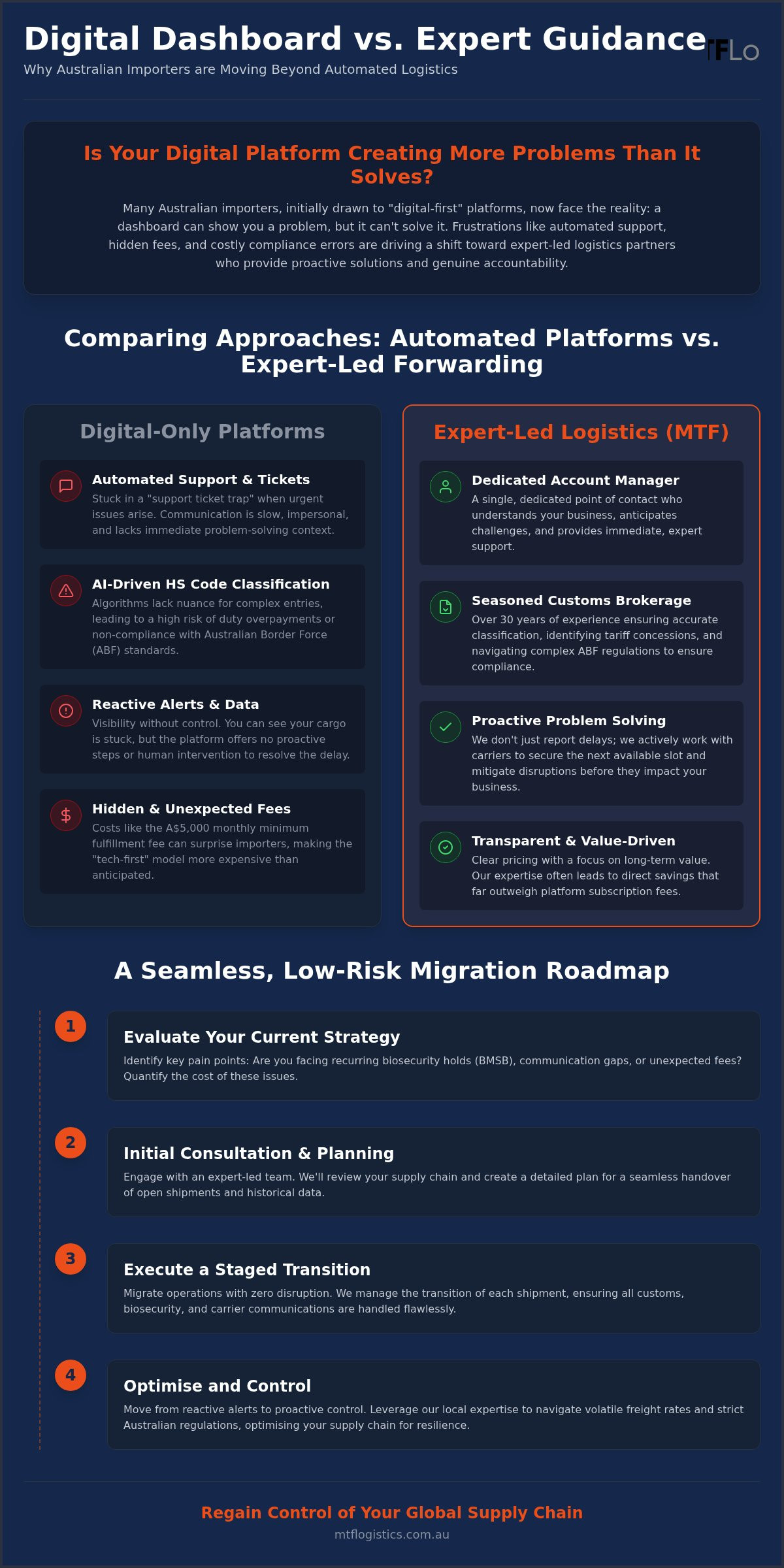
A digital dashboard can track a container across the ocean, but it can’t navigate a complex Australian Border Force inspection or clarify a specific tariff concession. While tech-heavy platforms offer initial appeal, many importers eventually find that automated customer service and rigid algorithms don’t account for the nuances of local regulations. If you’ve experienced the frustration of hidden fees or a lack of expert support, it’s likely time to migrate from Flexport Australia to a more personalised, expert-led freight strategy.
We understand that visibility and data are vital, but they shouldn’t come at the expense of accurate customs compliance or a dedicated point of contact. You need a partner who understands the 2026 customs tariff updates and the strict biosecurity requirements of the current BMSB season. This guide provides a clear roadmap for a seamless transition, ensuring you maintain high visibility while gaining the support of a seasoned Australian customs broker. We’ll walk you through the steps to move your operations, improve your border compliance, and regain control over your global supply chain.
The Australian logistics market is undergoing a fundamental shift. For several years, the promise of “digital-first” global platforms captivated importers with sleek interfaces and automated dashboards. However, as global trade becomes increasingly volatile, many businesses are discovering that a dashboard cannot replace local industry-literate expertise. The decision to migrate from Flexport Australia often stems from a need for a steady hand in a market where global schedule reliability only recently reached 64.7% as of May 2026. While technology is a powerful tool, it’s the human element of freight forwarding that ensures cargo actually moves when the unexpected occurs. At MTF Logistics, we’ve spent over a decade acting as that reliable guide for Australian importers.
Automation excels at repetitive tasks but often falters when faced with specific Australian port disruptions or industrial action. When a shipment is delayed, a “support ticket” system rarely provides the immediate resolution an importer requires. This “support ticket trap” leaves businesses in the dark at critical moments. Additionally, while AI-driven classification systems aim for speed, they frequently lack the nuance required for complex Australian customs entries. This can lead to costly duty overpayments or, worse, non-compliance with Australian Border Force (ABF) standards. The ABF is increasingly using advanced data analytics to monitor shipments in real-time, making accurate human oversight more critical than ever.
A primary trigger for businesses looking to migrate from Flexport Australia is the realisation that visibility doesn’t equal control. You might see that your cargo is stuck, but without a dedicated account manager to facilitate a resolution, that data is purely reactive. Warning signs that your current model is failing include recurring biosecurity holds or delays during the Brown Marmorated Stink Bug (BMSB) season, which runs from September 1 to April 30. If your digital provider is hitting you with unexpected costs, such as the A$5,000 monthly minimum fulfillment fee introduced in 2026, it’s time to evaluate the true value of your partnership. Reliable sea freight services require more than just an algorithm; they require a partner who prioritises accuracy and local regulatory knowledge. We focus on providing that end-to-end support, ensuring your supply chain remains resilient against global disruptions.
Visibility is a tool. Accountability is a result. While a digital dashboard can provide SKU-level tracking milestones, it cannot physically intervene when a container is flagged for a random biosecurity inspection. When businesses decide to migrate from Flexport Australia, they’re often looking for a partner who takes ownership of the outcome rather than just reporting the status. Digital platforms excel at data aggregation, but they often struggle with the “last mile” of problem-solving that defines successful logistics management Australia. In a high-stakes environment, knowing your cargo is delayed is less valuable than having a broker who is already working with the carrier to secure the next available slot.
Algorithms are designed for the “average” shipment. They lack the intuition to navigate the complexities of Australian customs compliance when a shipment falls outside standard parameters. A local broker with over a decade of experience can identify specific tariff concessions or valuation adjustments that an automated system might overlook. These human-led insights often result in direct bottom-line savings that far outweigh the perceived efficiency of a “tech-first” model. Choosing to migrate from Flexport Australia allows your business to move from reactive notifications to proactive resolution.
The Australian regulatory landscape is unique, particularly regarding biosecurity and the Department of Agriculture, Fisheries and Forestry (DAFF) requirements. Navigating the 2026 biosecurity landscape requires more than just a digital upload of documents; it requires an understanding of how local officers interpret specific packing declarations. Our team provides specialised customs clearance Australia services that ensure your documentation is audit-ready before it even reaches the border. This local knowledge is the “steady hand” that prevents minor clerical errors from turning into weeks of port storage fees.
Modern logistics doesn’t require a choice between technology and people. It requires technology that empowers people. At MTF Logistics, we integrate advanced tracking tools with a dedicated account management model. You don’t have to wait for a support ticket response from a global call centre. Instead, you have a direct line to a professional who understands your specific cargo requirements. This human-centric approach ensures that response times are measured in minutes, not days. If you’re ready for a more reliable approach to your supply chain, you can speak with an MTF expert today to discuss your transition requirements.
Transitioning your international supply chain requires a methodical approach to ensure zero downtime. While the decision to migrate from Flexport Australia often begins with a desire for better service, the physical execution of the switch determines your success. It isn’t merely a data migration; it’s a relocation of your operational trust. A seamless handover ensures that your sea and air freight operations continue without administrative bottlenecks or unexpected port storage costs.
Success starts with a comprehensive audit of your current logistical footprint. You’ll need a clear record of your HS code history and previous customs clearance Australia filings. This documentation ensures your new partner can maintain compliance from day one. Review your existing service agreements for notice periods and termination clauses to avoid “double billing” during the crossover. Understanding the official requirements for Importing goods to Australia helps you align your internal processes with national standards. During this phase, define specific KPIs for your new partner, such as response times for urgent queries or accuracy rates for documentation.
The most sensitive stage involves managing cargo already on the water or in the air. We recommend a “clean break” strategy for new bookings while allowing your previous provider to finalise shipments that have already departed. Clear communication with your global suppliers and factory partners is essential. They need to know exactly when to shift documentation to your new dedicated team to prevent misdirected cargo. Provide your suppliers with updated contact details and a formal letter of authority to facilitate a smooth transition of responsibilities.
Testing your new visibility tools before your first major shipment arrives prevents blind spots in your inventory management. A steady transition allows you to integrate tracking data without losing sight of your goods. By following this structured roadmap, you can migrate from Flexport Australia with the confidence that your supply chain remains resilient. We focus on providing a “steady hand” during this process, managing the granular details so you can stay focused on your core business operations. This proactive management style ensures that your transition is a strategic upgrade rather than a logistical hurdle.
The Australian Border Force (ABF) increasingly relies on advanced data analytics and automated risk profiling to monitor imports in real-time. While global platforms often lean on automated systems, these algorithms frequently struggle with the specific “grey areas” of the Australian Customs Tariff. When you migrate from Flexport Australia, you shift from a system that prioritises automated speed to one that prioritises regulatory accuracy. Relying on generic HS code classifications in a high-audit environment is a significant risk. Even a minor misclassification can lead to investigations, penalties, or the loss of trusted trader status, which can disrupt your operations for months.
Specialised brokers act as a protective barrier between your business and regulatory friction. They ensure that every line item on your commercial invoice is scrutinised against current 2026 customs tariff update procedures. This level of detail is essential for maintaining a seamless supply chain. If you’re managing complex shipments, you need a partner who understands the local landscape better than a machine-learning model. This human oversight ensures that your documentation is not just “finished,” but correct and defensible.
Optimising duty payments is not about cutting corners; it’s about applying the law correctly. Many importers unknowingly overpay because their automated systems fail to identify valid tariff concessions. Understanding how to import goods into Australia requires a deep dive into the specific concessions available for your industry. For 2026 compliance, tariff concessions must be supported by precise evidence of local non-equivalence to withstand ABF scrutiny during a post-entry audit. This human-led verification ensures you pay exactly what is required, protecting your margins while maintaining total compliance.
Industries such as pharmaceuticals, medical supplies, and garments face unique regulatory hurdles that go beyond standard freight requirements. Perishable goods and high-risk imports must also meet strict biosecurity integrity standards set by the Department of Agriculture, Fisheries and Forestry (DAFF). During the Brown Marmorated Stink Bug (BMSB) season, which runs from September 1 to April 30, mandatory treatment is required for target high-risk goods. When compliance deadlines are tight, leveraging air freight Australia services can provide the speed necessary to clear cargo before storage fees escalate. Our team ensures that specialised cargo is handled with the precision it demands, from dangerous goods documentation to perishable cold-chain monitoring. To ensure your cargo meets every local requirement, contact our customs specialists for a comprehensive compliance review.
Choosing to migrate from Flexport Australia is a strategic move toward operational stability. Since our founding in 2014, MTF Logistics has provided the steady hand required to manage complex international supply chains. We don’t believe in a one-size-fits-all digital model. Instead, we combine modern visibility tools with the proactive oversight of seasoned professionals. This ensures your cargo doesn’t just show up as a data point on a screen; it’s actively managed through every port disruption and regulatory hurdle.
Our sea freight services are tailored specifically for the Australian market. We provide national coverage across all major ports, ensuring that your goods move efficiently regardless of their destination. This end-to-end management is supported by over a decade of industry knowledge, allowing us to anticipate issues before they become costly delays. By prioritising accuracy and reliability, we help you reduce the overall complexity of your logistics operations.
Every Australian client at MTF Logistics is assigned a dedicated account manager. You won’t find yourself trapped in a support ticket queue or speaking to a global call centre that doesn’t understand local port dynamics. We provide customised reporting that reflects the metrics that actually matter to your bottom line, moving beyond standard dashboard notifications. This personalised service is particularly vital for project cargo and heavy haulage logistics Australia, where technical expertise and individual attention are non-negotiable.
Logistics shouldn’t be a source of stress. It should be a competitive advantage. As you migrate from Flexport Australia, the focus shifts from managing a platform to growing your business. We offer scalable solutions that adapt to your changing requirements, whether you’re moving standard containers or specialised medical-grade pharmaceuticals. Our role is to act as your reliable guide, facilitating global reach while maintaining a focus on the specific details of every shipment.
Initiating your transition is a straightforward process. We begin with a comprehensive review of your current supply chain and documentation history. From there, our team manages the handover of open shipments, ensuring continuity and compliance at every stage. If you’re ready to move toward a more resilient, expert-led logistics strategy, contact MTF Logistics to discuss your migration roadmap.
Transitioning your supply chain is a strategic decision that prioritises long-term stability over automated convenience. When you migrate from Flexport Australia, you’re moving toward a model where human accountability and local regulatory knowledge take precedence. You’ve discovered how expert oversight prevents costly customs delays and how a methodical handover process protects your open shipments from unnecessary disruption.
MTF Logistics provides the steady hand required in today’s volatile global market. With over a decade of Australian customs expertise and national coverage across all major Australian ports, we ensure your cargo is managed with precision. Our dedicated local account managers provide the proactive support and clear communication that automated platforms simply can’t replicate. It’s time to move beyond support tickets and regain control of your international trade.
Request a tailored migration plan from the experts at MTF Logistics to begin your journey toward a more reliable, expert-led logistics strategy. We’re ready to help you simplify your supply chain and secure your business’s future.
Switching is a managed project that typically takes a few weeks to several months depending on your complexity. We act as your reliable guide, handling the administrative transition and supplier communication. Our team reviews your documentation history to ensure a seamless handover. By focusing on a structured roadmap, we minimize operational downtime and ensure your supply chain remains resilient as you migrate from Flexport Australia to our expert-led model.
You will maintain high visibility while gaining the benefit of proactive human management. We integrate modern tracking tools into our service model, providing the data insights you expect from a tech-forward entity. Unlike digital-only platforms, we combine this visibility with a dedicated account manager who can physically intervene when delays occur. This approach ensures you have both the data and the executive support required for effective logistics management and supply chain control.
We prioritise accuracy over automated speed by using seasoned customs brokers instead of rigid algorithms. Automated systems often miss specific tariff concessions or struggle with the “grey areas” of the Australian Customs Tariff. Our specialists scrutinise every line item against 2026 customs tariff update procedures. This human-led verification protects your business from costly duty overpayments and ensures total compliance with the Australian Border Force’s real-time data monitoring, which is more critical than ever in high-audit environments.
We recommend a “clean break” strategy where your previous provider finalises shipments already at sea or in the air. New bookings are directed to MTF Logistics immediately to establish your new workflow. This dual-run period ensures zero disruption to your inventory flow. We coordinate with your global suppliers to ensure they have updated instructions and letters of authority, facilitating a smooth handover of responsibilities once your in-transit cargo has cleared the Australian border safely.
Yes, we provide scalable solutions that can align with your existing internal systems and ERP software. During the migration process, we test data integration and visibility tools to ensure your supply chain management remains seamless. Our team works with your IT department to map out data flows, ensuring that you retain the digital efficiency you need while gaining the industry-literate expertise that a standard platform-first model often lacks for local operations.
To migrate from Flexport Australia successfully, you should provide your HS code history and previous customs clearance records. We also require a formal letter of authority to act on your behalf with the Australian Border Force and biosecurity agencies. Gathering your commercial invoices and packing declarations early helps us audit your current compliance level. This documentation allows our team to establish a defensible and accurate foundation for your future sea and air freight operations.
We maintain a deep understanding of Department of Agriculture, Fisheries and Forestry (DAFF) requirements, including the strict 2026 biosecurity regulations. Our team manages mandatory treatments for high-risk goods during the Brown Marmorated Stink Bug (BMSB) season, which runs from September 1 to April 30. By reviewing packing declarations and supplier certificates before your cargo arrives, we reduce the risk of random inspections and costly biosecurity holds at the Australian border.
Yes, we provide expert handling for dangerous goods, perishables, and pharmaceuticals. These sensitive commodities require precise documentation and specialised sea or air freight services to maintain biosecurity integrity. Our team understands the nuances of garment industry logistics and medical-grade shipping, ensuring that your high-risk imports meet every local requirement. We provide end-to-end support, from export documentation to final delivery, ensuring your specialised cargo is managed with the precision that over a decade of experience provides.


 Email
Email 1300 710 683
 Tariff Lookup
 HS Code Lookup
 Newsletter Signup