
Total Shipment Visibility, Simplified
Access all your shipment details in one place - track departures and arrivals, manage documents, notifications, invoices, and more.
Access all your shipment details in one place - track departures and arrivals, manage documents, notifications, invoices, and more.

With the Australian logistics market projected to grow at a compound annual rate of 10.2% through 2033, why do so many established businesses still struggle with opaque supply chain costs and frequent border penalties? It’s a frustrating reality for many importers who find their margins squeezed by unpredictable lead times and complex biosecurity requirements. You’ve likely experienced the stress of a shipment held at the border or the difficulty of coordinating multiple freight modes without real-time visibility.
Efficient logistics management Australia requires more than just moving cargo; it demands a strategic, data-driven approach to regulatory risk and integrated freight. This 2026 reference guide is designed to help you master these complexities. We’ll provide the framework you need to achieve full customs compliance, streamline your end-to-end processes, and ensure transparent reporting across every shipment. From understanding the latest biosecurity levy structures to implementing advanced freight coordination, we’ll walk through the essential steps to build a resilient and predictable supply chain.
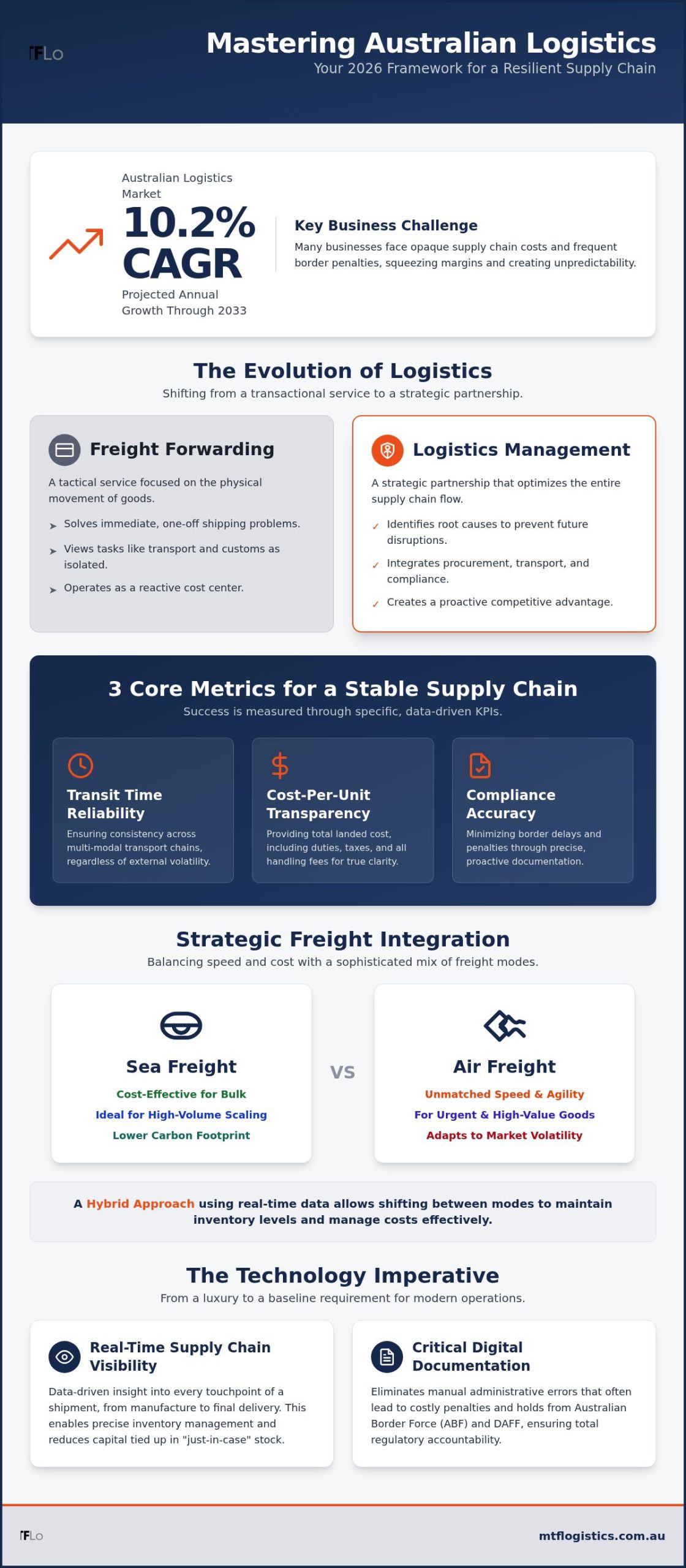
Traditional views of shipping often stop at the port. However, effective logistics management Australia in 2026 requires a much broader perspective. It’s the strategic integration of procurement, transport, and border compliance into a single, cohesive operation. Instead of viewing these as isolated tasks, businesses now treat them as a unified ecosystem that dictates the health of their bottom line. Organizations like the Australian Logistics Council (ALC) emphasize this shift toward policy and infrastructure integration to improve national efficiency and safety.
Success is no longer measured by just getting a box from one point to another. It’s measured through specific, data-driven KPIs that reflect the stability of the entire supply chain. With the Australian logistics market projected to grow at a CAGR of 10.2% through 2033, the margin for error has narrowed significantly. Integrated models prioritise three core metrics:
Freight forwarding is essentially a tactical service. It’s the physical movement of goods. Strategic logistics management is a partnership that seeks to optimise the entire flow. While a forwarder might solve an immediate shipping problem, a logistics manager identifies the root cause of the disruption. They look at why a delay happened and adjust procurement or customs strategies to prevent a recurrence. This proactive approach turns a cost centre into a competitive advantage. Understanding the distinction is critical; our comprehensive guide to choosing a freight forwarder in Australia can help you identify the right level of service for your business needs.
Technology has moved from a luxury to a baseline requirement for national operations. Real-time visibility allows businesses to manage inventory with precision, reducing the capital tied up in “just-in-case” stock. Digital documentation has also become critical. It eliminates the manual administrative errors that often lead to Australian Border Force penalties or Department of Agriculture, Fisheries and Forestry (DAFF) holds. In 2026, Supply Chain Visibility is defined as the real-time, data-driven insight into every touchpoint of a shipment, from the point of manufacture to final national delivery, ensuring total transparency and regulatory accountability.
A resilient national supply chain rests on the ability to move diverse cargo types through a unified network. In a landscape as vast as ours, consistency is the primary challenge. Effective logistics management Australia relies on a national network that maintains identical service standards whether cargo arrives in the north or the south. This structural reliability is supported by industry bodies like the Australian Logistics Council, which champions the infrastructure and policy needed for efficient, multi-modal movement. By focusing on these core pillars, businesses can transition from reactive shipping to a proactive model that balances speed, cost, and environmental responsibility.
Balancing speed and cost requires a sophisticated mode mix. For high-volume scaling where lead times allow for longer transit, businesses utilise reliable sea freight services. This remains the most cost-effective method for bulk inventory management and carries a lower carbon footprint per unit. Conversely, air freight Australia provides the necessary agility for urgent, high-value, or time-sensitive inventory. In 2026, market volatility often dictates a hybrid approach. Shifting between modes based on real-time data helps maintain inventory levels without over-committing to expensive express routes. It’s about having the flexibility to adapt when global shipping lanes face disruption.
Not all cargo fits into a standard container. Specialised sectors like pharmaceuticals and medical logistics require strict temperature controls to maintain cold chain integrity. Similarly, dangerous goods handling demands rigorous compliance with national safety codes to prevent penalties and environmental risks. When operations involve oversized industrial infrastructure or complex machinery, businesses must look toward heavy haulage logistics Australia. These complex projects require end-to-end management, from initial route surveys to final site delivery, ensuring that every piece of equipment arrives safely and on schedule. Managing these moving parts requires a partner that understands the specific regulatory and physical requirements of each cargo type. To gain a deeper understanding of how to balance these modes, you can review our guide on strategic air freight for urgent inventory.
Regulatory compliance is the pivot point where a well-planned shipment either succeeds or stalls. In Australia, the intersection of the Customs Act 1901 and the Biosecurity Act 2015 creates a rigorous environment for importers. A professional customs broker doesn’t just lodge paperwork; they act as a buffer against the substantial costs of non-compliance. These costs aren’t limited to fines. They include mounting wharf storage fees and the risk of “red-line” status, where every future shipment receives heightened scrutiny from the Australian Border Force. Proactive management ensures that your cargo moves through the border without becoming a financial liability.
Integrating customs clearance into your broader logistics management Australia strategy is essential for protecting business margins. Accurate HS code classification ensures you aren’t overpaying duty or, conversely, underpaying and risking an audit. Beyond import, managing export documentation is vital for seamless international trade. A methodical approach also identifies opportunities for duty drawback and tariff concession schemes, which can recover significant capital for eligible businesses. It’s about ensuring that every regulatory requirement is met before the cargo even arrives at the port, allowing for immediate release upon arrival.
The 2026 biosecurity landscape is increasingly complex, with the Department of Agriculture, Fisheries and Forestry (DAFF) implementing expanded cost-recovery charging as of July 1, 2025. This includes fees for all diagnostic activities, which are now subject to annual indexation. Navigating AQIS requirements, particularly during the Brown Marmorated Stink Bug (BMSB) season running from September to April, requires expert oversight. Citing the National Freight and Supply Chain Strategy, the government prioritises biosecurity to protect national interests, making pre-clearance for urgent shipments a critical operational step. Unforeseen biosecurity delays can extend Australian supply chain lead times by days or even weeks, disrupting inventory cycles and increasing downstream operational costs. Effective logistics management Australia ensures these risks are mitigated through proactive cargo profiling and document verification long before the goods reach the border.
Choosing a partner for logistics management Australia is a decision that impacts every facet of your supply chain. It’s no longer enough to look for the lowest freight rate. You need to evaluate the balance between technical literacy and traditional industry experience. A provider might have the latest tracking software, but without decades of local regulatory expertise, they may fail to anticipate a simple biosecurity hold that stalls your entire inventory. Look for a partner with national reach that ensures consistent service across all major ports, providing a steady hand regardless of the shipment’s destination.
A reliable partner should simplify the complex, not add layers of administration. When vetting providers, confirm who handles customs clearance and who is accountable if cargo is held. This integration reduces communication gaps and ensures that those managing your transport are also accountable for your compliance. Ask about their track record with specialised cargo, such as pharmaceuticals or garments, where handling requirements are strict. Most importantly, verify if they are capable of managing the entire process of how to import goods into Australia from the point of origin to final delivery. This end-to-end capability is what distinguishes a strategic manager from a tactical forwarder. For businesses based in Victoria, working with an experienced freight forwarder Melbourne businesses trust can provide the local market knowledge needed to navigate port-specific challenges effectively.
The “cheapest” quote often leads to the highest total cost of ownership. Low initial rates frequently hide a lack of support, leading to preventable border delays, storage fees, and administrative errors. When you calculate the ROI of a logistics partner, consider the value of reduced compliance risk and the time saved through transparent reporting and real-time tracking. In a volatile global market, the value of proactive problem-solving cannot be overstated. A manager who identifies a potential disruption before it occurs saves your business far more than a few dollars on a shipping container. Scalability is also vital; your partner must handle seasonal peaks and project-based growth with the same composure as day-to-day operations. Effective logistics management Australia is about protecting your margins through expertise, not just finding the lowest price.
If you’re looking for a partner that prioritises transparency and precision, you can contact MTF Logistics to discuss your national supply chain needs.
MTF Logistics has provided national excellence in freight and customs clearance since 2014. In an industry often defined by high-pressure sales and fragmented services, we offer a composed and methodical approach to logistics management Australia. We understand that global trade is inherently complex. Our role is to act as a steady hand, facilitating the seamless integration of sea freight, air freight, and customs clearance to simplify your supply chain. By managing the end-to-end flow of goods, we allow you to focus on business growth while we handle the regulatory and physical intricacies of international movement. Our national reach across all major Australian ports ensures that your cargo receives the same high standard of care regardless of its point of entry.
Our commitment is rooted in transparency and reliability. We don’t just move cargo; we provide organized expertise that alleviates the stress of international borders. Whether you’re managing delicate garment industry logistics or oversized industrial infrastructure through our project logistics services, our solutions are tailored to the specific needs of your sector. Clients gain direct access to seasoned freight and customs specialists who understand the granular details of your shipments. You won’t be navigating automated phone trees or dealing with entry-level coordinators. Instead, you’ll partner with professionals who prioritize clarity and mutual success, acting as a supportive guide through every stage of the logistics lifecycle. This level of professional oversight ensures that potential issues are resolved before they impact your lead times.
Transitioning to a more integrated model begins with a comprehensive supply chain audit. Our onboarding process is structured to identify immediate opportunities for cost reduction and efficiency gains. We analyze your current documentation, mode mix, and compliance history to pinpoint where administrative burdens can be eased. This methodical review often reveals hidden risks in HS code classification or missed opportunities for tariff concessions that have gone unnoticed. We focus on creating a roadmap for long-term stability rather than just solving immediate shipping problems.
If you’re ready to move from tactical shipping to strategic logistics management Australia, contact MTF Logistics for a strategic review of your supply chain. We’ll provide the data-driven insights and national expertise required to build a more predictable, resilient, and transparent logistics operation that supports your business goals.
Mastering logistics management Australia involves more than just finding the lowest freight rate; it requires a strategic integration of transport, data, and customs compliance. By focusing on end-to-end visibility and proactive risk management, businesses can transform their supply chains from cost centers into competitive assets. Reliable partnerships are the foundation of this stability, especially when navigating the evolving 2026 biosecurity and border regulations.
MTF Logistics has been a steady hand in global trade since 2014. With over a decade of industry expertise, we provide comprehensive national coverage for sea freight, air freight, and customs clearance. We specialize in complex project logistics and high-compliance cargo, ensuring that even the most difficult shipments move with calm confidence. It’s time to move beyond transactional shipping and embrace a methodical, integrated approach to your operations.
Optimise your supply chain with MTF Logistics and secure a predictable path for your future trade.
Logistics management is a strategic, end-to-end oversight of the entire supply chain, whereas 3PL usually focuses on specific outsourced functions like warehousing or distribution. To see how these services are optimized for modern retail, you can explore E-commerce Fulfilment through specialized resource guides. In the context of logistics management Australia, the focus is on integrating procurement, transport, and customs into a unified strategy. A management partner acts as a consultant and coordinator, ensuring that every tactical provider aligns with your broader commercial goals and regulatory requirements.
Costs for managing national logistics vary significantly based on shipment volume, cargo complexity, and required service levels. Most providers utilize a fee structure based on managed freight spend or specific transaction volumes for customs and transport. Since every supply chain has unique requirements, businesses should focus on the total cost of ownership. This includes evaluating how professional management reduces indirect costs like storage fees, border penalties, and administrative labor.
Custom brokerage is essential because it serves as the primary defense against border delays and financial penalties. A licensed broker ensures that goods are classified correctly under the Harmonized System (HS) codes, which determines the duty and tax obligations. In an integrated model, the broker works alongside freight managers to prepare documentation before arrival. This proactive approach prevents cargo from being held by the Australian Border Force or Department of Agriculture, Fisheries and Forestry.
Yes, a strategic provider identifies legal opportunities to minimize duty through tariff concession schemes and Free Trade Agreements (FTAs). They conduct thorough audits of your product classifications to ensure you aren’t overpaying due to incorrect HS codes. Additionally, they can facilitate duty drawback claims for goods that are eventually re-exported. This level of technical oversight directly protects your profit margins by ensuring you only pay the minimum required by Australian law.
The most common delays in 2026 stem from biosecurity compliance and wharf congestion. Key factors include:
Effective logistics management Australia mitigates these issues by ensuring all pre-shipment requirements are met long before cargo arrives at the border.
Integrated management improves visibility by consolidating data from multiple carriers, customs systems, and warehouses into a single reporting framework. This is particularly valuable for e-commerce entities that rely on 3PL fulfillment services to manage high-velocity order processing and inventory synchronization across disparate regions. Instead of tracking individual shipments through various portals, you receive a unified view of your inventory’s progress. This real-time data allows for more accurate demand planning and faster response times when disruptions occur. High-level visibility ensures that every stakeholder has access to the same information, reducing communication gaps and administrative errors.
MTF Logistics specializes in handling both dangerous goods and oversized project cargo as part of our comprehensive service offering. We manage the complex safety requirements and regulatory permits needed for hazardous materials, pharmaceuticals, and perishable items. Our project logistics team handles heavy haulage and industrial infrastructure, providing end-to-end oversight from initial route surveys to final delivery. This specialized expertise ensures that high-risk or non-standard shipments move through the national network without compromising safety.
Switching providers requires a phased transition that starts with a thorough audit of your active shipments and historical data. We recommend beginning the process by trialing the new provider with a small percentage of your volume or a specific lane. This allows you to test their systems and communication without risking your entire supply chain. Once the new workflows are established and data integration is complete, you can gradually migrate the remaining operations for a seamless handover.


 Email
Email 1300 710 683
 Tariff Lookup
 HS Code Lookup
 Newsletter Signup