
Total Shipment Visibility, Simplified
Access all your shipment details in one place - track departures and arrivals, manage documents, notifications, invoices, and more.
Access all your shipment details in one place - track departures and arrivals, manage documents, notifications, invoices, and more.

In 2026, a single digit error in an HS code classification isn’t just a clerical mistake; it’s a direct trigger for automated Australian Border Force audits. As the Simplified Trade System expands, the margin for error has vanished, leaving importers to face a landscape where data precision is the only path to stability. Maintaining rigorous customs compliance Australia standards is now a core pillar of supply chain resilience rather than a back-office administrative task.
You’re likely familiar with the stress of cargo being held at the border or the fear of heavy financial penalties stemming from a simple miscalculation of duty rates. It’s frustrating to manage shifting biosecurity charges and complex Import Processing Charges that can disrupt your bottom line. This guide provides the clarity you need to master these complexities and protect your business from unnecessary disruptions. We’ll examine the 2026 regulatory framework, detail how to utilize Trusted Trader status for faster border clearance, and provide a methodical approach to reducing your risk of audits.
Modern customs compliance Australia standards have transitioned into a highly sophisticated digital ecosystem. The Australian Border Force (ABF) now utilizes advanced data analytics and automated risk profiling to monitor every shipment entering the country. This technological shift means the ABF identifies discrepancies in real time, often before cargo reaches the port. For businesses, compliance is no longer a reactive administrative task. It’s the essential foundation of a proactive customs clearance Australia strategy that ensures supply chain continuity and predictable cash flow.
While many view compliance solely as a way to avoid trouble, it’s actually a strategic tool. Accurate reporting allows for better utilization of duty deferral schemes and trade agreements, which directly improves your bottom line. When your data is precise, your cargo moves through the border with minimal friction. This stability is vital in a global market where delays can ripple through your entire operation, leading to stockouts and broken promises to your customers.
The Customs Act 1901 remains the primary legislation governing trade, but 2026 has brought specific updates to the Customs Regulation 2015. These updates emphasize digital identity verification and expanded reporting obligations for the “Importer of Record.” The Department of Home Affairs works alongside the ABF to enforce these standards, ensuring that every entity in the supply chain is accountable. You’re legally responsible for the accuracy of all data submitted, even if you use third-party providers. Maintaining a clear audit trail of your classification and valuation decisions isn’t just good practice; it’s a legal necessity to protect your business during post-clearance audits.
Errors in documentation carry immediate consequences through the Infringement Notice Scheme (INS). These fines are issued for mistakes regardless of your intent. In the context of Australian customs law, strict liability dictates that an importer is legally responsible for inaccuracies in a declaration, even if the error was unintentional or made without negligence. Beyond the initial financial penalty, the long-term repercussions are often more damaging. Non-compliance triggers a higher risk score in the ABF’s automated systems, which leads to:
A single misstep can create a cycle of intervention that slows your entire supply chain. By prioritizing accuracy from the start, you maintain your reputation as a reliable trader and keep your goods moving without unnecessary interference.
Achieving consistent customs compliance Australia requires a deep understanding of three technical pillars: classification, valuation, and origin. These components don’t exist in isolation; they interact to determine your total landed cost and your legal standing with the ABF. When one pillar is weak, the entire declaration becomes vulnerable to audits and delays. This Customs Regulations Guide highlights the necessity of accurate reporting for international traders entering the Australian market.
Every item imported into Australia must be assigned a ten-digit code from the Australian Customs Tariff Schedule. Correct HS code classification Australia is the most frequent area of error for importers. Misdescription, which is identifying goods by a generic name rather than their technical function, often leads to incorrect duty rates. If you’re unsure about a complex product, seeking a formal Tariff Advice from the ABF provides a legally binding ruling that protects you from future disputes.
The Customs Value (CV) is typically based on the Price Actually Paid or Payable (PAPP). However, the CV isn’t just the invoice price. You must include “assists,” which are materials provided to the manufacturer for free, along with royalties and certain packing costs. Conversely, you might be able to deduct international freight and insurance if they’re already included in the price. Precise valuation data is essential because an import duty calculator Australia relies on the exact Customs Value to provide an accurate estimate of your total landed cost.
In 2026, Australia maintains a robust network of Free Trade Agreements (FTAs) that can reduce duty to zero. To claim these benefits, you must understand whether your goods are “Wholly Obtained” in the partner country or have undergone “Substantial Transformation.” Simply shipping from an FTA country isn’t enough; you must maintain Certificates of Origin (CoO) and supporting evidence for at least five years. Errors in origin claims are a high priority for ABF enforcement because they directly impact government revenue.
Managing these pillars requires a methodical approach to data. Partnering with a professional for customs clearance helps you navigate these technicalities with confidence, ensuring every declaration is audit-ready from day one.
Effective customs compliance Australia management requires more than just accurate data entry; it demands a structured approach to risk mitigation. While the technical pillars of classification and valuation provide the framework, strategic internal controls ensure your business remains audit-ready at all times. Central to this strategy is a rigorous recordkeeping process. Under Australian law, you’re required to maintain all relevant import documentation for a minimum of five years. This includes commercial invoices, packing lists, and Certificates of Origin. Referencing the Australian Border Force trade and goods compliance guidelines helps you understand the specific evidence required to support your declarations during a post-clearance review.
The Australian Trusted Trader (ATT) program has evolved in 2026 into a vital tool for high-volume importers. By demonstrating a secure supply chain and compliant internal practices, your business receives “front-of-line” priority processing for both sea and air freight. This status significantly reduces the frequency of physical cargo interventions. One of the most tangible benefits for 2026 traders is duty deferral, which allows you to settle your obligations monthly rather than per shipment. This shift improves business cash flow and simplifies financial planning. Additionally, the Consolidated Cargo Clearance (CCC) benefit enables you to clear multiple lines of cargo on a single declaration, effectively shortening lead times and reducing administrative overhead.
Customs clearance and biosecurity are inextricably linked in the Australian border environment. Failing to meet 2026 AQIS import requirements Australia can result in significant delays and unexpected treatment costs. The Department of Agriculture, Fisheries and Forestry (DAFF) maintains strict oversight, particularly regarding seasonal pests like the Brown Marmorated Stink Bug (BMSB). Compliance involves ensuring that your suppliers follow mandatory treatment paths before the goods depart. Managing these risks proactively is the most effective way to avoid customs delays Australia. When biosecurity protocols are integrated into your broader compliance framework, your cargo moves through the port without the friction of secondary inspections or fumigation holds.
Maintaining this level of control requires regular internal audits to identify potential gaps before the ABF does. A steady, methodical review of your supply chain ensures that your “low-risk” profile remains intact, protecting both your reputation and your operational efficiency.
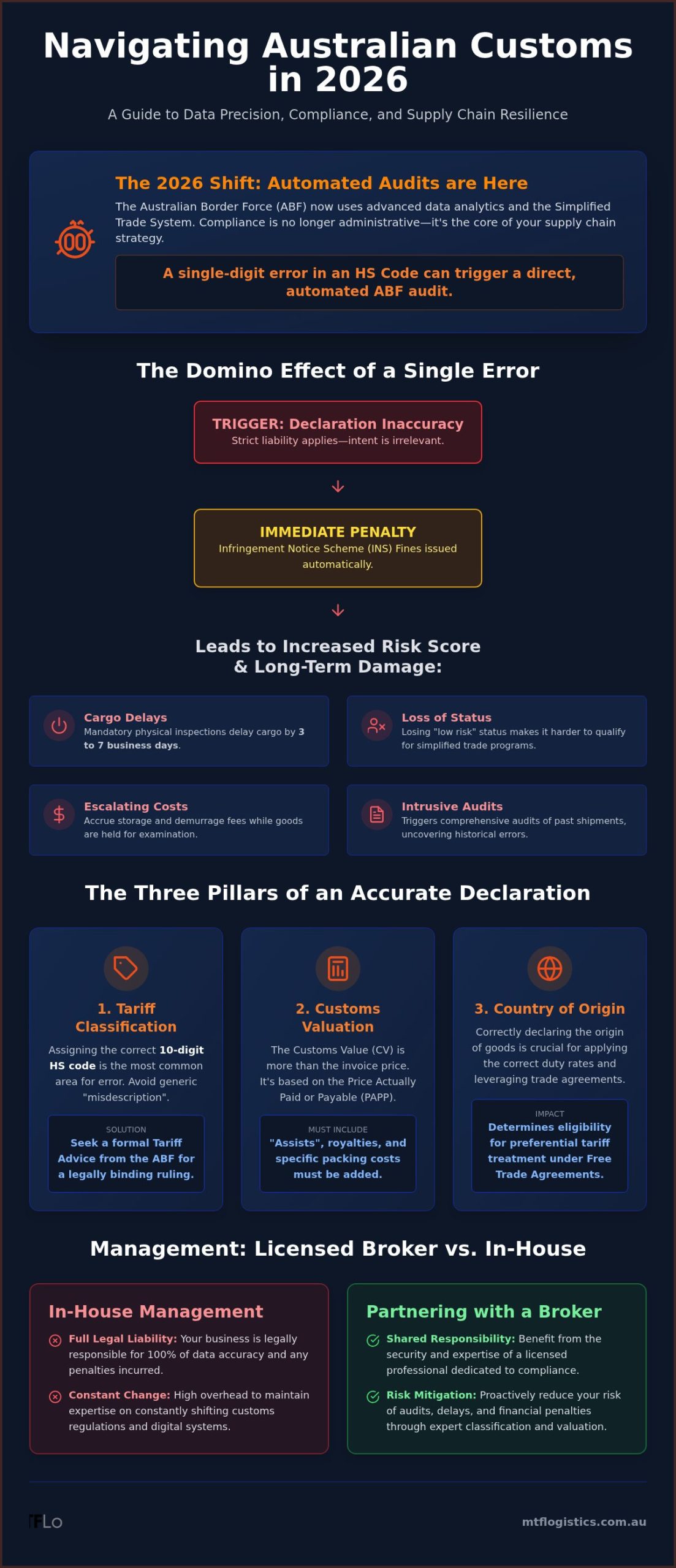
Deciding between managing imports in-house or outsourcing to a specialist is a critical decision for customs compliance Australia. As regulations tighten in 2026, the technical burden on internal teams often exceeds their capacity. While an in-house team understands your specific products, they might lack the broad industry exposure needed to handle sudden regulatory shifts or complex cargo types. Managing the border is a full-time commitment that requires constant monitoring of legislative changes and ABF policy updates.
It’s vital to remember that the legal liability for accurate reporting always rests with the importer of record. A licensed customs broker acts as your agent, but the ABF holds your business accountable for the data submitted. However, a broker’s role is to mitigate this risk by applying a layer of expert verification that most generalist staff cannot provide. The ROI of professional brokerage is found in the absence of costs: fewer fines, no demurrage from delays, and optimized duty payments through correct classification.
A licensed professional does more than just lodge paperwork. They are essential when managing project logistics or dangerous goods, where a single misstep can lead to severe safety and legal consequences. To hold a Customs Broker License in Australia, an individual must demonstrate high technical competence through accredited qualifications and satisfy the Department of Home Affairs that they meet the “fit and proper” person criteria required to manage national border integrity. If your business faces an ABF audit or a valuation dispute, your broker acts as an authoritative representative, navigating the legal complexities to reach a resolution that protects your interests.
Modern compliance relies on seamless data flow. Digital platforms in 2026 utilize Electronic Data Interchange (EDI) to link directly with the Integrated Cargo System (ICS), ensuring that cargo reporting timelines are met with precision. Real-time tracking isn’t just about knowing where a container is; it’s about providing the visibility needed to identify missing documentation early in the process. This transparency reduces the risk of deficient information in your reports, which is a primary trigger for border holds. When your data is integrated, the chance of a manual intervention decreases significantly.
Partnering with a specialist ensures that your customs compliance Australia framework remains robust and scalable. Learn more about our customs clearance services to see how professional management can stabilize your supply chain.
A truly resilient supply chain doesn’t treat customs compliance Australia as an isolated task. Instead, it integrates regulatory precision into every stage of the logistics lifecycle. MTF Logistics provides this integration by combining our Sea Freight Services and Air Freight Services with expert Customs Clearance. This end-to-end management ensures that the data used for your cargo reporting is consistent from the moment an order is placed until the goods are cleared at the port. By removing the information gaps that occur when using multiple providers, we provide the visibility needed to manage 2026’s automated risk profiling with confidence.
Our approach is built on the idea of being a steady hand in a volatile global market. We don’t just facilitate movement; we manage the complex technical requirements that protect your business from audits and penalties. Whether you’re dealing with pharmaceuticals, dangerous goods, or garment industry logistics, our framework is designed to simplify the difficult tasks so you can focus on your core operations.
Consistency is the hallmark of a compliant importer. With over a decade of expertise since our founding in 2014, MTF Logistics provides national coverage across all major Australian ports. While the ABF operates under a federal mandate, local operational nuances can still impact lead times. Our team applies a uniform compliance standard across the country, ensuring that your declarations meet the same high bar regardless of the entry point. Having a single partner for sea, air, and project logistics means your recordkeeping is unified, making it much easier to meet the five-year mandatory document retention requirements.
The first step toward a managed compliance model is identifying the hidden risks currently residing in your supply chain. MTF Logistics conducts a comprehensive review of your historical declarations to find discrepancies in HS code classification or valuation methods. We look for missed opportunities in Free Trade Agreements and ensure that your biosecurity protocols are robust enough to prevent seasonal delays. This proactive health check is essential for any business looking to reduce its audit risk and improve cash flow through more accurate duty management.
Building a framework that lasts requires technical precision and a partner you can rely on for long-term stability. Contact MTF Logistics for a strategic compliance review to ensure your 2026 import processes are fully optimized and secure.
Mastering customs compliance Australia requirements in 2026 is about building a resilient, data-driven strategy. By focusing on the technical precision of HS code classification and leveraging programs like Australian Trusted Trader, you transform regulatory obligations into competitive advantages. These steps reduce the risk of costly ABF audits and ensure your goods move through the border without the friction of unexpected holds or penalties. Consistency in your documentation is the most effective way to protect your bottom line from the volatility of the global market.
Managing these complexities requires a partner with deep national expertise. With over a decade of experience and full coverage across all major Australian ports for sea and air freight, MTF Logistics provides the organized expertise needed to stabilize your global operations. We specialize in complex project and industrial cargo, ensuring that even the most difficult shipments meet every regulatory standard. Partner with MTF Logistics for Expert Customs Compliance and gain the visibility you need to trade with confidence. A steady hand at the border is the key to a seamless and efficient supply chain.
In 2026, the primary requirements for customs compliance Australia include submitting accurate Import Declarations for goods valued over A$1,000. You must correctly classify goods using the ten-digit HS code, determine the precise Customs Value, and pay applicable duties and GST. Additionally, you’re responsible for meeting all biosecurity reporting standards and ensuring that your international transport and insurance costs are correctly calculated to determine the taxable importation value for GST purposes.
You are legally required to maintain all import-related records for a minimum of five years from the date of the declaration. This documentation includes commercial invoices, packing lists, Certificates of Origin, and evidence of the price actually paid or payable. These records must be readily accessible in the event of an Australian Border Force audit. Failing to provide these documents during a review can lead to significant financial penalties and a loss of compliant trader status.
While it’s legally possible for an individual to lodge their own declarations, the complexity of modern logistics makes this a high-risk approach. Most businesses use a licensed customs broker to manage the process. A broker holds a formal license from the Department of Home Affairs and possesses the technical expertise to navigate tariff schedules and valuation rules. Since the importer remains legally liable for any errors, professional management provides a critical layer of risk mitigation.
Using the wrong HS code triggers the strict liability provisions of Australian customs law, meaning you can be fined even if the mistake was unintentional. The Australian Border Force may issue an Infringement Notice carrying an immediate financial penalty. Beyond the initial fine, misclassification increases your risk profile in the ABF’s automated systems, which often leads to mandatory physical inspections and more frequent audits of your historical shipments.
Achieving Australian Trusted Trader (ATT) status provides your business with front-of-line priority processing for both sea and air freight. This status reduces the frequency of cargo examinations and allows for monthly duty deferral, which significantly improves your cash flow. It demonstrates that your customs compliance Australia framework is robust and secure, allowing the ABF to treat your shipments as low-risk, effectively shortening your lead times and reducing administrative friction.
A Self-Assessed Clearance (SAC) declaration applies to goods with a value of A$1,000 or less. These declarations are simpler than formal Import Declarations and are typically used for low-value air and sea freight shipments. While they don’t usually attract customs duty or GST, they still require accurate reporting of the goods’ description and value. If the goods are subject to biosecurity controls or are restricted, a SAC declaration is still mandatory for clearance.
Customs compliance focuses on trade regulations, revenue collection, and border security managed by the ABF. Biosecurity requirements, managed by the Department of Agriculture, Fisheries and Forestry, focus on preventing the entry of pests and diseases. While they are separate regulatory mandates, they’re inextricably linked during the clearance process. Your cargo cannot be released until it has cleared both customs and biosecurity hurdles, making integrated management essential for avoiding port delays.
Deficient or late information in sea cargo reports can result in immediate financial penalties under the Infringement Notice Scheme. The ABF requires precise data regarding the consignor, consignee, and goods description within strict timeframes, usually 48 hours before arrival. Inaccurate reports trigger automated holds, leading to increased storage fees and demurrage costs. Consistently poor reporting can result in your business being flagged for mandatory comprehensive audits of all logistics processes.


 Email
Email 1300 710 683
 Tariff Lookup
 HS Code Lookup
 Newsletter Signup