
Total Shipment Visibility, Simplified
Access all your shipment details in one place - track departures and arrivals, manage documents, notifications, invoices, and more.
Access all your shipment details in one place - track departures and arrivals, manage documents, notifications, invoices, and more.

A single missing certificate for a shipment of retorted salmon roe can now trigger an immediate re-export order, costing your business thousands in lost cargo and wasted freight. It’s a high-stakes environment where a minor oversight leads to major financial setbacks. You likely find the constant evolution of biosecurity protocols exhausting, especially when trying to reconcile legacy terms like AQIS import requirements Australia with the current Department of Agriculture, Fisheries and Forestry (DAFF) standards. The BICON system is a powerful tool, but its complexity often creates more questions than it answers for busy importers.
This article provides the professional clarity you need to master Australian biosecurity with a comprehensive checklist tailored for 2026. We’ll help you manage the latest regulatory shifts, including the July 1 fee indexation and new mandatory government certificates for specific food imports. You’ll gain a clear compliance roadmap that eliminates the fear of border delays and ensures your documentation is audit-ready before your goods even leave the origin port. We’ve simplified the technical jargon into actionable steps, giving you total control over your global supply chain and ensuring a seamless clearance process.
While the Australian Quarantine and Inspection Service (AQIS) was officially absorbed into the Department of Agriculture years ago, the name remains the industry standard for many international traders. Even in 2026, importers frequently search for AQIS import requirements Australia when preparing their documentation. This legacy terminology persists because the core mission hasn’t changed; the government remains focused on protecting Australia’s unique ecosystem from exotic pests and diseases.
The modern Department of Agriculture, Fisheries and Forestry (DAFF) manages a sophisticated regulatory framework that has evolved far beyond simple border inspections. Biosecurity is the management of risks to Australian animal, plant, and human health. Under the current department structure, your cargo clearance depends on digital data integration and risk-based assessments. This shift means that the way you interact with the department today is primarily through digital portals like BICON and COLS. These systems allow for faster processing but leave zero margin for error; a single mismatched HS code or incorrect declaration can trigger a manual review that lasts for days.
Australia maintains the world’s most stringent border controls because the national economy relies on a pest-free environment. With agricultural production forecast to reach $98.3 billion in 2026-27, a single invasive species could devastate local industries. For importers, non-compliance isn’t just a regulatory hurdle; it’s a significant financial risk. Failing to meet the specific AQIS import requirements Australia mandates can lead to immediate penalties. If your cargo is found to be “unclean” or lacks the correct documentation, you face mandatory treatment costs, expensive storage fees at bonded warehouses, and in extreme cases, the total destruction of your goods at your own expense.
Beyond the direct costs, biosecurity failures stall your entire supply chain. Storage fees at Australian ports are notoriously high, and these costs accumulate daily while your cargo sits in quarantine. Integrating a professional strategy for customs clearance Australia ensures that your biosecurity obligations are met long before the vessel arrives. This proactive approach minimizes the risk of the “hold” status that often plagues unprepared importers. The Biosecurity Act 2015 provides the legal authority for these measures, ensuring that every shipment meets rigorous standards before it’s released into the Australian market.
The first step in your pre-shipment strategy is correctly identifying your goods using the Harmonized System (HS) code. This numeric classification acts as the universal language of trade and is the primary filter for determining which biosecurity rules apply. Once you’ve confirmed your HS code, you must consult the Biosecurity Import Conditions (BICON) system to pinpoint the specific AQIS import requirements Australia mandates for your commodity. This database is the authoritative source for every rule governing entry into the country.
BICON categorizes goods into three primary streams: Permitted, Prohibited, or Permit Required. If your goods are permitted, you don’t need a specific permit, though you must still comply with standard packing and cleanliness rules. Prohibited items cannot enter the country under any circumstances. However, many commercial goods fall into the “Permit Required” category. You must assess this requirement and secure your permit before the goods leave the origin port; failing to do so usually results in the cargo being denied entry or ordered for re-export upon arrival in 2026.
The BICON database houses conditions for over 20,000 different products, ranging from minerals to complex biological samples. To get the most accurate results, use scientific names rather than common trade names. For example, searching for a specific botanical name often yields more precise results than using a generic term like “timber furniture.” Always check the “Alerts” and “Changes” tab within the system. DAFF frequently updates conditions based on global pest outbreaks, and a condition that was valid last month might have changed by the time your ship docks. Staying ahead of these shifts is essential for maintaining a compliant supply chain.
Applying for an import permit is a formal process managed through the DAFF online portal. In 2026, lead times for permit approval vary depending on the complexity of the commodity, but you should generally allow at least 20 working days for standard assessments. It’s vital to remember that an import permit cannot be issued once the goods have landed in Australia. If you’re unsure about the specific permit category for your shipment, consulting with a professional customs broker can prevent the costly error of shipping without the correct authorization. This proactive step ensures your documentation is lodged correctly in the Cargo Online Lodgement System (COLS) well before your cargo reaches the border gate.
Satisfying the AQIS import requirements Australia enforces depends entirely on the accuracy of your documentation. Once the Biosecurity Import Conditions (BICON) system has identified your specific requirements, you must produce evidence that your cargo meets those standards. The most critical document for many processed goods is the Manufacturer’s Declaration. This isn’t a generic statement; it must use precise wording that matches DAFF’s expectations for processing temperatures, durations, and hermetic sealing. For instance, as of March 5, 2026, retorted salmon roe requires a mandatory Official Government Certificate instead of a simple declaration to prove it reached a core temperature of 100°C.
The Packing Declaration remains a non-negotiable requirement for all sea freight shipments. It serves as your formal statement regarding the presence of timber, bamboo, or straw packaging within the container. Even if your goods contain no biological material, the packaging itself is a high-risk vector for pests. Ensuring this document is correctly formatted saves you from the 3.8% increase in assessment fees implemented on July 1, 2026, which applies to every 15 minutes of manual document processing.
Distinguishing between Full Container Load (FCL) and Less than Container Load (LCL) declarations is vital. While FCL declarations cover the entire unit, LCL shipments require individual declarations from each supplier to ensure the integrity of the consolidated cargo. You can find detailed how to avoid customs delays Australia insights on our blog to ensure your templates are current for 2026. Any mention of timber or bamboo must trigger a check for ISPM 15 compliance markings, which must be clearly visible on the packaging material.
When BICON dictates that your cargo requires treatment, you must provide a valid Treatment Certificate. In 2026, DAFF continues to prioritise heat treatment over chemical alternatives for many commodities, though Methyl Bromide and Sulfuryl Fluoride are still utilised for specific biosecurity risks like the Brown Marmorated Stink Bug (BMSB). It’s essential to verify that your offshore provider is part of the DAFF-approved treatment provider scheme. A common error that leads to document rejection is a date mismatch; the treatment must occur within a specific window before shipment, and the certificate date must align logically with the Bill of Lading.
Finally, ensure your Commercial Invoice and Packing List are perfectly consistent with your biosecurity documents. Discrepancies in piece counts or weights between a treatment certificate and a packing list often cause the system to flag your shipment for manual intervention, resulting in avoidable administrative fees and unnecessary delays at the border.
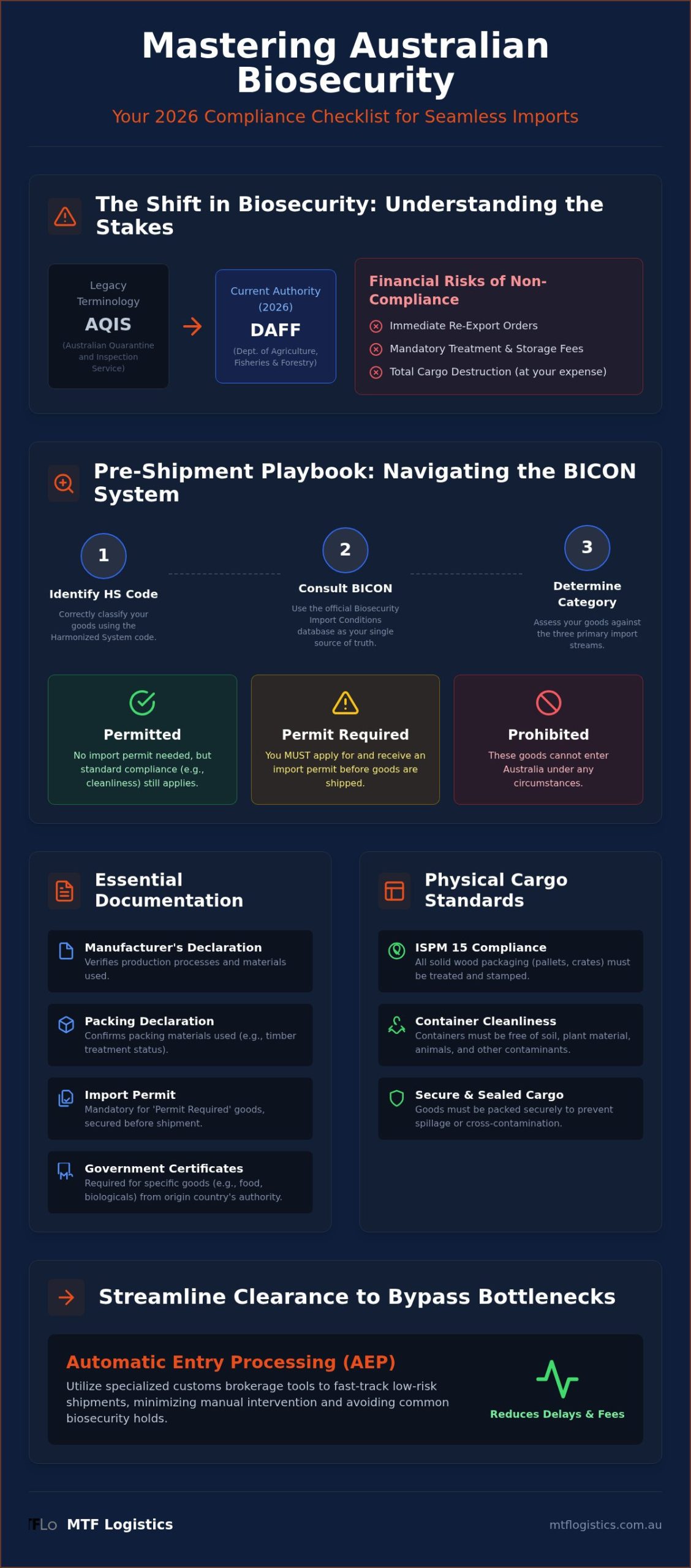
Physical compliance is the point where theoretical planning meets border reality. Even with perfect documentation, your shipment can be rejected if the physical state of the cargo or its packaging fails to meet the specific AQIS import requirements Australia mandates. DAFF officers maintain a zero-tolerance policy for biosecurity contaminants such as soil, seeds, or animal matter. Containers must be swept clean of debris before loading; a single clump of dirt on a tyre or a stray leaf in a container corner can lead to an immediate order for cleaning at a specialised facility. This process adds significant costs and delays to your arrival timeline.
All solid wood packaging material must comply with the ISPM 15 international standard. You can identify compliant timber by the IPPC mark, which is a permanent stamp or brand on the wood that includes the country code, producer code, and treatment type. In 2026, DAFF continues to prioritise heat treatment to a core temperature of 56°C for 30 continuous minutes. If your pallets or crates lack this stamp, the “re-export or destroy” rule applies. To avoid this risk entirely, many modern importers switch to alternatives like plastic pallets, cardboard dunnage, or plywood, which is considered a manufactured wood product and doesn’t require the ISPM 15 stamp.
The 2026 Brown Marmorated Stink Bug (BMSB) season remains a critical period for anyone importing from the northern hemisphere. BMSB measures typically apply to goods manufactured in or shipped from specific countries between September and April. During this window, target high-risk goods, such as machinery, vehicles, and metal products, must undergo mandatory offshore treatment. If these goods arrive untreated from a target risk country, they’ll be denied discharge and ordered for immediate re-export. For used machinery and automotive parts, the requirements are even stricter; these items must be professionally cleaned and free from all organic residue before they’re presented for shipment.
Managing these physical standards requires coordination with your suppliers and warehouse staff at the origin. If you need assistance verifying the compliance of your offshore packing processes, contact our expert team for a detailed physical cargo assessment. Ensuring your cargo is “border-ready” prevents the most expensive types of logistics failures and keeps your supply chain moving without interruption.
While understanding the technicalities of AQIS import requirements Australia is essential for your pre-shipment planning, the actual clearance process at the border is where professional expertise becomes indispensable. A licensed customs broker acts as your interface with the Department of Agriculture, Fisheries and Forestry (DAFF), managing the intricate data entry required to move cargo from “arrived” to “released.” By utilizing Automatic Entry Processing (AEP), brokers can often facilitate the release of low-risk goods without direct departmental intervention, significantly reducing wait times. This system allows authorized brokers to assess documents and determine outcomes, bypassing the standard queue for many commodities.
All supporting evidence, from manufacturer’s declarations to treatment certificates, must be uploaded through the Cargo Online Lodgement System (COLS). This isn’t a simple upload task; it requires a methodical review to ensure every document aligns perfectly with the specific BICON conditions. In 2026, the cost for in-office assessment is $42.00 per 15 minutes. Any document errors that require a reassessment or trigger a manual review directly impact your bottom line and delay your cargo’s entry into the market.
If DAFF directs your cargo for a physical inspection, the logistics become more complex. Inspections typically occur at Approved Arrangements (AA) sites, which are private premises authorized by the government to handle biosecurity risks. Coordinating the move from the wharf to these sites requires precise timing to avoid excessive port storage fees. A professional broker manages this “tailoring” process, ensuring your goods are presented for inspection in a way that satisfies the biosecurity officer on the first visit. This proactive management drastically reduces the “Request for Information” (RFI) cycle, where shipments are stalled because an officer needs further clarification on a document or packing method.
At MTF Logistics, we combine decades of industry experience with modern digital tools to provide end-to-end visibility through the biosecurity maze. Our national network of experts ensures that your cargo is compliant regardless of which Australian port it enters. We seamlessly integrate these compliance measures with our sea freight services, ensuring that biosecurity is a planned milestone rather than an unexpected hurdle. We don’t just lodge papers; we provide a steady hand in a volatile regulatory market, making difficult tasks feel effortless for our clients.
Contact MTF Logistics for a biosecurity compliance audit today to ensure your 2026 supply chain remains resilient and compliant with all current Australian regulations.
Success in the 2026 trade environment requires more than just shipping goods; it demands a proactive approach to biosecurity that begins months before departure. By mastering the BICON system and ensuring every physical pallet meets ISPM 15 standards, you eliminate the most common causes of border rejection. Accurate documentation remains your primary defense. It shields your business from the rising costs of manual assessments and diagnostic fees. Navigating the specific AQIS import requirements Australia enforces is a complex task, but it becomes manageable when integrated into a structured compliance roadmap.
You don’t have to manage these complexities alone. With decades of experience navigating DAFF and AQIS regulations, our team provides a national customs brokerage network designed to protect your cargo from avoidable delays. We specialize in complex industrial project logistics, ensuring even the most difficult shipments meet every regulatory hurdle with precision. Simplify your Australian biosecurity compliance with MTF Logistics and gain the visibility your business deserves. With a steady hand guiding your shipments, you can focus on growth while we handle the intricacies of the border.
AQIS is the legacy name for the agency responsible for border protection, while DAFF is the current department managing these regulations in 2026. The industry still uses the term AQIS import requirements Australia out of habit, but all official lodgements occur through DAFF systems. Understanding this distinction is vital for navigating modern portals like BICON and COLS, where current legislative standards under the Biosecurity Act 2015 are strictly enforced for all commercial cargo.
No, not every shipment requires a formal import permit. The BICON database classifies goods into categories: permitted, prohibited, or permit required. Many manufactured items enter under standard conditions without a specific permit, provided they meet cleanliness and packing rules. However, biological materials, specific foods, and high-risk commodities often require a permit to be secured before the goods depart the origin port. Shipping without a required permit usually leads to mandatory re-export.
If your cargo arrives with timber packaging that lacks the ISPM 15 stamp or shows signs of infestation, DAFF will issue a re-export or destroy order. You can’t fix non-compliant wood once it has landed in Australia. The entire container may be held, leading to significant port storage fees and the cost of specialised disposal. To prevent this, ensure all pallets and crates are heat-treated and clearly marked by an approved offshore provider before shipment.
As of July 1, 2026, biosecurity fees have increased due to indexation. An out-of-office inspection now costs $70.00 per 15 minutes of attendance. If you require an inspection on a weekend or public holiday, the rate rises to $93.00 per 15 minutes after the minimum attendance charge is applied. Additionally, in-office document processing and assessments are charged at $42.00 per 15-minute block, making document accuracy essential for controlling your overall logistics budget and avoiding unnecessary expenses.
The Brown Marmorated Stink Bug (BMSB) seasonal measures apply to goods manufactured in or shipped from target risk countries between September 1 and April 30. During this window, high-risk commodities like machinery and automotive parts must undergo mandatory offshore treatment. Failing to treat these goods before they depart results in the vessel being denied permission to discharge the cargo. Always verify the specific target country list on the DAFF website before the season begins each year.
While you can legally attempt to clear biosecurity yourself, the complexity of the Biosecurity Act 2015 makes professional brokerage the safer choice. Licensed brokers utilise the Automatic Entry Processing (AEP) system to expedite clearances that would otherwise require manual departmental intervention. A broker ensures your documentation meets the exact AQIS import requirements Australia mandates, reducing the risk of expensive Request for Information cycles and minimising the time your cargo spends sitting at the port.
Biosecurity clearance timelines vary based on the commodity risk and documentation accuracy. If your broker uses AEP for low-risk goods, release can be almost instantaneous upon vessel arrival. However, if DAFF directs your cargo for a physical inspection or manual document assessment, the process can take five to ten business days. Delays often stem from document discrepancies or seasonal backlogs, highlighting the importance of lodging your paperwork through COLS well before the ship docks at the port.
Every sea freight shipment requires a core set of documents to pass biosecurity. These include a valid Packing Declaration, a Commercial Invoice, and a detailed Packing List. If your goods fall under specific risk categories, you must also provide Treatment Certificates for fumigation or heat treatment and any required Import Permits. Ensure that your Manufacturer’s Declaration uses the specific wording required by DAFF to avoid manual processing delays and the associated 2026 fee increases for document assessment.


 Email
Email 1300 710 683
 Tariff Lookup
 HS Code Lookup
 Newsletter Signup