
Total Shipment Visibility, Simplified
Access all your shipment details in one place - track departures and arrivals, manage documents, notifications, invoices, and more.
Access all your shipment details in one place - track departures and arrivals, manage documents, notifications, invoices, and more.

The lowest shipping quote in your inbox is often the most expensive mistake you’ll make this year. You’ve likely felt the frustration of a shipment stalled at the border or the sting of a hidden port fee you never agreed to. Managing international trade into Australia is complex, and it’s natural to feel that the logistics process is a black box where visibility often disappears.
Knowing the right questions to ask a freight forwarder is the only way to move from uncertainty to total control. You deserve a partner who acts as a risk-management expert rather than just a transport provider. This 2026 importer’s checklist is designed to help you identify reliable, compliant, and cost-effective partners for Australian trade. We will walk through twenty-five essential vetting points, ranging from Australian Border Force compliance to end-to-end visibility. By the end of this guide, you’ll have the framework needed to ensure your supply chain remains stress-free and your pricing stays transparent.
Longevity isn’t just a marketing claim. It’s a reflection of a firm’s ability to survive economic downturns, port strikes, and shifting trade policies while keeping client cargo moving. In the logistics sector, experience translates directly into risk mitigation. Before committing to a partnership, it’s helpful to understand the foundational role of the industry. What is a Freight Forwarder? Essentially, they are the architects of your supply chain, responsible for the movement of goods across borders. The first set of questions to ask a freight forwarder should focus on their historical performance and their ability to handle the specific pressures of the Australian market.
There is a significant difference between an asset-based forwarder and a pure digital middleman. Digital startups often provide slick interfaces but lack physical control or deep-seated relationships at the ports. When a shipment is delayed, you need a partner who can pick up the phone and speak with a terminal manager they’ve known for decades. A middleman relying solely on automated systems often lacks this level of influence, leaving your cargo at the back of the queue.
Checking an ABN history reveals whether a company has a stable foundation or if they’ve recently rebranded after financial instability. An established forwarder offers a level of stability that a tech startup cannot match, as they’ve built the institutional knowledge required to handle complex customs disruptions over a decade. This history ensures they’ve seen every possible scenario and have established protocols to manage them effectively.
Your forwarder is only as strong as their weakest link at the origin port. If they don’t have a vetted, long-term agent in the country you’re importing from, you’re at risk of communication breakdowns and documentation errors. Effective logistics management Australia depends on the forwarder’s ability to coordinate these agents with local transport providers. This ensures that once your goods clear customs, the final leg of the journey is handled with the same precision as the international transit. Using these questions to ask a freight forwarder will help you determine if they have the infrastructure to support your business long-term.
Not all cargo is created equal. While many providers excel at standard shipping, they may struggle with the nuances of perishables, pharmaceuticals, or high-fashion garments. These sectors require specific temperature controls, hygiene standards, or security protocols. Identifying these niche capabilities is a vital part of your questions to ask a freight forwarder. When you work with a specialist, you reduce the risk of spoilage or loss because the provider understands the specific environmental requirements of your goods. If you’re managing sensitive inventory, it’s often wise to speak with a logistics expert who understands these complexities.
End-to-end management is particularly critical for complex shipments. If a forwarder only handles the port-to-port leg, you’re left to coordinate the dangerous goods documentation or the final mile delivery yourself. This fragmented approach increases the likelihood of communication gaps and cargo damage. A partner who manages the entire lifecycle of the shipment provides a single point of accountability. This is especially true for Project Logistics, which involves moving oversized or high-value industrial equipment that doesn’t fit into standard containers.
Industrial projects demand a higher level of technical oversight than standard retail imports. You need to know if your partner has the infrastructure to support heavy-lift cargo. These shipments often require route surveys and local government permits before they even leave the port. Reviewing a dedicated heavy haulage logistics Australia guide can help you understand the regulatory hurdles involved in moving oversized machinery.
A reliable partner shouldn’t just offer one way to move your goods. They should provide modal flexibility based on your budget and timeline. While sea freight is cost-effective for bulk shipments, air freight is essential for urgent restocking or high-value electronics. For a deeper look at these options, consult a guide on air freight Australia to see how it fits your 2026 supply chain strategy.
Using these questions to ask a freight forwarder ensures you aren’t just buying a space on a ship. You’re securing a service tailored to the physical requirements of your specific cargo and the commercial needs of your business.
The most significant risk to your supply chain isn’t a storm at sea; it’s a paperwork error at the Australian border. Many businesses use the terms “freight forwarder” and “customs broker” interchangeably, but they represent two distinct functions. A forwarder manages the physical transit of goods, while a licensed customs broker acts as your legal representative before the Australian Border Force (ABF). When vetting potential partners, your questions to ask a freight forwarder must determine who will handle customs clearance and who is accountable if cargo is held.
A single point of accountability for freight and clearance stops problems falling between providers. A broker who is integrated into the forwarding team has immediate access to your shipping documents, which speeds up the lodgement process. Accurate HS Code classification is vital because misclassifying goods can lead to significant penalties from the ATO or ABF. For a detailed breakdown of these requirements, refer to our guide on customs clearance Australia.
The 2026 Australian Biosecurity (AQIS) landscape remains one of the most stringent in the world. High-risk cargo, such as timber or machinery, often requires specific treatment or physical inspections. A 48-hour customs delay can trigger thousands of dollars in wharf storage and container detention fees, often exceeding the original cost of the freight itself. Your partner should have a proactive strategy to manage these holds before the vessel even arrives at the port.
A forwarder with a deep understanding of Australian regulations acts as a shield for your business. By using these questions to ask a freight forwarder, you ensure that your logistics partner is equipped to handle the legal complexities of international trade. This level of oversight turns a potentially volatile process into a structured, predictable part of your operations.
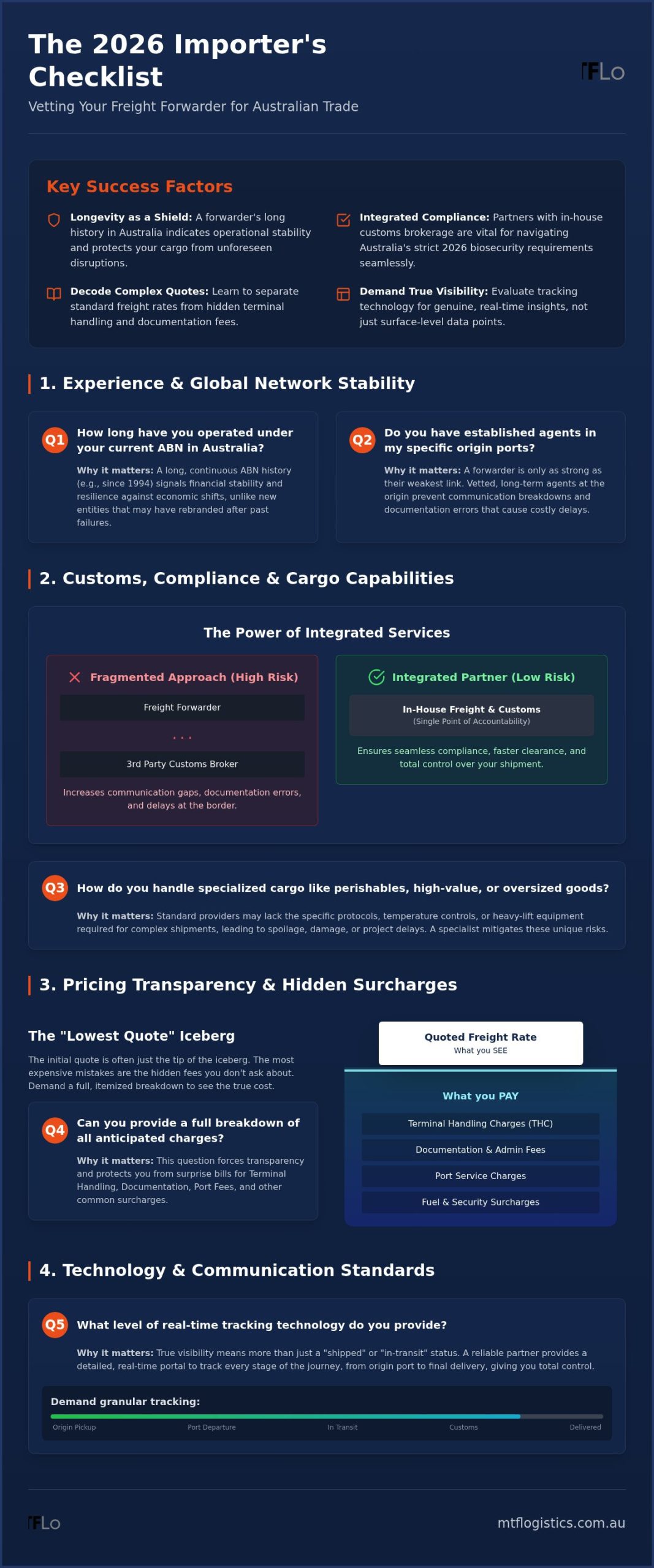
Technology should provide a window into your supply chain, not a wall of confusing notifications. Many modern providers lean heavily on “digital-first” platforms that offer instant quotes but lack the human expertise to manage exceptions when they occur. While real-time tracking is often marketed as a premium feature, its true value lies in how that data is interpreted and communicated. When evaluating questions to ask a freight forwarder, you must distinguish between a marketing gimmick and a tool that actually improves your operational control.
A composed and steady communication style is far more effective than a high-pressure stream of automated alerts. If a vessel is delayed due to port congestion, a simple automated email doesn’t solve the problem. You need a partner who provides a single point of contact; an expert who understands your specific business requirements and can offer alternative solutions. This human element ensures that visibility leads to resolution rather than just increased stress. If you value a tech-forward approach balanced with decades of industry knowledge, you should partner with a reliable logistics guide who prioritizes clarity.
Transparency is about more than just seeing a dot on a map. It’s about knowing exactly where your documentation stands and when your cargo will be cleared for final delivery. This is particularly vital for high-value air cargo, where every hour of delay impacts your bottom line. To see how global providers manage these complex requirements, you can learn more about ICAT Detroit and their specialized warehousing for sensitive freight. A dedicated account manager serves as a steady hand, filtering out the noise of global logistics to provide you with the specific insights you need to manage your inventory.
Digital documentation management is essential for speeding up the “cleared to deliver” process. Having a centralized, secure location for all import permits, commercial invoices, and bills of lading ensures that you are always ready for an audit. For those learning how to import goods into Australia, this organized approach is the best way to maintain compliance with Australian Border Force requirements.
Customized reporting allows you to move beyond simple shipping rates and understand the true cost of your goods. By integrating these questions to ask a freight forwarder into your vetting process, you ensure that your provider uses technology to simplify your workload, not add to it. This level of technical integration, combined with professional oversight, creates a predictable and transparent supply chain environment.
The lowest initial quote often masks a series of hidden expenses that only appear once your cargo is already in transit. In the logistics industry, a “too good to be true” sea freight rate usually signals that certain essential costs have been omitted to make the offer look more attractive. When preparing your questions to ask a freight forwarder, you must demand a breakdown that separates the base freight rate from itemized surcharges. This clarity prevents the shock of receiving a final invoice that far exceeds your original budget. Not all rates are equal, and transparency is the only way to protect your margins.
Common hidden costs include Terminal Handling Charges (THC), documentation fees, and fuel surcharges. These are standard parts of the shipping process, yet some providers fail to mention them during the initial sales phase. Understanding Incoterms like EXW (Ex Works), FOB (Free on Board), or CIF (Cost, Insurance, and Freight) is equally important. These universal trade terms define exactly where the forwarder’s responsibility begins and where your liability ends. If you don’t know who is responsible for the local charges at the origin or destination port, you risk paying twice for the same service. A steady partner will explain these nuances clearly so there are no surprises at the wharf.
The cheapest quote often results in the highest landed cost because it frequently excludes essential delivery fees or port-side handling. A professional partner provides a transparent, all-in overview that allows you to calculate your profit margins with total confidence. Using these questions to ask a freight forwarder ensures you aren’t comparing apples with oranges when reviewing multiple bids.
Standard liability coverage is often limited by international conventions and rarely covers the full value of your goods. For businesses utilizing sea freight services, arranging comprehensive marine insurance is a critical step in risk management. This ensures that in the event of heavy weather or vessel incidents, your financial investment remains protected. A reliable guide will always prioritize the security of your cargo over a slightly lower headline price.
Choosing a logistics partner is one of the most consequential decisions for your business’s bottom line. By using this checklist of questions to ask a freight forwarder, you’ve moved from passive shipping to active supply chain management. You now understand that true value lies in the intersection of transparent pricing, strict regulatory compliance, and the ability to handle specialised cargo with precision. A reliable partner doesn’t just provide a quote; they provide a framework for stability in a volatile global market.
Established in 2014, MTF Logistics has spent over a decade refining this process for Australian trade. We offer the quiet authority that comes from integrated customs clearance and specialist project logistics expertise, ensuring your goods clear the border without unnecessary penalties. If you’re ready to move beyond the uncertainty of hidden fees and communication gaps, it’s time to work with a team that prioritizes your success as much as you do. Request a transparent, expert freight consultation from MTF Logistics to begin building a more resilient supply chain. Taking control of your international trade is a journey that starts with the right partner by your side.
You can verify a freight forwarder’s legitimacy by checking their Australian Business Number (ABN) and their professional affiliations. In Australia, while forwarders don’t require a specific “forwarding license”, those providing customs services must employ a licensed customs broker. This is one of the foundational questions to ask a freight forwarder when confirming their ability to handle legal lodgements. Look for firms with a proven track record.
A freight forwarder manages the physical movement of goods across sea or air routes, coordinating carriers and local transport. A customs broker is a licensed professional who acts as your legal representative to ensure goods comply with Australian Border Force and biosecurity regulations. Many modern importers prefer a partner who provides both services under one roof. This integrated approach ensures that the logistics and the legal clearance processes are perfectly aligned, reducing the risk of costly delays.
It’s usually safer to appoint your own Australian-based forwarder rather than relying on a supplier’s contact. When you control the logistics, you gain full visibility over costs and transit times. Local experts understand the specific 2026 Australian biosecurity requirements and can advocate for you if delays occur. This is one of the most important questions to ask a freight forwarder during the vetting process to ensure they have a local presence and in-depth knowledge of the destination port.
To receive an accurate quote, you should have your commercial invoice and a detailed packing list ready. These documents provide the weight, dimensions, and value of your goods, which are essential for calculating rates. If you’re importing chemicals or batteries, you’ll also need a Material Safety Data Sheet (MSDS). Providing these details early allows you to receive specific feedback regarding specialized handling requirements or potential regulatory hurdles for your specific cargo type before the shipment departs.
A forwarder that handles customs clearance can help you minimize duties through accurate HS Code classification and the application of Free Trade Agreements (FTAs). They identify specific tariff concessions or exemptions that your business might be eligible for under current Australian regulations. By ensuring your goods are classified correctly from the start, you avoid overpaying the Australian Taxation Office while remaining fully compliant with all legal reporting obligations and avoiding potential border penalties.
Fees for logistics management vary significantly based on the mode of transport, cargo volume, and the complexity of the project. Typically, you’ll pay for the freight rate alongside service fees for documentation, customs clearance, and terminal handling. Instead of searching for a flat fee, focus on finding a provider who offers transparent, itemized pricing. This approach ensures you aren’t hit with unexpected surcharges during the final delivery phase of your shipment and helps you maintain profit margins.
If a shipment is lost or damaged, the forwarder’s liability is usually limited by international conventions, which may not cover the full value of your goods. This is why a reliable partner will always recommend arranging comprehensive marine insurance on your behalf. In the event of a total loss, insurance provides the financial protection needed to recover your investment. Your forwarder should facilitate the claims process, acting as a steady guide during a difficult and potentially stressful situation.
Yes, most professional forwarders manage the final leg of the journey from the Australian port to your warehouse. This “final mile” delivery is a critical part of end-to-end logistics management. They coordinate with local transport providers to ensure that once your cargo clears customs, it is moved efficiently to its destination. This integrated service prevents communication gaps between the international carrier and the local trucking company, ensuring a smoother transition for your supply chain operations.


 Email
Email 1300 710 683
 Tariff Lookup
 HS Code Lookup
 Newsletter Signup