
Total Shipment Visibility, Simplified
Access all your shipment details in one place - track departures and arrivals, manage documents, notifications, invoices, and more.
Access all your shipment details in one place - track departures and arrivals, manage documents, notifications, invoices, and more.

In 2026, the true cost of an Australian shipment isn’t found in the initial freight quote; it’s hidden in the silence between your customs broker and your transport provider. You’ve likely experienced the stress of a shipment stalled at the wharf, accruing avoidable port storage fees, simply because of a communication breakdown. It’s frustrating to manage separate entities that don’t share data, leaving you to piece together the status of your cargo while costs mount. Transitioning to end to end freight management Australia is the most effective way to eliminate this fragmentation and regain control over your landed costs. By consolidating your logistics into a single point of accountability, you can achieve faster border clearance and more predictable financial planning. This strategic guide outlines how to simplify your supply chain, from navigating the 2026 elimination of nuisance tariffs to managing expanded biosecurity cost recovery. We’ll show you how a steady, integrated approach transforms logistics from a source of uncertainty into a reliable driver of business growth.
End-to-end freight management Australia describes a holistic approach where every phase of the cargo journey, from the supplier’s warehouse at the point of origin to the final delivery at the destination, is managed under a unified strategy. To understand What is Logistics in a modern context, one must move beyond simple transportation. It represents a fundamental shift from transactional shipping, where businesses book isolated legs of a journey, to a strategic supply chain model. This method ensures that the flow of goods is not just a series of movements but a synchronized process designed to optimize time and capital.
In the 2026 trade environment, fragmentation is the primary driver of “hidden” expenses. When separate entities handle different segments of the supply chain, communication gaps are inevitable. These gaps often lead to costly Australian port storage fees and demurrage, which can quickly erode the profitability of an entire shipment. Digital integration is changing national freight expectations, requiring data to flow as quickly as the physical goods to allow for proactive adjustments to congestion or regulatory delays.
While freight forwarding is a tactical service focused on the movement of goods from one point to another, management acts as a strategic partnership. A lead logistics provider coordinates various third-party assets—such as Jagelo Haulage for secure container movements at the point of origin in the UK—and regulatory requirements to ensure a seamless flow. This moves the focus from individual freight rates to the total landed cost, ensuring one partner remains responsible for the integrity and timing of the entire journey from start to finish.
Adopting a managed approach provides immediate relief from the administrative burden of coordinating multiple vendors. Instead of chasing different brokers and carriers, businesses receive consolidated reporting that offers a clear overview of their logistics management Australia. This high-level visibility is critical for maintaining lean inventory levels without risking stockouts.
In 2026, the complexity of global trade requires a steady hand. A managed approach doesn’t just move boxes; it provides the data-driven insights necessary to navigate a volatile market with confidence and precision. For businesses seeking reliable partners to manage international legs of their journey, you can learn more about active forwarding Uluslararası Taşımacılık Ltd. Şti. and their specialized logistics expertise.
Developing a robust national integrated logistics strategy requires more than just moving containers from one point to another. It involves aligning your operations with broader frameworks like Australia’s National Freight and Supply Chain Strategy to ensure long-term resilience. Successful end to end freight management Australia hinges on the seamless transition between international arrival and domestic distribution. This synchronization prevents the bottlenecks that typically occur when cargo changes hands between multiple uncoordinated providers, ensuring that the momentum gained at sea isn’t lost at the wharf.
Technology acts as the nervous system of this strategy, enabling data-driven decision making for route and carrier selection. Rather than relying on static schedules, modern logistics management uses real-time data to pivot when disruptions occur. Warehousing and 3PL services provide a critical buffer, protecting your supply chain from market volatility and sudden demand spikes. This integrated approach allows businesses to maintain lean inventory levels while knowing their backup stock is positioned strategically to meet national demand.
A hybrid supply chain often provides the best balance of cost and speed. Importers must evaluate whether to utilize sea freight services for bulk inventory or air options for high-value, time-sensitive stock. Managing Full Container Load (FCL) and Less than Container Load (LCL) shipments within a unified framework allows for better space utilization and cost control. During peak seasons, experienced air freight forwarders act as a pressure valve, accelerating supply chains when sea lanes become congested or when stockouts are imminent.
Standard shipping protocols often fail when dealing with complex, oversized, or sensitive cargo. Managing heavy haulage logistics Australia requires deep technical knowledge of route planning, specialized equipment, and permit requirements for infrastructure projects. This level of expertise is equally vital in other specialized sectors:
These specialized needs aren’t just optional add-ons; they are core components of a managed logistics model that prioritizes the safety and integrity of your cargo. If you’re looking to stabilize your operations, reaching out for expert logistics support can provide the steady hand your business needs to navigate these complexities.
Many businesses view customs as a final, isolated hurdle in the shipping process. In reality, it’s the foundation of a reliable timeline. Treating freight and customs as separate entities often leads to a disconnect where the transport provider isn’t aware of documentation delays until the cargo is already at the wharf. This misalignment is a primary cause of expensive demurrage and detention fees. Within a framework of end to end freight management Australia, these two functions are synchronized. Data flows to the brokerage team long before the vessel arrives, allowing for pre-clearance strategies that ensure goods move directly from the terminal to the warehouse without sitting idle.
The financial stakes of compliance are high. As of July 1, 2026, a single Commonwealth penalty unit is valued at $364. Administrative errors in customs declarations can quickly result in multiple penalty units, significantly inflating your landed costs. An integrated manager mitigates this risk by maintaining a single source of truth for all shipment data. They also leverage Free Trade Agreements (FTAs) more effectively, ensuring that your business realizes every possible duty concession rather than defaulting to standard rates due to a lack of coordination. Understanding how to select a qualified customs broker Australia is essential for protecting your business from unexpected penalties and systemic delays under the nation’s strict liability framework.
Biosecurity remains one of the most complex aspects of the Australian import landscape. The 2025-2026 Brown Marmorated Stink Bug (BMSB) season, running from September 1, 2025, to April 30, 2026, requires mandatory treatment for high-risk goods from specific countries. Failing to coordinate these treatments with the freight schedule can lead to terminal delays and expanded DAFF cost-recovery fees, which were increased in July 2025. Effective customs clearance Australia depends on a partner who anticipates these seasonal requirements. In 2026, a licensed customs broker acts as a specialized legal intermediary who ensures every shipment complies with the Customs Act 1901 and the Biosecurity Act 2015 while minimizing financial exposure to duties and taxes. Industry bodies like the Freight & Trade Alliance (FTA) emphasize that this integration is vital for maintaining supply chain integrity.
Accurate HS Code classification is essential for tax compliance and cost control. In July 2026, the Australian government eliminated 497 “nuisance tariffs” to streamline trade. While this simplifies some processes, it requires an integrated manager to re-evaluate existing classifications to ensure you aren’t overpaying. Integrated teams identify duty refund opportunities that standalone brokers might miss because they lack visibility into the broader logistics context. By avoiding common documentation mistakes, such as incorrect valuation for goods over the $1,000 AUD threshold, businesses can maintain a clean compliance record and a predictable budget.
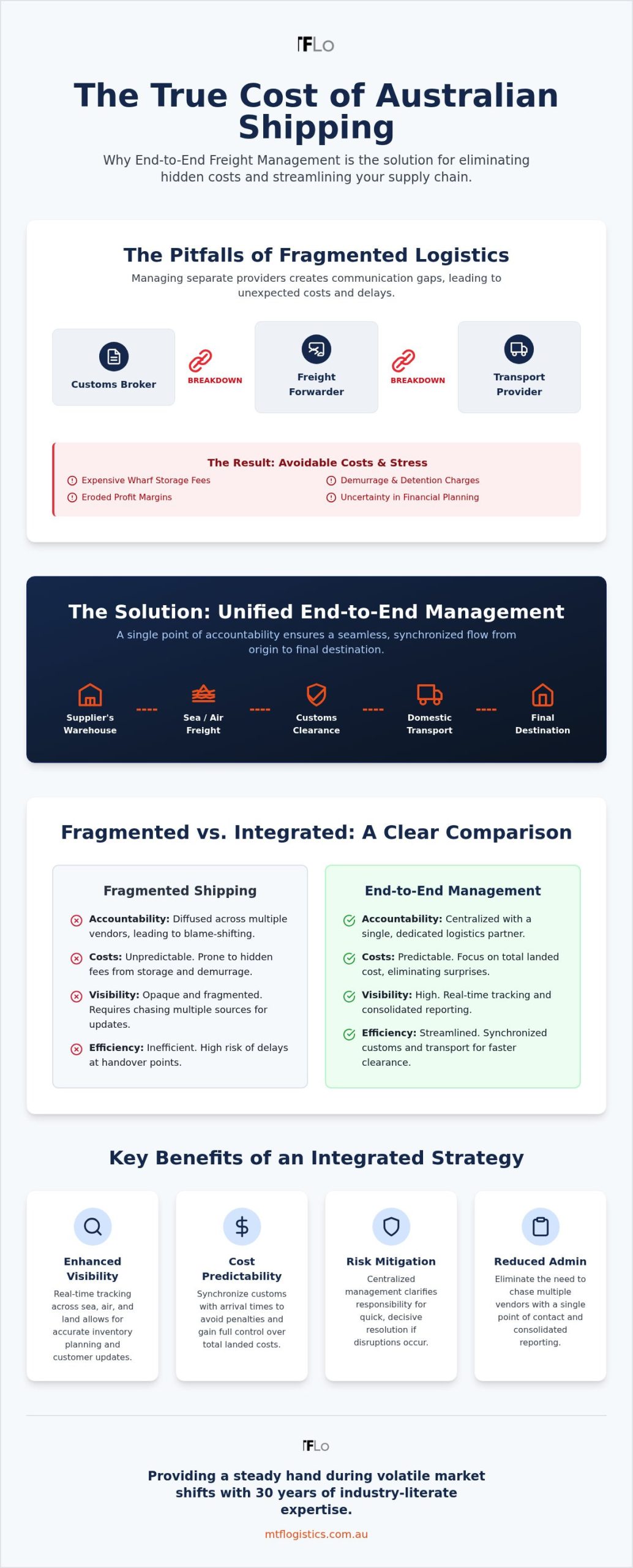
Selecting a partner for end to end freight management Australia requires a move away from comparing simple freight rates toward assessing operational depth. A reliable partner must demonstrate a comprehensive national reach, ensuring they can manage cargo across all Australian ports without relying on secondary agents who might lack accountability. This national consistency is vital for maintaining the “single point of contact” model, which prevents information loss as goods move through different jurisdictions. It’s the difference between a provider who merely books space and one who actively manages the cargo’s progress.
Industry-specific expertise is non-negotiable for specialized sectors. If your cargo includes Dangerous Goods, pharmaceuticals, or medical equipment, your partner must possess the technical literacy to manage strict regulatory and handling requirements. This expertise should be backed by local Australian support rather than offshore call centres. In a volatile market, having a steady hand on the ground who understands the local biosecurity landscape and port conditions ensures that issues are resolved before they escalate into delays. A technology audit is also essential; a modern platform must provide real-time status updates and immediate access to essential documents like Bills of Lading and customs declarations.
Use these questions to determine if your current provider offers a truly integrated service that adds value to your business:
A lower “freight rate” on a quote often acts as a mask for higher total landed costs. When freight and customs are fragmented, the lack of coordination leads to avoidable port storage and demurrage fees. The “transparency test” involves looking for hidden fees that aren’t disclosed upfront, such as unexpected documentation charges or inflated local handling fees. Calculating the true value of a partner involves factoring in reduced lead times and the administrative savings gained from a simplified, transparent supply chain. If your current provider cannot answer your questions with confidence, it may be time to consult with a professional logistics partner who prioritizes accountability and industry-literate expertise.
MTF Logistics has provided a steady hand in the global market since 2014. With over a decade of established industry experience, we’ve seen how fragmentation costs businesses time and capital. Our approach to end to end freight management Australia focuses on removing the stress of coordinating multiple unaligned vendors. By integrating customs clearance with our sea and air freight services, we provide a single point of accountability for every shipment. This integration ensures that data flows as fast as the cargo, allowing for proactive resolution of potential wharf delays before they become expensive liabilities. We don’t just move freight; we manage the entire lifecycle of your shipment with the quiet authority of a seasoned partner.
Navigating the legalities of how to import goods into Australia requires a partner who understands that every industry has unique requirements. We tailor our logistics strategies for complex sectors, including infrastructure project cargo and pharmaceutical cold chains. Our commitment to documentation accuracy is absolute. We prioritise precision in tariff classification to ensure your business remains compliant with Australian Border Force standards and biosecurity regulations. Case studies in our project logistics division demonstrate that a methodical, detail-oriented approach is the only way to manage high-stakes cargo successfully without risking avoidable penalties or delays.
Transitioning your business to a managed model doesn’t have to be disruptive. It starts with a comprehensive logistics audit where our experts review your current freight flow to identify hidden inefficiencies. We look for redundant administrative hours, suboptimal route selections, and gaps in communication that lead to port storage fees. This audit serves as a baseline for improving your logistics management Australia. Our onboarding process for new national accounts is structured and deliberate, ensuring a seamless handover of operations with minimal impact on your daily workflow. If you’re ready to stabilise your supply chain and reduce landed costs, we invite you to request a detailed freight quote and experience the MTF difference.
Transitioning to a managed model is a strategic necessity for businesses looking to mitigate risk and stabilise landed costs in a volatile market. By aligning your international transport with customs clearance, you eliminate the costly communication gaps that lead to avoidable wharf storage and biosecurity delays. Implementing end to end freight management Australia ensures your operations benefit from a single point of accountability across every major port, providing the visibility needed for precise financial planning.
Success in 2026 depends on having a partner who understands the intricacies of global trade and the specific requirements of your industry. With over a decade of logistics expertise and integrated customs clearance, MTF Logistics offers the steady hand required to manage your most complex shipments with confidence. We invite you to Request a Comprehensive End-to-End Freight Quote to see how a unified strategy can simplify your operations. Your logistics should be a reliable driver of business growth; let’s build a more resilient and transparent supply chain for your business together.
End-to-end freight management Australia includes the coordination of every logistical step from the supplier’s warehouse to the final delivery point. This comprehensive service covers international sea or air freight, customs clearance, biosecurity compliance, and national distribution. By managing these elements under a single strategy, businesses eliminate the need to coordinate multiple vendors, ensuring a seamless flow of data and physical goods across the entire global supply chain.
Integrated customs brokerage saves money by preventing communication gaps that lead to expensive wharf storage and demurrage fees. When your broker and freight manager operate as one team, documentation is processed before the vessel arrives, facilitating faster border clearance. This synchronization also ensures accurate tariff classification and the full utilization of Free Trade Agreements, which reduces duty payments and protects your business from heavy administrative penalties for compliance errors.
Yes, end-to-end management is highly effective for both sea and air freight, as well as hybrid supply chains that use both modes. A managed approach allows you to shift between transport methods based on inventory urgency and cost requirements without losing visibility. Whether you’re moving bulk commodities via sea freight or time-sensitive pharmaceuticals via air, a single management framework ensures consistent documentation standards and reliable national delivery across all transport legs.
Common causes of customs delays include inaccurate documentation, incorrect HS code classification, and biosecurity holds. During the 2025-2026 BMSB season, failing to coordinate mandatory treatment for high-risk goods can lead to significant terminal bottlenecks. Additionally, missing or inconsistent information on commercial invoices often triggers manual diagnostic activities by the Department of Agriculture, Fisheries and Forestry, which increases both transit time and cost-recovery fees for the importer.
End-to-end logistics is particularly beneficial for small to medium businesses that lack dedicated in-house supply chain departments. By outsourcing the management of complex global processes, these companies can focus on their core operations while benefiting from professional-grade logistics expertise. This model provides SMEs with the same level of supply chain visibility and cost control as larger enterprises, helping them avoid the financial risks associated with fragmented shipping and customs errors.
You track your shipment through a centralized digital platform that provides real-time visibility across sea, air, and land segments. An integrated supply chain replaces multiple tracking numbers from different carriers with a single source of truth. This system allows you to access essential documents, monitor customs status, and receive automated updates on arrival times. This level of transparency is vital for accurate inventory planning and maintaining clear communication with your own customers.
Importing goods in 2026 requires several core documents, including a Bill of Lading or Air Waybill, a detailed Commercial Invoice, and a Packing List. For goods valued over $1,000 AUD, a formal Import Declaration is mandatory. You must also provide a Packing Declaration to meet biosecurity standards. Depending on the cargo type and country of origin, additional certificates like Free Trade Agreement declarations or specialized permits for dangerous goods may be necessary for clearance.
MTF Logistics handles dangerous and perishable goods through specialized protocols that prioritize safety and regulatory compliance. Our team applies over a decade of industry experience to manage the specific documentation and equipment requirements for hazardous materials and cold chain integrity. We coordinate every step, from specialized packing at the origin to temperature-controlled transport in Australia. This methodical approach ensures that sensitive cargo, such as pharmaceuticals or perishables, maintains its integrity throughout the entire journey.


 Email
Email 1300 710 683
 Tariff Lookup
 HS Code Lookup
 Newsletter Signup