
Total Shipment Visibility, Simplified
Access all your shipment details in one place - track departures and arrivals, manage documents, notifications, invoices, and more.
Access all your shipment details in one place - track departures and arrivals, manage documents, notifications, invoices, and more.

In a global market where ocean freight spot rates have hit a 22-month high as of July 2026, simply securing vessel space is no longer enough to protect your bottom line. With the Shanghai Containerised Freight Index reaching nearly 3,000 points in June, Australian businesses face a landscape where the base rate is only the beginning of the story. You likely feel the pressure of managing unpredictable transit times and the frustration of navigating complex customs regulations that often lead to unexpected duties or biosecurity delays.
We understand that a truly resilient supply chain requires more than just a booking; it demands a steady hand to manage the end-to-end journey. This article provides the expert guidance you need to master sea freight services, ensuring your cargo moves with precision from port to warehouse. You’ll learn how to integrate seamless customs brokerage and specialized logistics to achieve predictable costs and total visibility. We will examine the impact of the 2026-27 Brown Marmorated Stink Bug season, strategies for handling new EU carbon declarations, and how to maintain control in a volatile global market.
Australia’s geographic position makes maritime transport more than just a logistical choice; it is a strategic necessity. For businesses importing high-volume inventory or heavy machinery, sea freight services provide the scale required to maintain consistent stock levels across the continent. Approximately 90% of all traded goods move via global sea freight services, serving as the foundational layer of the Australian economy. Within this framework, a freight forwarder acts as the strategic architect of the journey. They don’t just book space on a vessel; they map out complex routes, coordinate with wharf carriers, and manage the transition of goods through major Australian port entries like Botany, Melbourne, and Fremantle.
Current market conditions emphasize the significant cost-per-kilogram advantage of the ocean. While air freight offers speed for urgent medical or pharmaceutical supplies, the price premium is often prohibitive for general consumer goods or industrial components. This economic reality supports a “just-in-case” supply chain model. Australian businesses are increasingly using the lower costs of sea transport to maintain larger safety stocks, which buffers them against the volatility of global shipping lanes. Beyond the financial balance sheet, the environmental impact is a growing priority for modern enterprises. Maritime transport remains the most carbon-efficient method for moving bulk goods, offering a much lower footprint per tonne-kilometre than any aviation alternative.
Clarity in communication prevents costly errors at the border. It’s essential for Australian businesses to distinguish between international ocean freight and coastal shipping, which refers to the movement of cargo between domestic ports like Adelaide and Brisbane. Mastery of Incoterms is equally vital for defining where risk and cost transfer between the buyer and seller. Common terms include:
The Bill of Lading serves as the most critical document in sea logistics, acting simultaneously as a title of goods, a receipt of shipment, and a binding contract of carriage. Understanding these technical foundations allows a business to engage with sea freight services with the confidence of a seasoned professional, ensuring that every shipment is backed by clear legal and financial boundaries.
Selecting the right shipment method requires a balance of volume, budget, and risk tolerance. For Australian businesses, the choice between Full Container Load (FCL) and Less than Container Load (LCL) defines the speed and security of their supply chain. While FCL offers a dedicated environment for your goods, LCL allows for cost-sharing among multiple importers. Understanding the mechanics of these sea freight services helps you avoid overpaying for space you don’t need or risking delays in consolidation hubs.
FCL is the gold standard for security and speed. Because the container is sealed at the origin and only opened at your warehouse, the risk of damage from handling is significantly lower. It’s often the fastest ocean option because it bypasses the deconsolidation phase at the wharf. LCL serves as a flexible alternative for smaller volumes or startup importers testing new product lines. However, LCL involves more handling as cargo is grouped with other shipments. The math for switching from LCL to FCL is quite specific. Once your cargo reaches approximately 15 cubic metres, the consolidated port charges and handling fees typically exceed the flat rate of a 20ft container. At this threshold, FCL shipping in Australia becomes the more economical and efficient choice for your bottom line. For a deeper understanding of how to navigate these decisions in the current environment, our complete 2026 guide to container shipping in Australia provides detailed insights on FCL versus LCL options and current Import Processing Charges.
Standard containers don’t suit every industry. Pharmaceutical and medical logistics require strict cold chain integrity, utilizing refrigerated “reefer” containers to maintain precise temperatures across the equator. Dangerous Goods (DG) demand even higher levels of scrutiny. Managing DG shipments involves rigorous compliance with class-specific safety protocols to ensure the vessel and other cargo remain protected. For the fashion industry, Garment-on-Hanger (GOH) solutions are essential. These specialized containers allow clothes to be shipped on racks, arriving at Australian retailers ready for the floor without the need for expensive pressing or steaming.
Managing these variables requires a partner who understands the granular details of specialized equipment and international regulations. For businesses managing these complexities, partnering with an expert in sea freight services ensures that every variable is accounted for before the vessel departs. This proactive approach prevents the “border friction” that often leads to unexpected costs and delays at the port of entry.
Many logistics providers treat customs clearance as a secondary “bolt-on” service. In reality, the integration of brokerage with sea freight services is the primary driver of transit speed. When these two functions operate in silos, the result is often “border friction.” This friction manifests as demurrage fees charged by shipping lines for containers left at the wharf too long, or detention fees for the late return of empty equipment. From July 1, 2026, wharf ancillary charges at Australian ports increased by approximately A$5 to A$15 per container. These costs compound rapidly if your documentation isn’t perfectly aligned with your cargo’s arrival.
Accurate tariff classification is your first line of defence against Australian Border Force (ABF) penalties. Misclassifying goods doesn’t just lead to fines; it can result in the forfeiture of duty concessions that your business is legally entitled to receive. A steady hand in brokerage ensures that every item, from industrial machinery to garments, is assigned the correct HS Code before the vessel even departs the origin port. This proactive management extends to export documentation, where precise filings ensure smooth international departures and prevent cargo from being bumped to later sailings.
Waiting for a ship to dock before starting the paperwork is a recipe for delay. We employ pre-clearance strategies that begin the moment the Bill of Lading is issued. This approach is particularly vital for managing biosecurity and quarantine requirements overseen by the Department of Agriculture, Fisheries and Forestry (DAFF). For example, the 2026-27 Brown Marmorated Stink Bug (BMSB) season begins on September 1, 2026. Targeted goods from at-risk countries must meet strict treatment standards. Failing to provide verified treatment certificates can lead to expensive on-shore fumigation or even the redirection of the entire container.
Our philosophy is rooted in providing total transparency regarding landed costs. We help you calculate duties, GST, and government charges upfront so there are no surprises when your goods arrive. By leveraging decades of industry experience since our founding in 1994, we simplify the most complex entries, including those for Dangerous Goods or pharmaceuticals. This level of organized expertise transforms a volatile global process into a predictable part of your business operations. Ensure your next shipment is compliant with MTF Customs Brokerage to maintain the integrity of your supply chain.
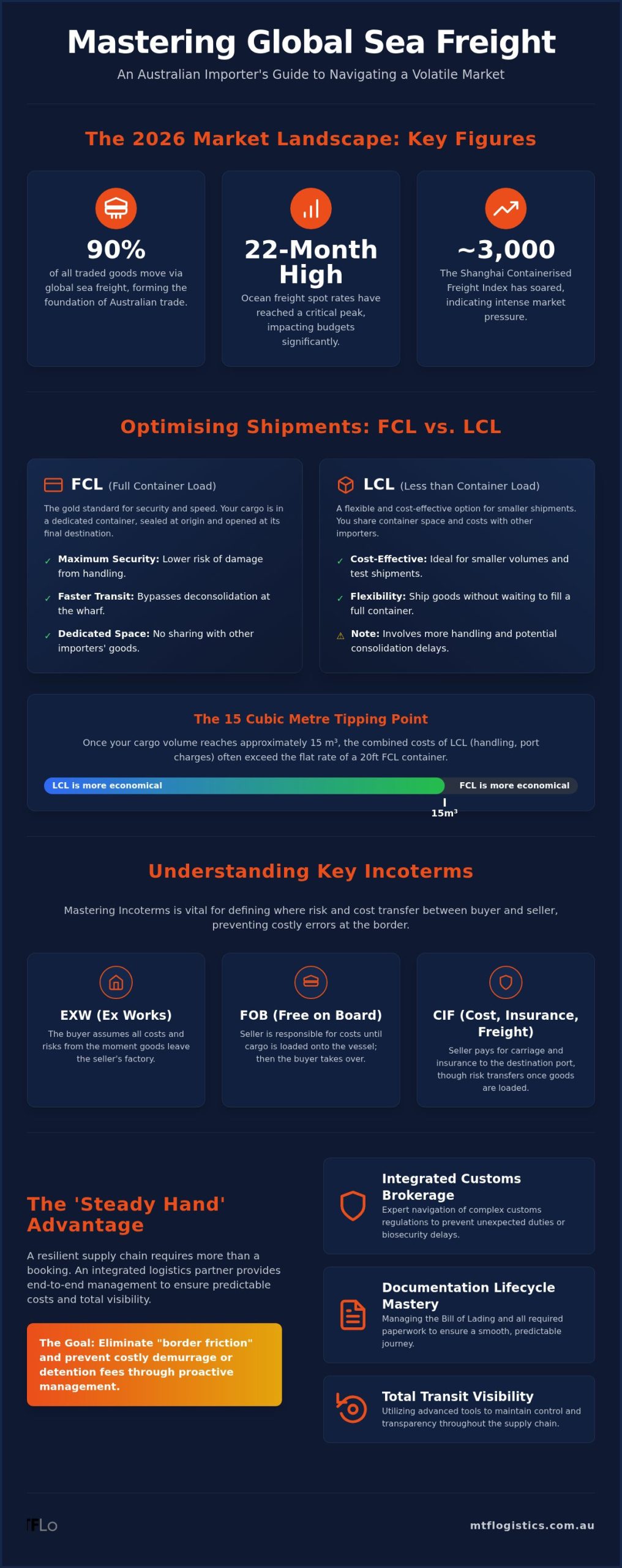
The movement of physical cargo is only half the battle. Successful sea freight services depend on a parallel stream of data and documentation that must remain perfectly synchronized. Errors in this paper trail don’t just cause minor inconveniences; they trigger a cascade of costs. For example, a missing packing declaration can halt a container at the terminal, leading to storage charges that quickly erode profit margins. Managing this complexity requires a methodical approach to the documentation lifecycle, ensuring that every regulatory requirement is met before the vessel arrives in Australian waters.
A clean entry into the Australian market starts with three fundamental pillars. First, the Commercial Invoice and Packing List must provide an exact itemization of the cargo to facilitate correct duty assessments. Second, the Packing Declaration is vital for meeting Department of Agriculture, Fisheries and Forestry (DAFF) standards, particularly regarding timber packaging and cleanliness. Finally, the Certificate of Origin is the primary tool for unlocking Free Trade Agreement (FTA) benefits. Without this specific document, your business may be forced to pay the full tariff rate, even if the goods are technically eligible for a concession. These documents form the legal basis of your shipment and must be treated with the highest degree of accuracy.
Current global schedule reliability sits at approximately 37 to 39 percent as of June 2026. While this is an improvement over previous months, it remains well below historical norms. Ongoing disruptions in the Red Sea have forced many carriers to take the longer route around the Cape of Good Hope, adding significant time to European and Middle Eastern lanes. This volatility makes proactive communication essential. Visibility is not just tracking; it is the ability to act on data. When a vessel is delayed, you need to know immediately so you can adjust inventory levels or manage customer expectations. Our end-to-end management reduces the “black hole” of transit by providing real-time updates and proactive exception management.
Risk mitigation is the final piece of the puzzle. Marine insurance is non-negotiable for sea freight, as it protects your capital against the rare but catastrophic events that can occur at sea. From heavy weather damage to general average declarations, the financial exposure of an uninsured shipment is too great for any responsible business to ignore. If you are looking to secure your supply chain and gain total transparency over your cargo’s journey, contact MTF Logistics for comprehensive sea freight services today. We provide the steady hand needed to guide your goods through the most complex global lanes.
In an industry often defined by high-pressure urgency and market volatility, we offer a composed alternative. Our “Steady Hand” philosophy isn’t just a slogan; it’s a commitment to maintaining control over global processes that can otherwise feel overwhelming. By providing a single point of contact for your sea freight services, customs clearance, and local transport, we eliminate the fragmentation that leads to communication breakdowns. This integrated approach ensures that the person who understands your cargo’s requirements is the same person overseeing its transition through the wharf and across the border.
Scalability is a core pillar of our service model. We don’t believe in a one-size-fits-all solution because the needs of a startup importer are vastly different from those of a large-scale industrial enterprise. Whether you’re moving a single LCL shipment of garments or managing a complex project involving oversized machinery, our team applies the same level of organized expertise. For those requiring specialized road safety coordination during the final leg of transport in South East Queensland, you can check out Acquired Awareness Traffic Management to ensure your heavy haulage meets all local compliance standards. We act as a supportive partner rather than just a service provider, focusing on transparency and mutual success to help you navigate the complexities of international trade with confidence.
Founded in 1994, MTF Logistics has spent decades building the carrier relationships and industry knowledge required to move cargo efficiently. This longevity provides our clients with a distinct advantage: we’ve seen every type of market disruption and developed the pragmatic strategies needed to resolve them. Our national reach extends across all major Australian port entry points, including Botany, Melbourne, Fremantle, Adelaide, and Brisbane. This comprehensive coverage means we can facilitate your logistics requirements regardless of where your goods enter the country, maintaining a professional and industry-literate standard of communication at every step; for specialized vehicle or machinery movement in the Queensland region, you can visit Done Wright Towing & Transport to learn more about their haulage solutions.
Obtaining an accurate sea freight quote is the first step toward a more predictable supply chain. To provide a precise calculation, we require specific details about your shipment, including dimensions, weight, the origin and destination ports, and the agreed-upon Incoterms. This information allows us to identify the most cost-effective routing and equipment options for your specific cargo. Our consultation process goes beyond simple pricing; we actively look for cost-saving opportunities, such as tariff concessions or more efficient consolidation methods, to improve your overall landed cost.
We pride ourselves on being a tech-forward entity that remains grounded in traditional values of service. While we utilize modern data-driven insights to track your shipments, we never lose sight of the specific, granular needs of an individual booking. If you’re ready to move away from impersonal, portal-only logistics and toward a partner-led approach, we’re here to guide you. Request a comprehensive sea freight solution from MTF Logistics and experience the clarity that comes with professional end-to-end management.
Mastering the complexities of international trade requires a shift from reactive shipping to proactive management. The integration of sea freight services with expert customs brokerage serves as the primary driver for transit speed and cost predictability. By understanding the threshold for FCL efficiency and maintaining total documentation accuracy, your business can bypass the “border friction” that leads to unexpected wharf fees and biosecurity delays. These strategic choices protect your bottom line during periods of global disruption.
As global schedule reliability remains below historical norms, the value of a steady hand cannot be overstated. We provide the organized expertise needed to navigate these shifts, from managing seasonal BMSB requirements to optimizing landed costs through precise tariff classification. As an Australian owned and operated entity since 1994, we offer national coverage across all major port entries and specialize in complex project logistics. We’re committed to making difficult tasks feel effortless for our partners.
Partner with the sea freight experts at MTF Logistics to gain total visibility over your cargo’s journey. We look forward to helping you build a more resilient and transparent supply chain for the years ahead.
Transit times vary significantly based on the port of origin and current global routing. Shipments from major Southeast Asian hubs typically arrive in 12 to 25 days, while European services via the Cape of Good Hope now often exceed 45 to 60 days. These estimates include port-to-port time but exclude land transport or customs clearance. We recommend booking at least three weeks in advance to secure vessel space during peak periods.
FCL, or Full Container Load, provides a dedicated container for a single importer, offering higher security and faster transit by avoiding consolidation hubs. LCL, or Less than Container Load, involves sharing container space with other businesses, making it a cost-effective choice for smaller volumes. While LCL reduces base freight costs, it requires more handling at the wharf. FCL shipping Australia typically becomes more efficient once a shipment volume reaches approximately 15 cubic metres. To understand how these options apply to the current Australian market, our 2026 container shipping guide for Australia covers the latest compliance strategies and market trends in detail.
We provide fully integrated customs clearance as a core part of our sea freight services. Our team manages the entire entry process, including tariff classification, duty calculations, and GST assessments. By starting the documentation lifecycle before the vessel docks, we facilitate pre-clearance to minimize the risk of storage fees or wharf delays. This end-to-end approach ensures your cargo moves seamlessly from the terminal to your final Australian destination.
Delays are often caused by a combination of terminal congestion, documentation errors, and geopolitical disruptions. Geopolitical issues have forced carriers to adopt longer routes, impacting schedule reliability across global shipping lanes. Locally, biosecurity holds or missing packing declarations can stall a container at the wharf. We mitigate these risks through proactive exception management and by ensuring all regulatory paperwork is verified well before the ship’s arrival.
Standard sea freight rates typically do not include marine insurance. While carriers have limited liability under international conventions, this coverage is often insufficient to protect the full value of your investment against heavy weather damage or theft. We strongly advise all Australian businesses to secure comprehensive marine insurance as a non-negotiable risk management tool. We can facilitate this coverage to ensure your capital is protected throughout the international journey.
The total cost is a combination of the base ocean freight rate and various mandatory surcharges. These include the Bunker Adjustment Factor for fuel, Peak Season Surcharges, and local terminal handling charges at Australian ports. For LCL shipments, costs are calculated based on weight or volume, whichever is greater. It’s essential to factor in government fees and duties to understand the true landed cost of your goods in Australian Dollars.
Our team specializes in the management of complex and industry-specific cargo. This includes Dangerous Goods requiring strict safety compliance, pharmaceuticals needing cold chain integrity, and Garment-on-Hanger solutions for the fashion sector. We also manage project logistics for oversized industrial machinery and perishable goods. Our decades of experience ensure that these sensitive shipments meet all Australian regulatory standards while maintaining the necessary environmental controls during transit.
If the Department of Agriculture, Fisheries and Forestry flags your container, it will be moved to a bonded facility for inspection. This process typically incurs additional handling fees and can delay delivery by several days. Common triggers include timber packaging without proper treatment or seasonal biosecurity risks like the Brown Marmorated Stink Bug. We manage this process by coordinating with inspectors and ensuring all required treatment certificates are presented promptly.


 Email
Email 13OO 71O 683
 Tariff Lookup
 HS Code Lookup
 Newsletter Signup