
Total Shipment Visibility, Simplified
Access all your shipment details in one place - track departures and arrivals, manage documents, notifications, invoices, and more.
Access all your shipment details in one place - track departures and arrivals, manage documents, notifications, invoices, and more.

Choosing the cheapest shipping route often ends up being the most expensive mistake an Australian importer can make. While sharing container space might seem economical on paper, the hidden costs of delays and handling risks can quickly erode your margins. If you’ve ever felt the sting of unpredictable transit times or the stress of damaged cargo in a shared container, you aren’t alone. Most experienced traders eventually realize that FCL shipping Australia isn’t just about volume; it’s a strategic move to secure your supply chain and gain total control over your inventory’s journey.
We understand that moving to a Full Container Load feels like a significant step, but it’s one that offers unparalleled reliability. This guide provides the clarity you need to master the logistics process, from conducting a rigorous cost-benefit analysis against LCL to managing the latest 2026 biosecurity and customs requirements. We’ll explore how to navigate the current A$71.00 biosecurity charge for sea cargo and ensure your documentation is flawless. By the end of this article, you’ll have a clear roadmap to streamline your imports and protect your bottom line.
FCL, or Full Container Load, designates a shipment where an importer has exclusive use of an entire sea freight container. Unlike consolidated options, you aren’t sharing space with other businesses. This distinction is vital for FCL shipping Australia because it grants you total control over the packing environment and the security of your goods. It’s a common misconception that the container must be physically full to qualify as FCL. In reality, the term refers to the booking status; you pay for the entire unit regardless of whether you utilize 10% or 100% of the internal volume.
Australia’s geographic isolation makes sea freight the backbone of the national economy. Major ports across the country serve as the primary gateways for global trade. These hubs are optimized for modern containerization, allowing for the efficient transfer of standardized units from massive vessels to local road and rail networks. This infrastructure ensures that FCL cargo moves through a streamlined system designed for speed and high-volume throughput.
Most Australian imports arrive in two standard sizes: the 20-foot (TEU) and the 40-foot (FEU) container. A standard 20ft General Purpose (GP) container offers approximately 33 cubic metres (cbm) of space. For larger volumes, a 40ft GP provides roughly 67 cbm, while a High Cube (HC) variant offers extra height for bulky items, reaching about 76 cbm. While volume is a key consideration, weight is equally critical. Australian road transport regulations impose strict mass limits on vehicles. If you’re importing heavy machinery or stone, your container might reach its legal road weight limit long before the physical space is exhausted.
The process begins at the supplier’s warehouse with a ‘Seal and Load’ protocol. Once the cargo is packed, a high-security bolt seal is applied. This seal number is recorded on the Bill of Lading, a legal document that serves as a receipt of goods and a contract of carriage. The container then travels to the departure port for loading. During the sea transit phase, your freight forwarder provides arrival notifications as the vessel nears Australian waters. This visibility allows for the proactive lodgement of customs entries, ensuring that once the container is discharged at a terminal, it can move quickly to its final destination. This end-to-end visibility is a hallmark of FCL shipping Australia, providing the steady hand required in a volatile global market.
Deciding between FCL and LCL is a calculation of volume, value, and velocity. For FCL shipping Australia, the cost structure is straightforward: you pay a flat rate for the entire container. This differs significantly from LCL (Less than Container Load), where pricing is based on weight or measurement (W/M). While LCL is helpful for small test shipments, it carries inherent complexities that can disrupt a growing supply chain. As your volume grows, the simplicity of a single container rate often provides better financial predictability. Understanding current sea freight rates Australia is essential to making this comparison accurately, as base ocean quotes can account for as little as 40% of your total landed cost.
Transit times for FCL are consistently faster. When your container arrives at an Australian port, it’s moved directly to the terminal for clearance. LCL shipments, however, must be transported to a Container Freight Station (CFS) for de-consolidation. This extra step typically adds three to five days to your delivery timeline. If you’re managing tight retail windows, these delays aren’t just an inconvenience; they’re a threat to your market position. FCL bypasses these shared-cargo bottlenecks entirely.
Security remains the primary reason many importers choose FCL for high-value cargo. In a shared container, your goods are handled multiple times and packed alongside cargo from other shippers. This increases the risk of physical damage or contamination. If you’re importing sensitive items like medical equipment or high-end electronics, the exclusive environment of an FCL container is the gold standard for risk mitigation. You control the packing, and you control the seal.
Speed to market often outweighs the marginal savings of a shared container. If your inventory is seasonal or time-sensitive, FCL is the logical choice. It’s also essential for specialized sectors like pharmaceuticals or garment logistics. Our Sea Freight Services are designed to manage these nuances with precision. By eliminating shared space, you also reduce biosecurity touchpoints. In the current regulatory environment, where the biosecurity charge for a Full Import Declaration is A$71.00, minimizing the risk of a full-container inspection due to a co-loader’s mistake is a major operational win.
The ‘breakeven point’ for switching to FCL usually sits between 15 and 20 cubic metres. Beyond this volume, LCL port service charges and handling fees often exceed the flat rate of a 20ft container. LCL also exposes you to ‘co-loading’ risks. If another shipper in your shared container has documentation errors or biosecurity issues, the entire container is held at the port. This means your cargo is delayed through no fault of your own. FCL shipping Australia provides price stability and a level of control that LCL simply cannot match as your business scales.
Beyond the immediate security and speed advantages, FCL shipping Australia offers significant operational efficiencies that simplify landside logistics. When you book a full container, the entire unit moves as a single, sealed entity from the wharf to your delivery point. This eliminates the multi-stage handling required for LCL, where goods must be deconsolidated and sorted at a Container Freight Station before they reach your warehouse. This streamlined flow reduces the administrative burden on your logistics team and minimizes the potential for documentation errors during the final leg of the journey. By maintaining the integrity of the container from origin to destination, you also simplify the coordination of transport providers and delivery windows.
As your import volume grows, the need for efficient warehouse access and traffic management becomes paramount; you can discover ML Traffic Engineers UK to see how specialized traffic engineering documentation is used to secure planning approvals for logistics-related developments.
Cost predictability is another cornerstone of the FCL strategy. Because you pay a flat rate for the container, calculating the landed cost per unit becomes a straightforward exercise. You aren’t subject to the fluctuating volume-based surcharges often associated with shared containers. This financial clarity allows for more accurate budgeting and pricing strategies. Additionally, tracking a single container number provides superior supply chain visibility. You can monitor the precise location of your entire shipment through port terminals and inland transport networks, ensuring your inventory planning is based on real-time data rather than estimates.
Achieving the best return on your freight spend requires a strategic approach to packing. Shippers often choose between palletizing cargo for speed or floor loading to maximize volume. While pallets facilitate rapid unloading with forklifts, floor loading can increase usable space by up to 20%, which is vital for high-volume, low-weight goods. Regardless of the method, maintaining even weight distribution is critical. Australian road transport laws, specifically the Heavy Vehicle National Law, are strict regarding axle mass limits; an imbalanced container can lead to significant fines or safety risks during transit. Volumetric weight in sea freight is a calculation that compares the physical size of the cargo to its actual weight to determine the basis for shipping costs. For importers navigating the complexities of local delivery routes and road safety compliance, you can discover ML Traffic Engineers Australia for expert traffic engineering support.
Operational success in FCL shipping Australia depends on managing the clock. Demurrage refers to the daily fees charged by the port terminal when a container remains on the wharf beyond its allocated free time. Conversely, detention fees apply once the container has left the port but hasn’t been returned empty to the shipping line’s depot. To avoid these spiralling costs, importers must coordinate arrival, customs clearance, and warehouse delivery with precision. A proactive freight forwarder mitigates these risks by negotiating extended free time periods and ensuring that transport providers are ready to move the container the moment it’s discharged from the vessel. This level of coordination transforms the container into a temporary storage solution, providing a buffer for your warehouse operations without the long-term overhead of traditional racking.
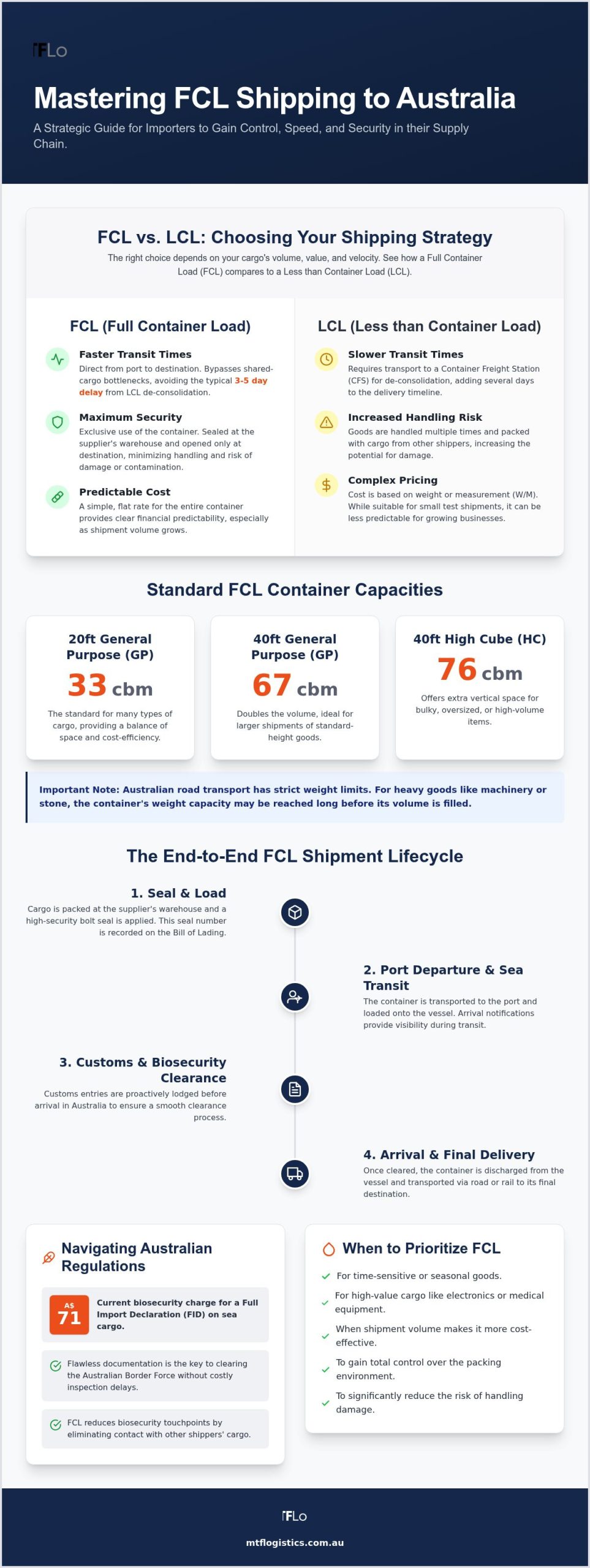
Every FCL shipment entering Australia must pass through a rigorous regulatory filter. The Australian Border Force (ABF) and the Department of Agriculture, Fisheries and Forestry (DAFF) work in tandem to monitor every container. While the ABF manages revenue and security, DAFF focuses on biosecurity risks. For FCL shipping Australia, compliance begins long before the vessel arrives. As of July 1, 2026, the biosecurity charge for a Full Import Declaration (FID) for sea cargo is A$71.00. This fee applies to goods with a customs value exceeding A$1,000. Any discrepancy in your lodgement can trigger an inspection, leading to assessment fees of A$42.00 per 15 minutes for in-office document processing.
Documentation is the foundation of a smooth clearance process. You must provide a comprehensive packing list, a commercial invoice, and a packing declaration. The commercial invoice is used to calculate the 10% Goods and Services Tax (GST) and the standard 5% customs duty. Accurate HS Code classification is the only way to ensure you’re paying the correct amount. Underpaying duties, even by accident, can lead to ABF audits and heavy fines. Conversely, overpayment wastes capital that could be better spent on growing your business.
Certain FCL containers are subject to ‘tailgate’ inspections, especially if they’re moving to rural postcodes. Biosecurity officers check the container for external pests, soil, or plant material. Timber packaging is a high-risk category. All wooden pallets must meet ISPM 15 standards and bear the official certification mark. If your supplier uses untreated timber, DAFF may order the container to a bonded warehouse for fumigation. This adds significant cost and time to your delivery. To avoid this, ensure your suppliers understand that Australian standards are among the strictest in the world.
Managing FCL shipping Australia is significantly easier when you utilize integrated Customs Clearance services. A licensed customs broker understands the nuances of the Australian Customs Tariff and can pre-clear your cargo while it’s still in transit. This proactive approach ensures your container is available for transport immediately after discharge. If your shipment is flagged for a random inspection or a ‘Customs Hold,’ your broker provides the professional representation needed to resolve the matter quickly. They serve as a reliable guide, turning a complex legal process into a manageable operational step.
MTF Logistics operates with a philosophy of end-to-end management that simplifies the inherent complexities of global trade. We act as a reliable guide through the volatile sea freight market, providing a steady hand when port congestion or shifting schedules threaten your supply chain. Our approach prioritizes transparency and control, ensuring that your FCL shipping Australia remains a predictable component of your business operations. By integrating our customs brokerage expertise with freight facilitation, we remove the friction between international transit and local delivery. This seamless transition is supported by real-time visibility tools that provide precise insights into your container’s status and clearance progress.
We recognize that different commodities require specialized care. Our team provides tailored solutions for diverse sectors, including Pharmaceuticals & Medical Logistics, where temperature integrity and speed are paramount. We also manage complex Project Logistics for heavy-lift or oversized cargo that exceeds standard container dimensions. Whether you’re moving high-volume garment shipments or sensitive medical equipment, our logistics frameworks are designed to protect your cargo and your commercial interests. This industry-literate service ensures that your specific operational requirements are met with accuracy and professionalism.
Founded in 2014, MTF Logistics brings decades of Australian market experience to every shipment. We’ve spent years cultivating strong relationships with major global shipping lines, which allows us to secure container space and competitive rates even during peak seasons. Our national coverage across all major Australian ports ensures that your logistics strategy remains consistent, regardless of where your cargo lands. You’ll work with a dedicated account manager who understands your business needs and provides proactive solutions to avoid delays. This personalized level of service is a cornerstone of our commitment to mutual success.
Obtaining an accurate quote is the first step toward a more efficient supply chain. To provide a precise estimate, we require the origin and destination ports, the container size (20ft or 40ft), and a detailed description of the goods, including weight and dimensions. We believe in transparent pricing that accounts for all foreseeable costs, helping you avoid unexpected port-side surprises. Our goal is to provide a clear financial roadmap so you can calculate your landed costs with confidence. When you’re ready to elevate your import strategy, Request a tailored FCL shipping consultation from MTF Logistics to discuss your specific requirements with our expert team.
Mastering the complexities of FCL shipping Australia transforms a standard logistical task into a powerful competitive advantage. By prioritizing exclusive container use, you gain the security and predictability needed to scale your operations with confidence. We’ve explored how a strategic approach to volume thresholds, combined with a deep understanding of current 2026 biosecurity and customs requirements, protects your bottom line from unexpected delays and fees.
Logistics shouldn’t be a source of stress. Since 2014, MTF Logistics has provided the steady hand required to manage global volatility. Our expert customs clearance and comprehensive national port coverage ensure your cargo moves seamlessly through the Australian landscape. Whether you require specialized industry logistics or general sea freight support, we’re committed to your long-term success.
Streamline your Australian imports with MTF Logistics’ expert FCL services and experience the clarity of a truly integrated supply chain. We’re ready to help you navigate the path ahead.
FCL (Full Container Load) means you book an entire container for your exclusive use, while LCL involves sharing space with others. For FCL shipping Australia, this choice impacts transit times and handling fees. FCL moves directly from the wharf; LCL requires de-consolidation at a Container Freight Station. This exclusive use reduces the risk of damage or contamination from third-party cargo. It’s a strategic move that provides greater control over your supply chain.
A standard 20ft container typically holds 10 to 11 standard Australian pallets (1165mm x 1165mm) in a single tier. If you’re using International Standard (ISO) pallets (1200mm x 1000mm), you can usually fit 10. The exact number depends on whether your cargo can be double-stacked or floor-loaded. You don’t want to overlook weight distribution, as Australian road laws are strict regarding axle mass limits once the container is on a truck.
FCL shipping costs vary significantly depending on the origin port and current seasonal demand. While ocean freight rates fluctuate, importers must always account for fixed Australian government fees. These include the A$71.00 biosecurity charge for Full Import Declarations and the 10% GST on the Value of Taxable Importation. For shipments valued over A$10,000, an Import Processing Charge of A$152 also applies. It’s best to request a specific quote for current market rates, and reviewing a comprehensive breakdown of sea freight rates Australia can help you anticipate General Rate Increases and plan your budget accordingly.
The most frequent causes of delays are incorrect HS Code classification and incomplete documentation. If your commercial invoice doesn’t match the packing list, the Australian Border Force may flag the shipment for an audit. Biosecurity concerns, such as the presence of untreated timber or soil, also trigger mandatory inspections. Lodging all paperwork before the vessel arrives is the most effective way to maintain a smooth flow through the port and avoid storage fees.
While not legally mandatory, using a licensed customs broker is highly recommended for commercial FCL shipping Australia. The Australian Customs Act is complex, and errors in duty calculation or biosecurity declarations lead to significant fines. A broker manages the Full Import Declaration and ensures compliance with the latest 2026 regulations. They act as your representative, resolving issues with the ABF or DAFF to prevent costly port-side storage or detention fees.
A Packing Declaration is a mandatory document that informs biosecurity officers about the packaging materials used inside your container. It specifically addresses whether timber, straw, or bamboo was used and if it meets ISPM 15 standards. Without a valid declaration, your container can’t be cleared. This document is vital for protecting Australia’s agricultural industry from invasive pests. You’ll need to ensure your supplier provides an accurate, signed declaration before the container is shipped.
Standard ‘free time’ at Australian terminals is usually three days from the date of discharge. This is the window you have to collect the container before demurrage fees begin. Shipping lines also provide a separate free time period for returning the empty container, often ranging from seven to ten days. It’s common to negotiate extended free time through your freight forwarder. This provides more flexibility for warehouse unloading and helps you avoid unexpected detention costs.
You can ship many types of dangerous goods in an FCL container, provided they’re declared and packed according to the IMDG Code. However, certain classes of hazardous materials require specialized containers or specific stowage positions. You must provide a Dangerous Goods Declaration and ensure the container is placarded correctly. Some Australian ports have strict limits on the classes of hazardous cargo they’ll store on-site. Don’t forget to check with your forwarder before booking hazardous freight.


 Email
Email 1300 710 683
 Tariff Lookup
 HS Code Lookup
 Newsletter Signup