
Total Shipment Visibility, Simplified
Access all your shipment details in one place - track departures and arrivals, manage documents, notifications, invoices, and more.
Access all your shipment details in one place - track departures and arrivals, manage documents, notifications, invoices, and more.

In 2026, successful container shipping to Australia has less to do with moving a physical box and everything to do with mastering a complex digital data trail. For many importers, the logistics of international trade can feel like a moving target where unpredictable transit times and shifting biosecurity requirements create constant friction. It’s a challenge that requires more than just transport; it demands a strategic approach to compliance and cost management.
We understand that the pressure to maintain a predictable supply chain is higher than ever, particularly with the Australian Border Force implementing the new Simplified Trade System. This guide is designed to help you regain control. You’ll learn how to navigate the technicalities of international container shipping with expert insights on FCL versus LCL options, current 2026 Import Processing Charges, and essential customs compliance strategies. We will examine the latest market trends, from ANL rate restorations to mandatory BMSB seasonal treatments, providing you with a clear roadmap to a more cost-effective and reliable shipping strategy.
Container shipping serves as the primary artery for Australian commerce. It facilitates the movement of the vast majority of our international trade by volume, connecting local businesses to global markets. In 2026, the local shipping landscape is defined by a shift toward digital integration through the Simplified Trade System (STS) and increasingly rigorous biosecurity protocols. The distinction between sea and air freight is often a matter of balancing urgency against cost. While air freight offers speed for high-value medical supplies or perishables, sea freight remains the most viable option for bulk cargo due to its superior capacity and lower cost per unit. Understanding the Fundamentals of Containerization helps businesses grasp the scale and complexity involved in modern trade. Professional freight forwarding has become a critical risk mitigation strategy. It protects your business from volatile market rates and unexpected port congestion that can otherwise disrupt a fragile supply chain.
Choosing between Full Container Load (FCL) and Less than Container Load (LCL) is a pivotal decision for your logistics strategy. FCL gives you a dedicated container, which offers higher security and faster transit because the unit isn’t opened until it reaches your facility. It’s the standard choice for high-volume shipments that require a sealed, secure environment. FCL also simplifies the documentation process since you’re dealing with a single bill of lading for the entire unit. Conversely, LCL allows you to pay only for the volume you use by sharing space with other importers. While LCL is cost-effective for smaller batches, it requires additional handling at Container Freight Stations for consolidation and deconsolidation. This can introduce slight delays compared to a direct FCL shipment. For Australian importers, the decision often hinges on total cubic metres (CBM). Generally, once a shipment exceeds a certain volume threshold, FCL shipping Australia becomes the more economical and secure choice for container shipping operations.
A successful shipment relies on a structured cycle that moves from the point of origin to final national delivery. Your freight forwarder acts as the reliable guide for this journey, coordinating between shipping lines, port authorities, and customs brokers to maintain a steady flow. In the current market, end-to-end visibility is essential for operational control. Key milestones include the initial booking, the “Gate In” at the port of origin, and the vessel’s departure. Once the ship enters Australian waters, the focus shifts to biosecurity and customs clearance. This methodical approach transforms a volatile global process into a predictable business outcome. Managing these stages effectively ensures that your goods arrive in full compliance with current 2026 standards, preventing costly delays at the wharf and ensuring a seamless transition to the final delivery point.
Choosing the right equipment is a fundamental step in managing your container shipping costs and ensuring the safety of your goods. The 20ft and 40ft general-purpose units remain the workhorses of global trade. For businesses transporting bulk liquids or dry cargo, you can discover SIA Flexitanks to explore specialized packaging solutions like flexitanks and FIBCs that maximize container utility. A 20ft container is typically preferred for heavy, dense materials like stone, tiles, or industrial machinery to stay within weight limits. In contrast, the 40ft unit provides the necessary volume for lighter consumer goods. For those moving voluminous items such as furniture or large electronics, High Cube (HC) containers offer an extra foot of vertical space. This height increase can significantly improve the cost-efficiency of a shipment by allowing for more pallets per unit without increasing the container’s footprint on the vessel.
Specific industries often require tailored solutions to maintain product quality. For example, the garment industry frequently utilises “Garments on Hangers” (GOH) containers. These specialised units feature internal string or bar systems that allow clothes to be shipped directly from the factory to the retail floor without folding. This reduces packing time and eliminates the need for professional pressing upon arrival. The Shipping Australia Industry Body provides a broader perspective on how these equipment standards are integrated into the national port infrastructure to support diverse trade requirements.
Cold chain integrity is non-negotiable for perishable goods and pharmaceuticals. Refrigerated containers, commonly known as reefers, use integrated cooling units to maintain precise temperatures throughout the journey. This technology is vital for medical logistics where even a minor deviation can compromise an entire shipment. Maintaining this integrity requires constant monitoring of temperature and humidity levels during long-haul sea freight. We prioritise a methodical approach to reefer management, ensuring that the cold chain remains unbroken from the point of origin to the final Australian delivery site.
Not all cargo fits within the six walls of a standard box. Project logistics often requires flat racks or open-top containers to accommodate heavy-lift infrastructure or oversized machinery. Open tops allow for loading from above via crane, which is essential for tall equipment. Flat racks, which lack side walls and a roof, are used for “out-of-gauge” (OOG) cargo that exceeds standard dimensions. Securing this cargo requires strict safety protocols and specialised lashing techniques to prevent movement during transit. If you’re unsure which equipment suits your specific cargo dimensions, consulting with a specialist in Sea Freight Services can help clarify the most secure and cost-effective path forward.
Customs clearance is where the physical journey of container shipping meets the rigorous demands of regulatory compliance. It’s the most frequent point of supply chain failure because errors in documentation or classification lead to immediate wharf storage fees and significant delays. A licensed customs broker acts as your representative to the Australian Border Force, ensuring that every declaration is accurate and submitted within required timeframes. Our expertise in export documentation services ensures that all paperwork, from bills of lading to certificates of origin, is prepared to facilitate smooth international transit. Beyond simple entry, managing biosecurity remains a top priority. In 2026, the Brown Marmorated Stink Bug (BMSB) treatment season continues to run from September 1 to April 30. During this period, mandatory treatment is required for target high-risk goods from specific countries. Failure to comply doesn’t just mean a delay; it can result in the cargo being directed for export back to the origin at your expense.
Accurate Harmonized System (HS) code classification is the foundation of a cost-effective logistics strategy. Misclassifying goods leads to overpaying duty or facing penalties for underpayment. While the standard customs duty rate is typically 5% of the Free On Board (FOB) value, many Australian importers qualify for reduced rates through various Free Trade Agreements. We focus on precision to ensure you remain fully compliant while identifying every available cost-saving measure. A professional review of your tariff classifications often uncovers opportunities for duty drawbacks or concessions that directly improve your bottom line. Precision in this area prevents the type of regulatory friction that stalls international transit and impacts your profitability.
Shipping hazardous materials requires a heightened level of oversight and specialized documentation. Whether you’re moving industrial chemicals or lithium batteries, strict adherence to the International Maritime Dangerous Goods (IMDG) Code is mandatory. This involves specific labelling and packaging standards that must be met before the container is loaded. Our approach to dangerous goods handling involves a thorough audit of safety data sheets (SDS) and coordinating with carriers who hold the necessary certifications. Managing high-risk categories requires a steady hand to ensure that your strategy remains safe and legal. We integrate these complex requirements into a seamless workflow, providing the end-to-end visibility needed to track sensitive cargo throughout the entire sea freight journey. This methodical process ensures that even the most restricted cargo reaches its destination without compromising safety or compliance.
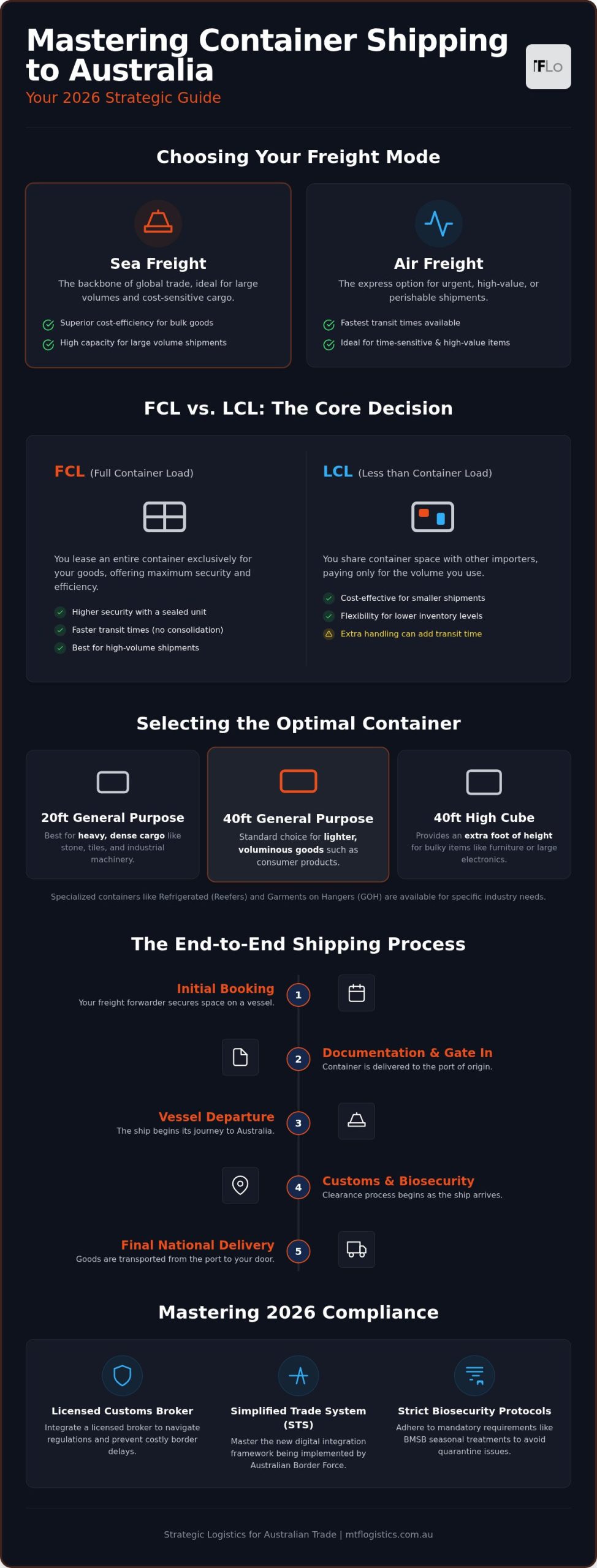
Success in container shipping is built on a foundation of proactive planning and precise timing. The journey begins long before the vessel leaves the port, starting with a strategic booking that accounts for current market conditions. In 2026, importers must remain vigilant regarding port congestion at major hubs like Shanghai and Ningbo, which continues to pose a risk to schedule reliability. Managing these transit times requires a buffer in your supply chain to absorb potential delays. Additionally, cargo insurance remains an essential component of international trade. While modern vessels are highly secure, the inherent risks of maritime transport mean that protecting your investment with comprehensive cover is a pragmatic business decision. It provides the financial security needed to manage unforeseen incidents without disrupting your long-term operations. With ocean freight spot rates reaching a 22-month high in mid-2026, partnering with specialists who offer reliable sea freight services for Australian business has become an essential strategy for managing unpredictable rate environments.
The documentation phase is where the technical accuracy of your shipment is established. You’ll need to gather several critical documents to meet Australian standards, including the commercial invoice, packing list, and the bill of lading. These documents must align perfectly to prevent discrepancies that the Australian Border Force might flag under the Simplified Trade System. Coordinating closely with your overseas suppliers is vital during this stage. You must ensure they understand the specific loading requirements and deadlines for your chosen container type. Clear communication at the origin ensures that the container shipping process starts without a hitch, setting the stage for a smooth transit to Australian shores.
Once your container arrives at an Australian port, the focus shifts to efficient landside logistics. The process involves coordinating wharf transport to move the unit from the terminal to your warehouse or a deconsolidation point. This requires selecting the right vehicle, such as a sideloader for ground-level delivery or a standard trailer for loading docks. A critical but often overlooked step is the management of empty container returns. You must de-hire the equipment back to the designated empty container park within the carrier’s “free time” period to avoid expensive detention fees. We manage these final-mile details with precision, ensuring that every milestone is met to maintain your supply chain’s cost-effectiveness. For expert assistance in managing these complex movements, you can rely on our comprehensive Sea Freight Services to provide end-to-end support.
Managing international trade involves more than just booking space on a vessel. It requires a partner that offers a high level of transparency and industry-literate expertise to navigate the complexities of global trade. Established in 1994, MTF Logistics has spent over 30 years refining our approach to container shipping, providing a reassuring voice in an often unpredictable industry. We act as a single point of contact for all your national logistics needs, which simplifies the communication flow and ensures that technical details aren’t lost between multiple providers. Whether you operate in the industrial, retail, or pharmaceutical sectors, our team tailors every solution to meet the specific compliance and handling requirements of your cargo.
Our team understands the unique pressures of the garment industry, the strict temperature requirements of pharmaceuticals, and the heavy-lift demands of project logistics. This specialized knowledge allows us to anticipate potential hurdles before they impact your delivery schedule. By integrating modern technical tools with traditional service values, we ensure that every shipment follows a methodical and logical path from origin to destination. This approach alleviates the stress of international trade by projecting an image of organized expertise and reliability across every stage of the journey.
Our service model provides seamless management across all major Australian trade gateways, including Sydney, Melbourne, Brisbane, Adelaide, and Fremantle. This national coverage ensures that your business can grow without being limited by regional logistics constraints. We support this scalability by leveraging a global network of trusted independent forwarders, giving you the reach of a multinational entity while maintaining the personalized service of a dedicated local partner. This integrated approach allows us to facilitate complex movements, such as dangerous goods or perishable logistics, with the same level of accuracy and visibility across every port of entry. We focus on providing end-to-end support that grows alongside your business requirements.
In Western Australia, the efficiency of the Fremantle gateway relies on a workforce of highly trained professionals; for those entering the logistics sector, Right Way Transport Training offers the essential heavy vehicle qualifications needed to support the national supply chain.
We believe that effective logistics management moves beyond transactional shipping. It’s about building a strategic partnership that prioritizes the long-term health of your supply chain. MTF Logistics simplifies complex global systems by acting as an authoritative expert who handles the granular details of customs clearance and export documentation on your behalf. This allows you to focus on your core business operations with calm confidence, knowing that your sea freight strategy is managed by seasoned professionals. We don’t just move boxes; we resolve the logistical challenges that stand in the way of your international success. Request a consultation for your national sea freight requirements to see how we can streamline your container shipping operations and provide the stability your business deserves.
Effective container shipping in the 2026 market demands a combination of technical precision and strategic foresight. By selecting the optimal equipment for your specific cargo and maintaining a proactive approach to Australian customs compliance, you can transform a volatile global process into a predictable business asset. Managing biosecurity risks and documentation requirements doesn’t have to be a source of supply chain friction when you have the right systems in place.
As an industry veteran established in 1994, MTF Logistics provides the steady hand needed to navigate these complexities. Our licensed customs brokerage expertise ensures that your goods meet every regulatory standard, while our full national coverage across all major Australian ports guarantees seamless end-to-end management. We invite you to Partner with MTF Logistics for Reliable Sea Freight Services and experience the clarity that comes with professional logistics management. We look forward to supporting your business growth and helping you achieve a more cost-effective, resilient supply chain.
Market rates for 20ft containers vary based on the trade lane and seasonal demand. As of August 2026, the market rate for a TEU from Shanghai to basic Australian ports was approximately A$3,250. Effective mid-August 2026, carriers implemented rate restorations of roughly A$750 per 20ft unit. These figures represent ocean freight only and exclude local wharf charges, biosecurity fees, and final-mile transport costs.
Full Container Load (FCL) gives you exclusive use of a 20ft or 40ft unit, while Less than Container Load (LCL) involves sharing space with other importers. FCL is generally more secure and faster because the unit remains sealed from origin to destination. For a detailed breakdown of how to conduct a rigorous cost-benefit analysis between these two options, our comprehensive guide to FCL shipping in Australia covers the full logistics process and 2026 compliance requirements. LCL is a cost-effective alternative for smaller volumes, though it requires extra time for consolidation and deconsolidation at local freight stations before final delivery.
Transit times depend on the specific port of origin and the chosen shipping line. Shipments from major Asian hubs like Shanghai usually arrive at Australian ports within 14 to 22 days. In contrast, sea freight from Europe typically takes between 40 and 55 days, depending on whether the vessel transits via the Suez Canal or the Cape of Good Hope. Port congestion and seasonal peaks can add several days to these estimates.
You must provide several key documents to satisfy Australian Border Force and biosecurity requirements. These include the commercial invoice, a detailed packing list, and the bill of lading. If you’re importing from a country with a Free Trade Agreement, a Certificate of Origin is necessary to claim duty concessions. Additionally, certain goods require packing declarations or treatment certificates, particularly during the Brown Marmorated Stink Bug (BMSB) season.
Yes, many dangerous goods can be shipped in standard containers provided they meet strict IMDG Code packaging and labelling requirements. Some hazardous materials require specialised equipment or specific segregation from other cargo on the vessel. You must provide a valid Safety Data Sheet (SDS) and a Dangerous Goods Declaration before booking. This ensures the carrier and port authorities can manage the shipment safely throughout the international transit process.
Several global influences drive rate fluctuations in the 2026 container shipping market. Key factors include marine fuel prices, geopolitical stability in regions like the Red Sea, and carrier capacity management through blank sailings. Local demand also plays a role; rates often increase during early peak seasons as retailers stock up for the end-of-year period. Compliance with new digital reporting standards under the Simplified Trade System can also impact overall logistics costs.
While not legally mandatory, engaging a licensed customs broker is highly recommended for managing complex international shipments. A broker ensures your goods are classified correctly under the Harmonized System (HS) and that all declarations comply with current 2026 regulations. This expertise prevents costly delays at the wharf and protects your business from penalties associated with misreporting. They act as a reliable guide through the technicalities of biosecurity and border clearance.
Import duty is typically calculated at 5% of the Free On Board (FOB) value of the goods. Goods and Services Tax (GST) is 10% of the Value of the Taxable Importation (VoTI), which includes the customs value, the duty, and the cost of international transport and insurance. For 2026, consignments valued at A$10,000 or more also incur a standard Import Processing Charge (IPC) of A$152 to cover administrative border costs.


 Email
Email 13OO 71O 683
 Tariff Lookup
 HS Code Lookup
 Newsletter Signup