
Total Shipment Visibility, Simplified
Access all your shipment details in one place - track departures and arrivals, manage documents, notifications, invoices, and more.
Access all your shipment details in one place - track departures and arrivals, manage documents, notifications, invoices, and more.

Why are you still paying a 5% import duty on goods that aren’t even manufactured in Australia? It’s a common frustration for importers who feel trapped by complex Australian Border Force paperwork and the looming threat of local manufacturers blocking their applications. You likely already know that these costs eat directly into your margins; however, you might not realise that approximately 80% of applications for a new concession are successfully approved.
This guide will show you exactly how to eliminate that 5% duty by mastering the tariff concession order Australia system. We’ll move beyond the jargon to provide a reliable, step-by-step framework for 2026. You’ll learn how to navigate the 28 day initial screening process, handle the specific requirements of Form B443, and ensure your goods meet the strict “substitutable goods” criteria. We’ll also explore how to leverage the 15,000 existing orders already in place to secure immediate savings and maintain long-term customs compliance for your business.
A tariff concession order Australia is a legal instrument granted by the Australian Border Force that facilitates the duty-free importation of specific goods. Under Part XVA of the Customs Act 1901, these orders are designed to assist local businesses by removing the standard 5% general duty rate when no substitutable goods are manufactured within the country. It’s essentially a mechanism that ensures Australian companies aren’t penalised for importing essential items that aren’t available from domestic producers. In the 2026 trade environment, these orders remain a cornerstone of cost-effective international procurement.
While many importers rely on Free Trade Agreements (FTAs) to reduce costs, a TCO operates on a different logic. An FTA is based on the country of origin, requiring specific certificates and proof of manufacture in a partner nation. In contrast, a TCO is based entirely on the description and use of the goods themselves. If a TCO exists for your specific product, you can often claim duty-free entry regardless of which country the goods were manufactured in, provided they meet the precise legal description of the order. This makes the tariff concession order Australia a more flexible tool for businesses sourcing from multiple global locations.
The primary benefit of a TCO is a direct and measurable reduction in the landed cost of your products. For businesses importing high volumes or high-value machinery, a 5% saving is a significant financial advantage that improves your cash flow and price competitiveness. Because a TCO remains in place until it’s revoked, it provides a stable foundation for long-term procurement strategies. You can forecast your margins with greater certainty, knowing that your recurring shipments are protected from unnecessary duty costs that your competitors might still be paying.
The ABF manages the Tariff Concession System with a focus on transparency and strict compliance. Every application and decision is published in the Commonwealth of Australia Tariff Concessions Gazette, which is released every Wednesday. This public record allows local manufacturers to monitor applications and object if they believe they produce a substitutable product. It’s a transparent system that balances the needs of importers with the protection of local industry.
Achieving success with the ABF requires meticulous attention to detail. Before you apply, you must ensure your customs tariff classification Australia is 100% accurate. If your goods are classified incorrectly, any TCO you obtain will be legally invalid; this can lead to back-dated duty payments and penalties. The ABF doesn’t just grant these orders; they monitor their use to ensure the integrity of the Australian trade border remains intact.
Determining if your goods qualify for a tariff concession order Australia requires more than a simple product search. The system hinges on the “Core Criteria,” which mandates that on the day the application is lodged, no substitutable goods are produced in Australia in the ordinary course of business. This isn’t just about whether an identical product exists; it’s about whether a local manufacturer makes something that can serve the same function. If the Australian Border Force (ABF) identifies a local producer that can meet the functional requirements of your import, your application will likely be rejected.
Certain goods are strictly excluded from the TCO system regardless of local manufacturing status. These are listed under Schedule 4 of the Customs Tariff Act and include items such as foodstuffs, clothing, and certain types of footwear. If your products fall into these categories, a TCO isn’t a viable path for duty savings. For all other eligible goods, the challenge lies in proving the absence of local production through a rigorous industry search and technical documentation.
To be classified as a local manufacturer, a business must perform at least one “substantial process” in the manufacture of the goods in Australia. The ABF typically applies a 25% value-add rule, meaning at least 25% of the factory cost of the goods must be attributed to Australian labour, materials, and overheads. Identifying these entities early is vital because they have the right to object to your application once it’s published in the Gazette. A proactive search of industry directories and trade associations can help you anticipate these hurdles before you commit to the application process.
The ABF defines “substitutable goods” as those produced in Australia that are “identical to, or have a use that is capable of being substituted for, the imported goods.” This is where many applications fail. Your import doesn’t have to be unique in its design or appearance. Instead, you must demonstrate that its specific functional application cannot be replicated by local products. Building a technical case requires detailed specifications to show why a local alternative isn’t a true substitute in a commercial or industrial context. Managing these technical distinctions is complex, which is why many businesses partner with a specialised customs broker to conduct the necessary industry research before lodging an application for a tariff concession order Australia.
Before you commit to the formal application process, your first step should always be a thorough search of existing concessions. There are currently approximately 15,000 active orders in the system, and at least 50 new ones are created every month. If a tariff concession order Australia already exists that matches your goods, you can apply it to your shipments immediately. This approach bypasses the 50 to 150 day waiting period required for a new application and eliminates the need for complex industry research. It’s a pragmatic way to secure duty savings without the administrative burden of a fresh lodgement.
The Australian Border Force (ABF) publishes the Commonwealth of Australia Tariff Concessions Gazette every Wednesday. This document serves as the official record for all proposed, granted, and revoked concessions. Navigating this database requires a methodical approach; you aren’t just looking for a product name, but a specific legal description that mirrors your import exactly. Recent publications, such as Gazette TC 26/16 from May 2026, demonstrate the high volume of activity within the system, making regular monitoring a vital task for any serious importer.
Successful research begins with your product’s HS code. Start by searching for concessions within the first four to six digits of your classification to narrow the field. Once you’ve identified potential matches, use technical keyword strategies rather than generic terms. For example, searching for “industrial centrifugal pump” will yield more accurate results than simply “pump.” You must also verify the current status of any TCO you find. The ABF frequently reviews and revokes legacy orders that are no longer utilised or where local manufacturing has commenced, so ensuring the concession is still active is a critical step.
Precision in the TCO system is binary; your goods either match the description perfectly or they don’t. Using a concession that “almost” fits is a significant compliance risk. If a tariff concession order Australia specifies a particular weight, material, or power output, and your goods vary even slightly, the ABF will consider the claim invalid. This can result in back-dated duty payments, interest charges, and substantial penalties. If you find an order that is close but not exact, it’s often safer to apply for a new, specific TCO rather than risking an audit. Consulting a customs broker to verify the applicability of an existing order ensures your duty savings don’t come at the cost of long-term compliance.
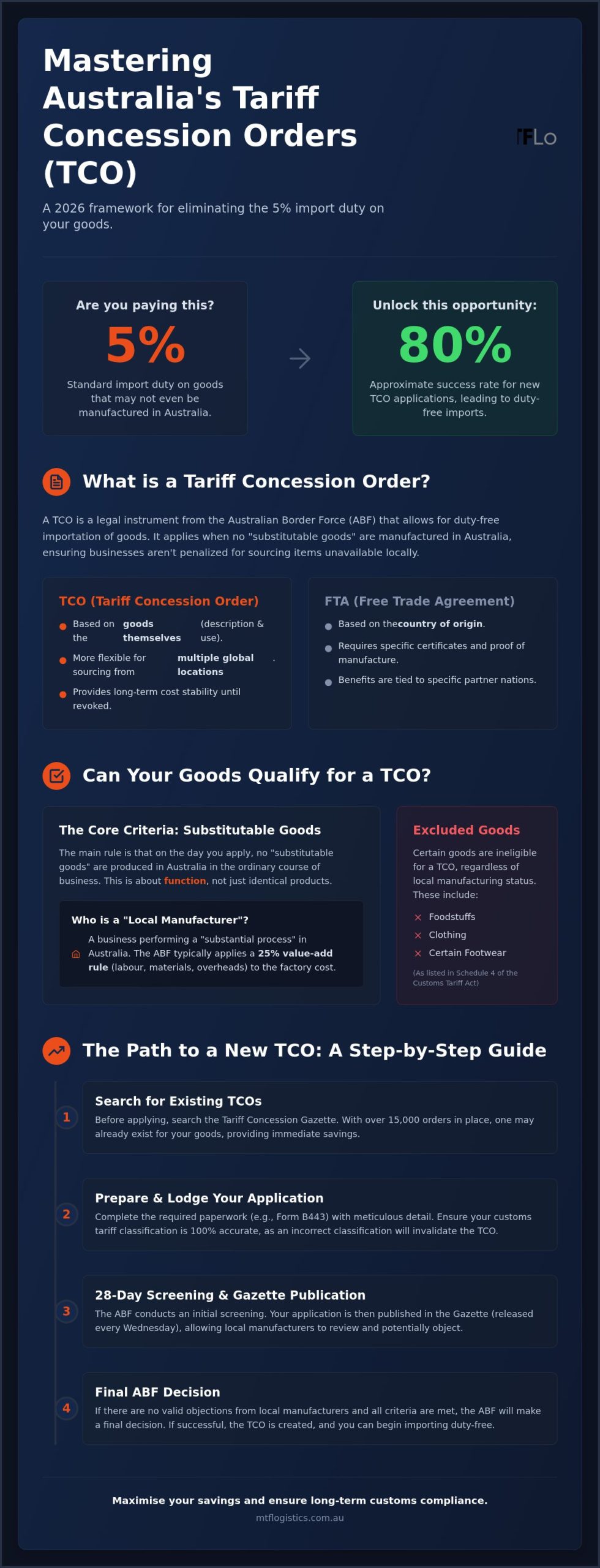
Applying for a new tariff concession order Australia is a methodical process that requires a high degree of technical accuracy. It isn’t merely a matter of filling out a form; it’s about building a legal case that survives public scrutiny. The process begins with confirming your precise HS code classification Australia. If the base tariff code is incorrect, the entire application is flawed from the outset. Once the classification is locked in, you must conduct a thorough local industry search. This involves contacting potential manufacturers and trade bodies to document that no substitutable goods are produced domestically.
The next stage involves drafting the TCO wording. You need a description that is broad enough to cover your product variations but specific enough to distinguish your goods from “almost” similar local products. Following this, you lodge Form B443 with the Australian Border Force. After lodgement, the ABF conducts an initial 28 day screening process to accept or reject the application for further consideration. If accepted, it moves to the Gazette notification period, where it remains open for public comment for at least 50 days. This transparency ensures the system remains fair for both importers and local industry.
If a local company believes they produce a substitutable product, they can lodge a formal objection. This shifts the application into a contested phase, extending the final decision timeframe to between 50 and 150 days. During this period, you must provide technical evidence of “non-substitution.” This often involves providing engineering drawings or performance data to prove that the local product cannot perform the specific function required by your business. Precision in these technical arguments is often the difference between approval and rejection.
One of the most valuable aspects of the system is the ability to recover costs. If your tariff concession order Australia is granted, it is backdated to the date the application was first received by the ABF. This allows you to claim a refund on the 5% duty paid for any shipments that arrived while the application was being processed. To facilitate this, ensure your freight forwarder is prepared to lodge “Duty Recovery” claims as soon as the TCO number is issued. Managing these timelines effectively is critical for capitalising on your duty savings. For assistance with complex applications or to secure professional customs clearance support, consult with an expert broker early in the process.
While the financial benefits of a tariff concession order Australia are clear, the administrative path to obtaining one is fraught with technical risks. DIY applications often fail because they lack the precise legal phrasing required to survive an Australian Border Force (ABF) review or a local manufacturer’s objection. A single descriptive error in your application can lead to a rejection that prevents you from reapplying for the same goods for a significant period. Engaging a professional broker provides a steady hand to manage all ABF correspondence, ensuring that your technical arguments are presented with clarity and authority.
Integrating these concessions into your broader logistics management Australia is essential for long-term efficiency. It isn’t enough to simply obtain an order; you must ensure it remains a functional part of your supply chain operations. MTF Logistics specialises in simplifying these complex global trade processes, transforming customs compliance from a hurdle into a strategic financial asset that directly improves your bottom line.
Securing a TCO is only the beginning of the compliance journey. The ABF actively monitors the system, revoking legacy orders that no longer meet eligibility requirements or haven’t been utilised. We provide ongoing monitoring to alert you if a relevant concession is under review or slated for revocation. Additionally, we ensure your commercial invoices and export documentation align perfectly with your TCO wording. This consistency is vital for passing customs audits and avoiding the back-dated duty penalties mentioned earlier in this guide. We also offer strategic advice on future product lines, helping you identify potential duty exemptions before you commit to new international procurement contracts.
Since 2014, MTF Logistics has provided national businesses with expert customs clearance and freight forwarding services. Our team consists of industry-literate professionals who understand the granular details of tariff classification and the nuances of the Customs Act. We prioritise transparent communication and provide data-driven insights that give you full visibility over your landed costs. This methodical approach ensures your shipments move through the border without unnecessary delays or financial surprises. By partnering with us, you gain a reliable guide dedicated to making the most difficult customs tasks feel effortless for your business.
Contact MTF Logistics for a Customs Audit Today to see how we can optimise your duty savings and strengthen your trade compliance.
Mastering the tariff concession order Australia system is more than a compliance exercise; it’s a strategic move to lower your landed costs and improve market competitiveness. By ensuring precise tariff classification and conducting rigorous local industry research, you can successfully eliminate the standard 5% import duty on eligible goods. Whether you’re leveraging one of the 15,000 existing orders or lodging a new application, the financial impact on your bottom line is significant and measurable. Duty savings are within reach.
Professional oversight ensures your applications are technically sound and resilient against manufacturer objections. Precision matters. MTF Logistics has been Australian owned and operated since 2014, providing national end-to-end logistics support and a specialised trade compliance team. Our experts act as a steady hand, managing the complexities of Australian Border Force requirements so you can focus on growing your business with confidence.
Streamline your customs duty with an expert TCO strategy from MTF Logistics. Taking control of your import costs today builds a more resilient and profitable supply chain for the years ahead.
A tariff concession order Australia typically saves your business the full 5% general duty rate otherwise applied to imported goods. By removing this tax, you directly reduce the landed cost of your products, which improves your profit margins or allows for more competitive retail pricing. These savings apply to every shipment of the specified goods for as long as the order remains active in the customs system.
The timeline involves two distinct phases managed by the Australian Border Force. First, there is a 28 day internal screening period to accept or reject the application for further processing. Once accepted and published in the Gazette, a final decision is made between 50 and 150 days later. If a local manufacturer objects, the process typically trends toward the longer end of that spectrum as technical evidence is reviewed.
You can lodge an application at any time; however, the duty-free status only applies to goods entered for home consumption on or after the date the application was received by the ABF. If your goods have already arrived and duty was paid, you can’t retrospectively apply a new TCO to that specific shipment unless the application was already in the system at the time of arrival.
The Core Criteria requires proving that no substitutable goods are produced in Australia in the ordinary course of business at the time of lodgement. This means a local manufacturer must not produce an identical product or one that serves a similar functional use. You must document a thorough industry search to demonstrate that your specific import can’t be sourced from a domestic manufacturer meeting the 25% value-add rule.
No, TCOs aren’t permanent and remain subject to ongoing scrutiny by the Australian Border Force. The ABF regularly reviews and revokes legacy orders that are no longer being utilised or where a local manufacturing capability has since been established. It’s vital to monitor the Gazette for revocation notices to ensure your shipments remain compliant and that you don’t inadvertently claim an expired or amended concession.
If an objection is lodged, the ABF will investigate the manufacturer’s claim that they produce a substitutable good. You’ll need to provide technical specifications, engineering drawings, or performance data to prove that the local alternative isn’t a functional substitute for your import. This process extends the decision timeframe and requires a robust technical argument to ensure your application for a tariff concession order Australia is still approved.
While you can technically lodge Form B443 yourself, engaging a specialised customs broker is highly recommended due to the technical complexity involved. Brokers ensure your HS code classification is accurate and draft the TCO wording to be legally resilient. Professional management helps avoid common errors that lead to rejection or future audits, providing a reliable path to securing long-term duty savings for your business shipments.
The Commonwealth of Australia Tariff Concessions Gazette is published every Wednesday on the official Australian Border Force website. This public document lists all new applications, granted orders, and revocations. Monitoring these weekly updates is essential for identifying existing exemptions that may apply to your goods, saving you the time and expense of lodging a completely new application for your imported products.


 Email
Email 1300 710 683
 Tariff Lookup
 HS Code Lookup
 Newsletter Signup