
Total Shipment Visibility, Simplified
Access all your shipment details in one place - track departures and arrivals, manage documents, notifications, invoices, and more.
Access all your shipment details in one place - track departures and arrivals, manage documents, notifications, invoices, and more.

Accepting a CIF quote from your overseas supplier might seem like the simplest way to manage your freight, but it is often the most expensive mistake an Australian business can make. Relying on someone else to dictate your shipping terms frequently leads to unexpected terminal handling charges and confusion over who is responsible for mandatory DAFF biosecurity inspections. This is why having incoterms explained for Australian importers is no longer just a logistical necessity; it’s a vital financial strategy for 2026.
Most importers feel the pressure of rising costs, especially with significant wharfage charges, often reaching A$186.62 per TEU, and updated biosecurity fees adding up quickly. It’s frustrating to realize that a lack of clarity in your shipping contract is directly eroding your bottom line. At MTF Logistics, we understand that managing global supply chains is complex, and we provide the stability and clear, actionable data you need.
This guide will help you master the 11 Incoterms 2020 rules to control your shipping risks, accurately calculate Australian customs duty, and protect your import margins. We’ll provide a clear framework for choosing the right term, ensuring predictable landed costs and seamless customs clearance without the usual delays.
At its core, Incoterms function as a universal language for global trade. They are a set of eleven three-letter codes that define exactly where the risk and cost transfer from a seller to a buyer. Having incoterms explained for Australian importers is not just a logistical exercise; it’s a fundamental step in protecting your profit margins. In 2026, the Incoterms 2020 update remains the definitive gold standard for Australian businesses. It provides the granular detail required for modern containerised transport and clear instructions for customs valuation at the Australian border.
One of the most critical distinctions you must understand is the difference between the ‘transfer of risk’ and the ‘transfer of ownership’. While an Incoterm tells you who’s responsible if a container is lost at sea, it doesn’t dictate who actually owns the goods at that moment. These terms also serve as the bedrock of your international commercial invoice. The Australian Border Force (ABF) relies on these terms to determine the ‘Customs Value’ of your cargo, which directly influences the amount of duty and GST you’ll pay upon arrival.
The International Chamber of Commerce manages these rules to ensure consistency across different legal systems. By using standardised terms, you prevent expensive legal disputes in international courts that could otherwise arise from simple misunderstandings. It’s essential to specify ‘Incoterms 2020’ explicitly in your purchase orders and contracts. This precision removes ambiguity and facilitates smoother communication with your customs broker. When your broker knows exactly which term you’re using, they can accurately classify your shipment and ensure you aren’t overcharged for services your supplier should have covered.
It’s a mistake to assume that an Incoterm replaces a full sales contract. These terms are specialised tools with a narrow focus: the delivery of goods. They don’t cover the transfer of title, payment terms, or what happens in the event of a breach of contract. You still need a comprehensive sales agreement to handle those commercial realities. Incoterms explained for Australian importers should always be viewed in the context of your broader risk management strategy, particularly regarding marine insurance. For example, under certain terms like CIF, the seller is only required to provide a minimum level of insurance. If your cargo requires specialised handling or higher coverage, you’ll need to negotiate those details separately within your contract to ensure your investment is fully protected during the long journey to Australian shores.
The 11 rules are divided into two distinct groups based on the method of delivery. This structure is essential when having incoterms explained for Australian importers, as it narrows your choices based on whether you are using air, sea, or multimodal transport. At one extreme, EXW (Ex Works) places maximum risk on you. You’re responsible for everything from the moment the goods leave the supplier’s factory. At the other end, DDP (Delivered Duty Paid) puts the burden on the seller. While DDP seems convenient, it often creates significant compliance risks regarding Australian GST recovery and duty valuation.
For modern supply chains, terms like FCA, CPT, and CIP offer the most flexibility. These allow for a clear handover point to a carrier, which is often more practical than traditional port-to-port terms. Selecting the wrong code can lead to unexpected expenses. Consulting with a specialist in customs clearance ensures your chosen term aligns with Australian regulatory requirements and protects your bottom line.
These seven rules apply to any combination of transport. DAP (Delivered at Place) is a frequent choice for e-commerce businesses because the seller handles the majority of the transit. DPU (Delivered at Place Unloaded) is unique because it requires the seller to unload the goods at the destination. This can be complex at Australian warehouses without prior coordination. If you use CIP (Carriage and Insurance Paid to), be aware that the 2020 update increased the default insurance requirement to a higher level of coverage. You can refer to official guidance on Incoterms for a deeper look at how these responsibilities shift between parties.
These four rules are strictly for port-to-port shipments. FOB (Free on Board) remains a staple for Australian bulk and container imports. It gives you control over the freight and local costs once the goods are on the vessel. In contrast, CIF (Cost, Insurance, and Freight) involves the supplier arranging insurance. This is often insufficient for Australian standards, potentially leaving you underinsured. CFR (Cost and Freight) and FAS (Free Alongside Ship) are more specialised. FAS is typically reserved for heavy machinery or bulk cargo that cannot be containerised. Understanding these nuances is a key part of incoterms explained for Australian importers, as it prevents the “double counting” of fees during the customs valuation process.
For businesses importing specialized industrial hardware rather than bulk cargo, choosing the right term is essential for protecting margins; you can learn more about TME Systems Pty Ltd and their range of rotary electrical connectors and slip rings for Australian industry.
The choice between FOB and CIF is more than a logistical preference; it’s a critical financial decision. The Australian Border Force (ABF) assesses customs duty based on the “Free on Board” (FOB) value of goods. This means that any international sea freight or insurance costs included in a CIF price must be deducted before duty is calculated. If your documentation doesn’t clearly separate these costs, you risk paying duty on the freight itself. This “double counting” is a common trap when incoterms explained for Australian importers are misunderstood by the parties involved.
The Incoterms® 2020 rules provide the necessary framework, but the application at the Australian border requires expert precision. When you import on CIF terms, the invoice total includes the cost of the goods, insurance, and freight to the destination port. However, Australian law mandates that duty is only payable on the value of the goods at the port of export. Without a broker to strip back these additional costs, your business pays more than necessary. Engaging a specialist for customs clearance Australia ensures these adjustments are made accurately on every declaration.
Importers must distinguish between the Customs Value (CVAL) and the Value of Taxable Import (VoTI). The CVAL is the figure used to calculate duty. It represents the price paid for the goods plus any costs incurred to get them to the port of export, such as inland transport in the origin country. Crucially, duty is only paid on the price of the goods plus costs to the port of export. If you are using a CIF invoice, your broker must manually subtract the international freight and insurance components to arrive at the correct CVAL. This process prevents the inflated duty payments that often plague businesses that lack visibility over their shipping terms.
While duty is calculated on the CVAL, the Goods and Services Tax (GST) uses a broader base. GST is 10% of the Value of Taxable Import (VoTI). The formula for VoTI is the CVAL plus the duty amount, plus the actual cost of international freight and insurance. This connection is where your total landed cost is established. If your terms are recorded incorrectly, the entire tax chain is affected. Overestimating your CVAL leads to higher duty, which then compounds into a higher GST payment. This error doesn’t just hurt your cash flow; it permanently reduces your profit margins. Having incoterms explained for Australian importers in this context is vital for ensuring you aren’t overpaying tax at the border.
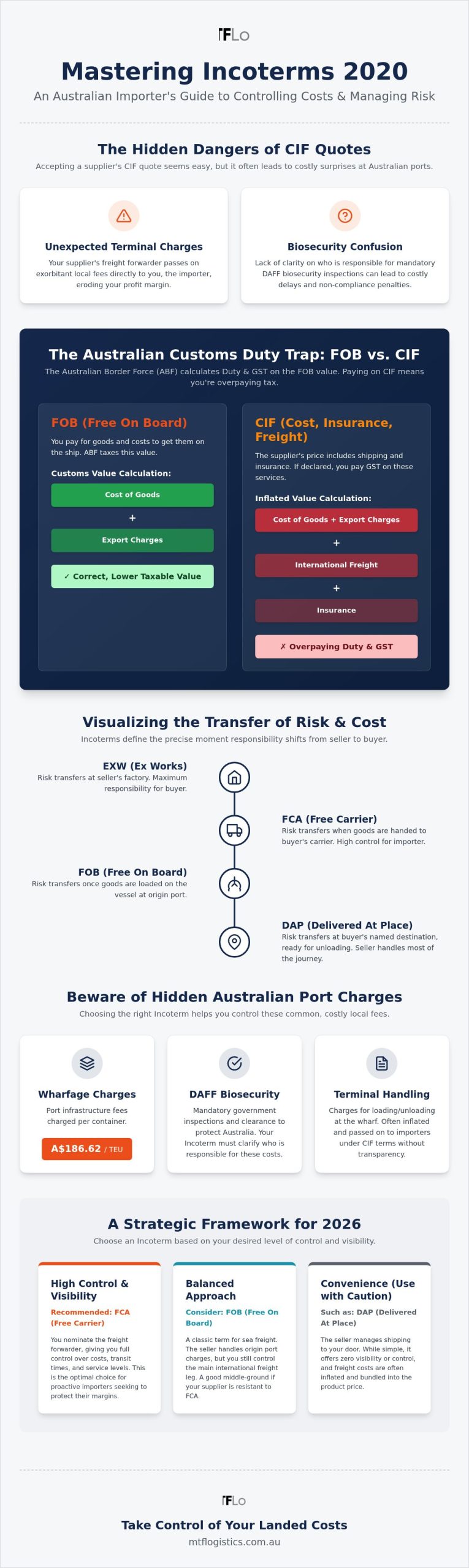
Many businesses believe that choosing a “delivered” term like DAP or DDP removes all local risk. This is a misconception. In the Australian context, regulatory bodies like the Department of Agriculture, Fisheries and Forestry (DAFF) operate independently of your shipping contract. Having incoterms explained for Australian importers means recognizing that while your supplier pays for the transport, you still carry the burden of compliance. Surprise costs often arise from biosecurity inspections or unexpected terminal handling charges (THC) at the wharf. Choosing sea freight services with transparent terms is the only way to prevent these cost blowouts.
Biosecurity is non-negotiable. As of 1 July 2026, the biosecurity cost recovery charge for a Full Import Declaration (FID) is A$71.00 for sea cargo and A$48.00 for air cargo. Even under DDP terms, the importer of record is ultimately responsible for biosecurity compliance. If DAFF orders a fumigation or a tailgate inspection, the associated costs and delays usually fall on the Australian party. You must account for these variables in your cost model to ensure your margins remain intact. It’s a pragmatic reality of the Australian market that no international trade term can fully outsource.
The debate over who pays the THC often causes friction between suppliers and importers. If you import on CFR or CIF terms, the supplier pays the freight to the port; however, the local handling fees are often billed to you upon arrival. This is particularly complex for Less than Container Load (LCL) shipments. In these cases, handling terms can vary significantly between different forwarders and consolidators. You also need to manage the risk of demurrage and detention. DAP terms don’t protect you from port storage fees if a biosecurity hold delays the “last mile” delivery. A steady hand is required to coordinate these moving parts. To secure your supply chain against these hidden variables, you can speak with our logistics specialists to refine your 2026 strategy. Understanding the nuances of incoterms explained for Australian importers ensures that you aren’t left holding the bill for costs that should have been managed at the point of origin.
Selecting a trade term is a strategic balance between operational control and administrative convenience. For many businesses, having incoterms explained for Australian importers reveals that the “easiest” option is rarely the most cost-effective. Experienced importers typically lean towards FCA or FOB. These terms allow you to nominate your own freight forwarder, providing direct visibility over the cargo’s progress and the ability to manage local Australian port charges without supplier markups. It’s about maintaining a steady hand over your supply chain costs.
While SMEs may be tempted by the hands-off nature of supplier-arranged shipping, the lack of transparency often leads to the “double counting” of fees discussed earlier. Managing your own logistics might require more initial coordination, but the long-term stability it provides to your margins is significant. By choosing a term that grants you control, you eliminate the surprise invoices that often arrive when a supplier dictates the local handling process.
The mode of transport and the nature of your cargo should dictate your choice. FCA is particularly effective for international air freight. It allows the seller to deliver goods to your chosen carrier’s terminal, ensuring you control the transit time and the specific costs involved. Conversely, we generally discourage DDP for commercial importers. Under DDP, the seller handles the GST at the border. This often complicates your ability to claim Input Tax Credits with the ATO, potentially trapping 10% of your shipment’s value in a compliance loop. Your industry also plays a role; perishable goods logistics require the tightest possible control over cold chain handovers, making FCA a far more reliable choice than terms where the supplier selects a third-party carrier without your input.
MTF Logistics has provided national end-to-end support since 1994. We help you navigate the complexity of EXW (Ex Works) imports by managing the entire process from the supplier’s door, effectively turning a high-risk term into a manageable solution. The true benefit of our service is the integration of freight management and customs brokerage. This dual approach allows us to provide a comprehensive landed cost assessment before your cargo even leaves the origin. You gain the data needed to choose the most efficient term for your specific volume and frequency. Before signing your next international purchase order, consider this final checklist:
By applying this framework, you move from reactive shipping to a proactive trade strategy. Our team is ready to facilitate this transition, providing the organized expertise required to make global trade feel effortless for your business.
Mastering international trade requires moving beyond the surface level of shipping shorthand. We’ve seen how the distinction between FOB and CIF can determine whether you overpay on customs duty or maintain healthy margins. By applying the principles of incoterms explained for Australian importers, you gain the control necessary to navigate 2026’s shifting biosecurity fees and port levies. Success in the global market is built on these precise, methodical decisions.
MTF Logistics brings over 30 years of Australian logistics and customs expertise to your supply chain. As specialists in navigating complex ABF and DAFF regulatory requirements, we provide national end-to-end freight management across all industries. We prioritise transparency and stability, ensuring your cargo clears the border without the stress of unexpected costs. Our role is to act as your reliable guide in a volatile global market.
Ready to protect your margins? Get a professional freight and customs quote from MTF Logistics to start optimising your shipments. With an expert partner by your side, managing global trade becomes a seamless part of your business growth.
FCA or FOB are generally considered the best options because they provide the importer with the highest level of control over the supply chain. By nominating your own freight forwarder, you can avoid the inflated shipping rates often hidden in supplier quotes. This control allows you to manage local Australian port charges directly and ensures you have full visibility over the cargo’s transit and arrival times.
Yes, the trade term directly influences your GST liability. GST is 10% of the Value of Taxable Import, which includes the customs value, duty, and the actual cost of international transport and insurance. If your chosen term results in an inflated customs value or includes non-deductible freight components, your GST payment will increase. Having incoterms explained for Australian importers ensures you calculate these values accurately to avoid overpaying tax.
The importer is responsible for all Australian biosecurity costs under FOB terms. Once the goods are loaded onto the vessel at the port of origin, the risk and cost transfer to you. This includes the A$71.00 sea cargo Full Import Declaration fee and any charges for mandatory DAFF inspections, storage, or treatments. You must factor these regulatory costs into your landed cost model to maintain your profit margins.
You can still use the 2010 version, but it’s not recommended for modern trade. If you choose an older set of rules, you must explicitly state “Incoterms 2010” in your commercial contracts to avoid legal ambiguity. However, the 2020 update provides much better clarity regarding insurance requirements and multimodal transport. It’s the safer, more precise standard for businesses navigating the current global logistical landscape.
FCA is the superior choice for containerised cargo because the risk transfers as soon as the goods are delivered to the carrier at a named place. FOB was originally designed for bulk cargo where risk transfers only when the goods cross the ship’s rail. Using FCA eliminates the “risk gap” that occurs while a container sits at a terminal before being loaded onto the vessel, providing better protection for the importer.
DDP is risky because it requires the overseas seller to manage Australian GST and duty payments. If the seller isn’t registered for GST in Australia, you may find it impossible to claim Input Tax Credits from the ATO, effectively increasing your costs by 10%. Additionally, suppliers often struggle with specific Australian biosecurity permits, which can lead to significant delays and storage fees at the wharf that they may refuse to pay.
Neither party is legally obligated to provide insurance under most terms, with the exceptions being CIF and CIP. In all other cases, the party who bears the risk of loss or damage at any given point in the journey should arrange their own coverage. We strongly advise Australian importers to secure their own comprehensive marine insurance policy to ensure their investment is protected regardless of the supplier’s chosen shipping term.
Incoterms determine which costs are included in the transaction price, which the Australian Border Force uses to calculate duty. Since duty is assessed on the FOB value, using a term like CIF requires your broker to manually deduct international freight and insurance from the invoice total. This is why incoterms explained for Australian importers are vital; they ensure your Customs Value is not artificially inflated by international transport costs.


 Email
Email 13OO 71O 683
 Tariff Lookup
 HS Code Lookup
 Newsletter Signup