
Total Shipment Visibility, Simplified
Access all your shipment details in one place - track departures and arrivals, manage documents, notifications, invoices, and more.
Access all your shipment details in one place - track departures and arrivals, manage documents, notifications, invoices, and more.

What if the difference between a profitable shipment and a $15,000 Australian Border Force penalty isn’t your product quality, but a single digit in a tariff code? For many Australian importers, the border remains a source of constant anxiety, filled with complex HS code classifications and strict biosecurity protocols. You likely understand that one small error can lead to costly AQIS delays or heavy fines. This leads many to ask, what is a customs broker, and why is their role so critical to business stability?
It’s natural to feel overwhelmed by the shifting regulations of 2026. This guide shows you how a licensed professional protects your interests by managing every technical detail of the clearance process. You’ll discover the specific legal responsibilities of a broker, how they safeguard your bottom line from avoidable penalties, and what to look for in a reliable partner. We’re providing a clear roadmap to ensure your cargo clears customs without the typical stress of border compliance.
To understand the mechanics of international trade, you must first understand what is a customs broker in a legal and operational context. A customs broker is a licensed professional who acts as the primary intermediary between your business and the Australian Border Force (ABF). Under the Customs Act 1901, these experts are the only parties, other than the cargo owner, legally authorized to lodge import declarations. Their mission is twofold: they ensure your business remains compliant with strict trade laws while simultaneously protecting the Commonwealth Revenue through accurate duty assessment. Ultimately, the customs broker is a specialized agent who translates complex trade law into successful cargo clearances.
The licensing of a customs broker is a rigorous process managed by the Comptroller-General of Customs. This isn’t a mere registration; it requires a deep demonstration of character and technical proficiency. While the law allows for “self-lodgement,” it’s often a high-risk strategy for those without specific training. Australian customs law operates on a “strict liability” basis. This means errors in your paperwork can lead to heavy fines regardless of whether you intended to break the rules. Licensed brokers mitigate this risk through established “Know Your Client” (KYC) protocols. These protocols ensure the identity of the importer and the nature of the goods are verified before any data enters government systems, maintaining the integrity of the supply chain.
When asking what is a customs broker, it’s essential to look beyond the paperwork. These professionals serve as a shield against regulatory volatility by staying updated on shifting Free Trade Agreements (FTAs) and tariff concessions that save your business money. They interpret data within the Integrated Cargo System (ICS), the digital infrastructure used by the ABF to monitor every shipment. Interpreting ICS data requires technical precision that goes beyond simple data entry. By maintaining professional indemnity insurance, a broker provides a layer of financial security, ensuring their advice is backed by professional accountability. This organized expertise allows you to focus on your core business while we manage the complexities of the border.
To understand what is a customs broker in a practical sense, you must look at the technical management they perform daily. They act as your authorized representative to both the Australian Border Force (ABF) and the Department of Agriculture, Fisheries and Forestry (DAFF). Their primary task involves ensuring every data point submitted to the government is accurate, timely, and compliant with the latest 2026 digital reporting standards. This goes far beyond simple paperwork; it’s about managing the legal and financial liability of your business at the border.
The foundation of every import declaration is the Harmonized System (HS) code. This 10-digit code determines the duty rate and GST applicable to your cargo. Classification is a precise science where a single digit error can change your tax liability from 0% to 5% or more. This can cost your business thousands of dollars in overpaid duties or, conversely, lead to underpayment penalties. A skilled broker analyzes your products to apply for Tariff Concession Orders (TCOs) when available. This legally reduces duty costs and helps you avoid the “lodge now, pay later” penalty traps that often catch inexperienced importers.
Australia’s biosecurity laws are among the most stringent globally. When considering what is a customs broker’s most vital daily function, many importers point to biosecurity management. If you’re importing high-risk goods like timber, food, or industrial machinery, your broker manages the exhaustive documentation required by AQIS. They coordinate physical inspections and, if the cargo is flagged, they organize treatment or fumigation at approved facilities. By managing these customs clearance requirements proactively, they prevent your cargo from being held in expensive quarantine or redirected.
Effective coordination is the final piece of the management puzzle. Your broker calculates and facilitates the payment of all government charges, ensuring funds are cleared before the cargo arrives. They liaise with various agencies to secure final releases, providing you with the visibility needed to maintain your supply chain’s integrity. This professional oversight ensures that once your goods hit the wharf, they move through the port without unnecessary friction or administrative delays. This steady approach transforms a complex regulatory hurdle into a predictable step in your logistics process.
Distinguishing between a freight forwarder and a customs broker is essential for managing a smooth supply chain. Think of the freight forwarder as a travel agent for your cargo. They manage the physical movement of goods across oceans and through skies, coordinating with carriers to find the best routes and rates. When you ask what is a customs broker in this context, they’re more like your legal counsel at the border. While the forwarder moves the physical container, the broker moves the sensitive data and legal declarations required by the Australian Border Force. For a detailed breakdown of these regulatory steps, refer to our Customs Clearance Australia: 2026 Importers Guide.
While their functions are different, these two roles are inextricably linked. A freight forwarder provides the manifest data and bills of lading that a broker needs to prepare an accurate import declaration. Timing is the most critical factor here. To avoid expensive port storage fees, your broker must lodge entries well before the ship arrives at the terminal. If the forwarder and broker aren’t in sync, documentation delays can lead to cargo being held on the wharf, triggering daily charges that erode your profit margins. Clear communication between these parties is the primary factor in avoiding border friction.
Many modern importers are moving away from using separate providers for transport and compliance. Choosing an integrated solution eliminates the “blame game” that often occurs when a shipment is delayed. If the transport provider and the customs agent are part of the same team, there’s no confusion over who holds the necessary paperwork. This provides a single point of contact and total visibility of your shipment from the factory floor to your warehouse. MTF Logistics combines these expertises to streamline national cargo movements, ensuring that physical logistics and legal compliance work in parallel. By managing both the freight and the brokerage, we provide the steady hand needed to navigate a volatile global market with confidence.
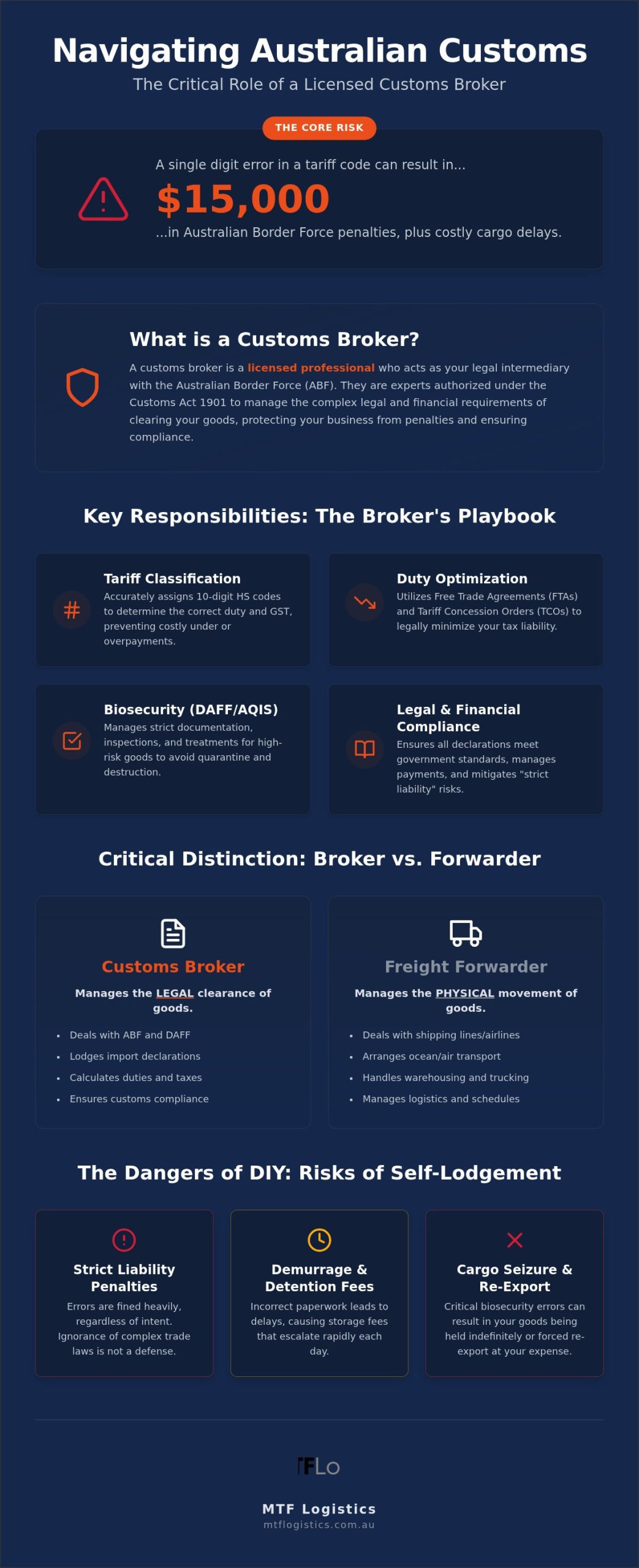
Attempting to manage your own import declarations might seem like a cost-saving measure, but it often exposes your business to significant financial risk. The Australian Border Force (ABF) operates under a regime of strict liability. This means that if an error is found in your lodgement, you can be issued an Infringement Notice regardless of whether the mistake was intentional. Understanding what is a customs broker involves recognizing them as a financial safeguard. They ensure that your business avoids these penalties while maintaining a clean compliance record, which is vital for long-term operational stability.
Inexperienced importers frequently stumble during the valuation process. It’s a common mistake to only declare the invoice price of the goods while forgetting to include “assists” or royalty payments, which are legally part of the customs value. Errors like these trigger “Red Line” audits, where the ABF targets specific shipments for high-intensity inspections. Additionally, many businesses fail to fully utilize Free Trade Agreements (FTAs). Without expert guidance, you might miss out on zero-duty benefits or, worse, claim them incorrectly without the necessary certificates of origin, leading to retrospective duty claims and fines.
The true value of a broker is most visible when your cargo reaches the wharf. Port demurrage and container detention fees are “hidden” costs that can escalate with alarming speed, sometimes exceeding the actual value of the goods. Consider a scenario where a $500 brokerage fee prevents a week of administrative back-and-forth that would have resulted in a $5,000 storage bill. Professional brokers mitigate this through “Pre-clearance” strategies. By lodging the entry before the vessel docks, they ensure your cargo is ready for immediate pick-up. This proactive management keeps your supply chain moving and protects your profit margins from the friction of border delays.
Ultimately, professional expertise should be viewed as a strategic investment rather than a simple overhead. A broker pays for themselves by identifying duty savings and preventing the administrative bottlenecks that paralyze smaller operations. If you want to ensure your next shipment is managed with this level of precision, you can partner with MTF Logistics for comprehensive customs support. We provide the steady hand and technical knowledge required to transform regulatory compliance into a competitive advantage for your business.
Selecting a partner to manage your border compliance is one of the most critical decisions for any Australian importer. When you’re evaluating what is a customs broker in the context of your specific supply chain, you must look beyond basic data entry. You’re searching for a legal representative who understands the nuances of your specific industry. The first step is to verify their credentials; ensure they’re a Corporate Customs Broker licensed by the Department of Home Affairs. This license is your guarantee that the firm meets the rigorous professional and ethical standards required to lodge declarations on your behalf.
Industry-specific expertise is equally vital. A broker who specializes in general retail might struggle with the complex permits required for pharmaceuticals, medical equipment, or dangerous goods. You need a partner who understands the specific commodity you’re moving. Furthermore, modern logistics demands visibility. Your chosen provider should offer digital documentation and real-time tracking so you’re never left guessing about your cargo’s status. Ideally, they should provide end-to-end capability, managing your sea freight services and air freight alongside customs to ensure a seamless transition from the port to your warehouse.
Before signing a service agreement, it’s prudent to conduct a thorough interview. A reliable guide will welcome these technical questions as an opportunity to demonstrate their organized expertise. Consider asking the following:
At MTF Logistics, we take an “Authoritative Expert” approach to every shipment. We’ve handled customs clearance since 2014, providing a steady hand in a volatile global market. Our team manages the technical complexity of the border so you can focus on scaling your business. We bring decades of experience in specialized logistics, from handling perishables and medical supplies to managing oversized project cargo. Our commitment to transparency and accuracy ensures that every lodgement is handled with professional integrity. By integrating freight management with expert brokerage, we provide the end-to-end support and visibility required for modern international trade.
Navigating the Australian border in 2026 requires more than just logistical coordination; it demands a deep commitment to regulatory precision. By understanding what is a customs broker and the legal shield they provide, you’ve taken the first step toward protecting your business from the financial impact of ABF penalties and biosecurity delays. A professional broker doesn’t just lodge paperwork. They act as your financial advocate, ensuring you utilize every available tariff concession while maintaining total compliance with strict liability laws.
Choosing a partner who offers end-to-end visibility transforms the border from a potential bottleneck into a streamlined component of your operations. This integrated approach eliminates communication gaps and keeps your cargo moving from the wharf to its final destination without unnecessary friction. It’s about moving from a reactive stance to one of organized control.
If you’re ready to move beyond the uncertainty of self-management, you can simplify your imports with MTF Logistics expert customs clearance. With National Port Coverage, we’re Specialists in Complex Project Logistics dedicated to your long-term success. We’re here to provide the steady hand you need to trade with confidence in a volatile global market.
You aren’t legally required to hire a broker; you can lodge an import declaration as the owner of the goods. However, most businesses choose professional representation to manage the significant legal liability of the Customs Act 1901. Self-lodgement requires a deep understanding of tariff codes and biosecurity laws. Without this expertise, you risk heavy fines or cargo seizures. A broker acts as your authorized agent to ensure every lodgement is compliant and accurate.
Brokerage fees vary based on the complexity of your shipment and the volume of goods being imported. Most providers charge a flat fee per entry, which covers the professional time required to classify goods and lodge data with the Australian Border Force. Additional costs apply for complex permits or biosecurity management. Investing in these services often prevents much larger costs, such as port storage fees or government infringement notices that hurt your bottom line.
Yes, a licensed professional identifies legal ways to minimize your tax liability at the border. They analyze your products to determine if any Tariff Concession Orders apply or if your goods qualify for zero-duty rates under various Free Trade Agreements. By ensuring your HS code classification is precise, they prevent you from overpaying duties. This strategic oversight is a core part of what is a customs broker’s value to your business stability.
The primary difference lies in their focus: physical movement versus legal compliance. A freight forwarder manages the logistics of moving cargo from point A to point B via sea or air. In contrast, a customs broker manages the legal relationship between the importer and government agencies. While the forwarder handles the container, the broker handles the data and duty payments. Many modern providers integrate both services to provide a seamless end-to-end solution.
To ensure a successful clearance, you’ll need to provide several key documents for every shipment. These typically include the commercial invoice, a detailed packing list, and the bill of lading or air waybill. If you’re claiming duty concessions, you might also need a Certificate of Origin. Providing these documents early allows your broker to pre-clear the cargo, which is essential for avoiding administrative delays once the vessel arrives at the terminal.
Most shipments are cleared within 24 to 48 hours if all documentation is provided in advance. Brokers often use pre-clearance strategies to lodge declarations before the cargo actually arrives in Australia. This proactive approach allows the Australian Border Force and biosecurity officers to review the data early. If there are no flags or inspection requirements, your goods can be released for pick-up the same day they hit the wharf.
If the Department of Agriculture flags your cargo, your broker manages the entire inspection process. They coordinate with biosecurity officers to arrange a physical examination at a licensed facility. If the goods require treatment, such as fumigation or steam cleaning, the broker organizes these services on your behalf. Their role is to facilitate a resolution as quickly as possible to minimize the daily storage costs associated with quarantine delays at the port.
Yes, a licensed broker manages the clearance of cargo regardless of the transport method. While the reporting timeframes and data requirements differ between air and sea freight, the core legal principles remain the same. Understanding what is a customs broker’s role means recognizing their ability to navigate the Integrated Cargo System for any entry point. Whether you’re moving urgent medical supplies via air or large machinery via sea, the compliance process remains consistent.


 Email
Email 1300 710 683
 Tariff Lookup
 HS Code Lookup
 Newsletter Signup