
Total Shipment Visibility, Simplified
Access all your shipment details in one place - track departures and arrivals, manage documents, notifications, invoices, and more.
Access all your shipment details in one place - track departures and arrivals, manage documents, notifications, invoices, and more.

Could a single administrative oversight be the only thing standing between your cargo and a duty-free entry? For many exporters, a Certificate of Origin Australia is far more than just a regulatory hurdle; it’s a strategic financial asset that determines the competitiveness of your products in the global market. You likely understand that accurate documentation is the backbone of successful trade, but the shifting landscape of Free Trade Agreements can make compliance feel like a moving target.
We recognize the frustration of navigating complex Chamber of Commerce requirements and the genuine fear of customs delays at a destination port. This article provides a comprehensive 2026 export documentation checklist designed to help you master these intricacies with confidence. We’ll examine the latest updates to the AANZFTA Second Protocol, explain the streamlined digital processing standards introduced this year, and provide a clear, step-by-step path to ensuring your shipments clear customs without unnecessary costs or interruptions. By following this methodical approach, you can reduce import duties for your customers and maintain total control over your international supply chain.
A Certificate of Origin acts as the official commercial passport for your goods. It’s a formal declaration that certifies exactly where a product was manufactured, produced, or processed. In the context of international trade, this document is the primary mechanism used by customs authorities to determine which taxes and duties apply to a shipment. Without a valid Certificate of Origin Australia, your overseas customers may be forced to pay full tariff rates, even when a Free Trade Agreement (FTA) is active. The Australian Chamber of Commerce and Industry (ACCI) remains the lead authorized body, overseeing a national network that ensures every issued certificate meets strict international standards.
Customs authorities worldwide rely on these documents to enforce “Rules of Origin.” These rules are complex criteria used to verify that a product truly originates from a specific country rather than just passing through it. Beyond tax reduction, these certificates play a critical role in national trade statistics and the application of anti-dumping measures. If you provide an accurate certificate, you immediately improve your commercial standing. You’re not just selling a product; you’re offering a lower landed cost for your buyer. This financial advantage often becomes the deciding factor for international partners choosing between Australian suppliers and global competitors.
The transition to digital Certificates of Origin (eCoOs) is now complete across the Australian trade landscape. By 2026, paperless documentation has become the default standard for efficiency and security. Modern eCoOs utilize blockchain-verified signatures and unique QR codes, allowing destination customs officers to verify authenticity in seconds. This shift has revolutionized processing times. For instance, many accredited bodies now offer a one-hour turnaround for digital applications submitted before late-afternoon cut-off times. You’ll benefit from significantly lower courier costs and a reduced risk of clerical errors. These digital systems align with the latest DFAT and ACCI accreditation standards, ensuring your documentation is recognized by trading partners who demand high-integrity, data-driven verification.
Preparation is the most critical phase of the export cycle. Before you access any digital portal to apply for a Certificate of Origin Australia, you must ensure your internal documentation is perfectly aligned. Discrepancies between a commercial invoice and a bill of lading are the primary reason for application rejections. This meticulous alignment isn’t just about bureaucracy; it’s about providing a clear, verifiable trail for customs authorities to follow. Every data point must be consistent across your entire document set to avoid manual queries that can stall your shipment for days.
If your business acts as a trader rather than the producer, you’ll need a Manufacturer’s Declaration. This document serves as the legal foundation for your origin claim, confirming that the goods meet the specific transformation requirements of the relevant trade agreement. Without this, the issuing body cannot verify the “Australian” status of your cargo. If you find these technical requirements overwhelming, our team provides comprehensive export documentation services to streamline the entire process for you.
Your application relies on three core documents that define the commercial and physical nature of the cargo:
Beyond the basic paperwork, you must supply specific technical data points that allow the issuing body to categorize your goods correctly:
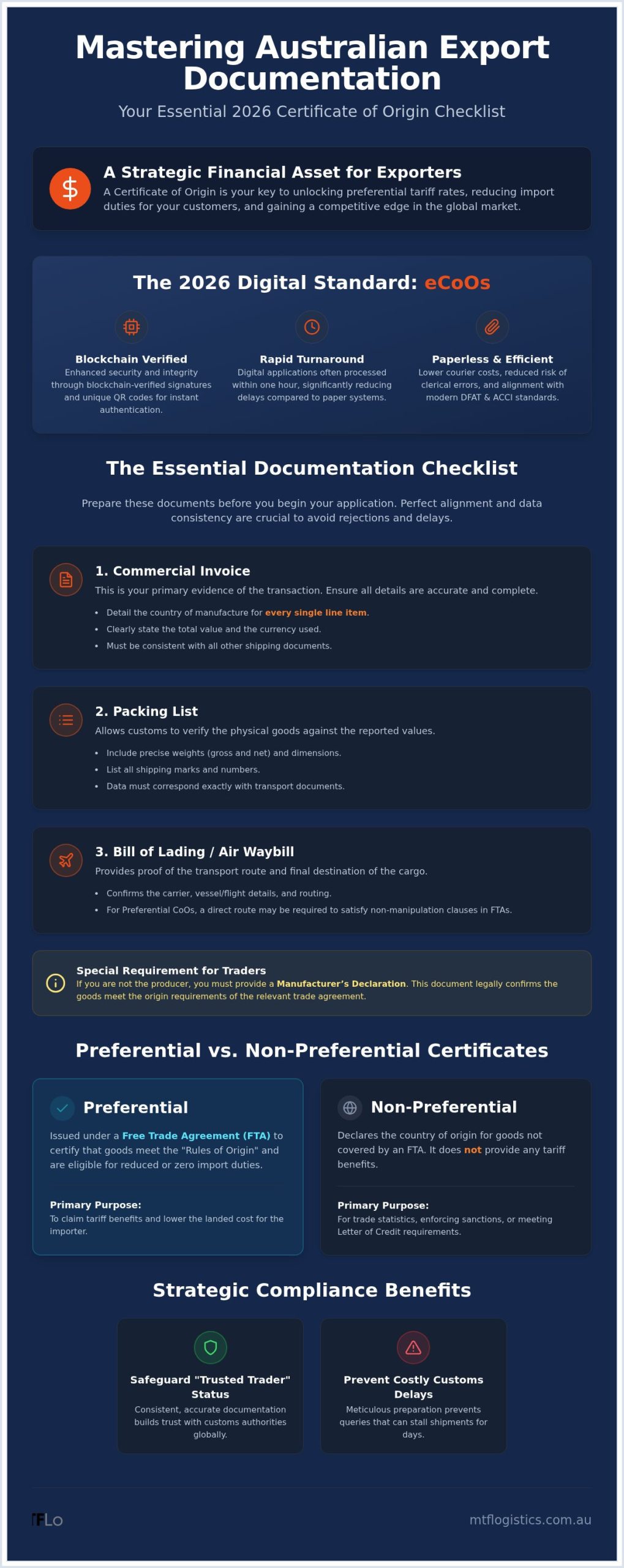
Selecting the correct document is a strategic decision that directly impacts your buyer’s bottom line. While all certificates verify provenance, they serve very different financial purposes. A Certificate of Origin Australia typically falls into one of two categories: preferential or non-preferential. Understanding this distinction is the difference between a shipment that clears customs with zero duty and one that incurs unexpected costs for your client. It’s also vital to remember that a certificate is specific to a single consignment. You can’t reuse documentation from a previous shipment, even if the goods and the buyer remain the same.
Preferential certificates are the primary tools for accessing reduced or zero duty rates under Australia’s extensive network of Free Trade Agreements. In 2026, the landscape is dominated by high-utilization agreements like the Australia-United Kingdom Free Trade Agreement (AUKFTA), the China-Australia Free Trade Agreement (ChAFTA), and the Comprehensive and Progressive Agreement for Trans-Pacific Partnership (CPTPP). These documents prove that your goods meet the specific “Rules of Origin” negotiated within those treaties.
To qualify, your products generally need to meet one of two criteria. “Wholly Obtained” goods are those produced entirely within Australia, such as minerals, agricultural products, or livestock. Alternatively, goods containing imported components may still qualify under the “De Minimis” rule. This allows a small percentage of non-originating materials, often up to 10%, to be used without disqualifying the finished product from preferential treatment. Some agreements, like ChAFTA, also allow for “Declarations of Origin” as an alternative, though many exporters still prefer the formal Certificate of Origin Australia for its higher level of acceptance by customs officials.
Non-preferential, or “ordinary,” certificates are used when no Free Trade Agreement exists between Australia and the destination country. While these don’t grant duty concessions, they are often mandatory for entry. Many countries in the Middle East, for example, require them for all imported cargo to satisfy national security or trade monitoring requirements. You’ll also find these certificates are a standard requirement for banking compliance, particularly when a Letter of Credit is involved in the transaction.
Beyond the standard format, certain industries require specialized certification. Wine exports, for instance, often need specific documentation to comply with international labeling and health standards. Similarly, perishable goods may require additional origin declarations to clear biosecurity hurdles. While these don’t provide the same immediate tax breaks as preferential certificates, they remain essential for seamless port entry and ensuring your cargo isn’t held in storage while you scramble for missing paperwork.
You must first register with an authorized, ACCI-accredited body. This involves setting up a secure company profile and nominating authorized signatories who are legally permitted to lodge documents on behalf of the exporter. Choosing the correct template is the next critical step. In 2026, digital portals offer specific templates tailored to different agreements, such as the AANZFTA Second Protocol or TAFTA. Selecting the wrong template is a common error that leads to immediate rejection, so you must verify the destination country’s specific requirements before you start drafting your application.
Once your profile is active, the submission process is primarily digital. You’ll upload your commercial invoice and any required manufacturer declarations directly into the portal for review. The Chamber’s verification team examines these documents to ensure the data matches your application exactly. Common rejection triggers include mismatched vessel names, transposed digits in HS codes, or inconsistent weight measurements between the packing list and the certificate draft. If you’re looking to streamline this process and avoid the risk of rejection, you can partner with MTF Logistics to manage these complex submissions on your behalf.
While 2026 has seen a significant global shift toward paperless trade, you must still account for “wet signature” requirements. Certain destination ports in the Middle East and parts of Asia still demand a physical stamp and ink signature on a paper document to satisfy their local customs laws. In these cases, you’ll need to factor in the additional time required for a physical certificate to be couriered to your office or the port. For standard digital issuance, the timeline is impressively efficient. Most Australian Chambers now offer a one-hour turnaround for digital applications submitted before 5:00 pm on weekdays, ensuring your cargo isn’t delayed by administrative bottlenecks at the point of departure.
Documentation errors are the primary cause of bottlenecks during customs clearance Australia. Even a minor discrepancy between your commercial invoice and your Certificate of Origin Australia can lead to a cargo hold, resulting in substantial storage fees and broken delivery promises. Beyond immediate delays, incorrect origin claims carry significant long-term risks. Customs authorities perform rigorous audits that can result in heavy financial penalties or the permanent loss of your “Trusted Trader” status. This status is a valuable asset that provides priority processing and reduced intervention; losing it can permanently increase your lead times. Professional management ensures that your documentation isn’t just a formality but a robust defense against these operational liabilities.
A customs broker acts as the final gatekeeper of document accuracy. They perform a comprehensive audit of your paperwork before it ever reaches a border official. Their primary objective is to ensure that HS codes are perfectly aligned across the CoO, the Commercial Invoice, and the Customs Entry. This synchronization is vital because any misalignment suggests a lack of internal control, which often triggers a manual inspection by authorities. MTF Logistics facilitates end-to-end documentation as part of our integrated sea freight services, ensuring that your origin claims are verified and cross-referenced alongside your transport bookings.
Managing global trade risks also requires expertise in complex scenarios like “Back-to-Back” Certificates of Origin. These are essential when goods are transshipped through regional hubs before reaching their final destination. A back-to-back certificate allows you to maintain the preferential status of the cargo even if it enters a third country, provided the goods remain under customs control and don’t undergo any physical transformation. This level of oversight is critical for maintaining the integrity of your supply chain and ensuring your customers still receive the duty concessions they expect.
Compliance doesn’t end when the shipment is delivered and cleared. You must maintain all Certificate of Origin Australia records and supporting evidence for at least five years. Most Free Trade Agreements allow for retrospective verification, meaning authorities can request proof of origin long after the transaction is complete. Proactive documentation management is always more cost-effective than reactive problem-solving. By establishing a data-first approach to your export paperwork, you protect your profit margins and ensure a steady, predictable flow of goods across international borders.
Navigating the complexities of international trade requires more than just filling out forms; it demands a methodical approach to data and compliance. By mastering the 2026 standards for a Certificate of Origin Australia, you ensure your products remain competitive through reduced tariffs while your shipments avoid costly port delays. We’ve explored how digital verification and precise HS code classification form the foundation of an efficient, modern supply chain.
Since 2014, MTF Logistics has served as a steady partner for Australian exporters, providing expert customs clearance and end-to-end international freight management. We handle the technical intricacies of documentation so you don’t have to manage the risk of customs rejections alone. Simplify Your Export Documentation with MTF Logistics and gain the clarity needed for seamless global operations. With the right documentation strategy in place, your business is well-positioned to thrive in the evolving global market of 2026.
It isn’t a legal requirement for every export, but it’s often a commercial necessity. You’ll need one if your buyer requires it for banking compliance or if they want to claim tariff concessions under a Free Trade Agreement. Without a Certificate of Origin Australia, your customer might pay higher duties, making your products less competitive. Some countries also mandate them for all imports to satisfy national security or trade monitoring protocols.
The Australian government authorizes specific bodies to certify these documents. These include the Australian Chamber of Commerce and Industry (ACCI) and its state branches, the Australian Industry Group (Ai Group), and digital platforms like Ozdocs, TradeWindow Origin, and WiseTech Global. These organizations ensure every document meets the strict accreditation standards required by international customs authorities. Working with an authorized body ensures your documentation is recognized at any global port.
The primary difference lies in who verifies the information. A Certificate of Origin is a formal document stamped and certified by an authorized third party, such as a Chamber of Commerce. In contrast, a Declaration of Origin is a self-certified statement made by the exporter on a commercial invoice or other shipping document. While some agreements like ChAFTA allow declarations, many buyers and banks still prefer the security of a formally certified certificate.
Fees for these documents vary depending on whether you’re a member of an authorized issuing body and the specific type of certificate required. Standard certificates generally cost less than those for specific agreements like TAFTA. While we manage the application process as part of our export documentation services, the issuing bodies set their own certification rates. You should also factor in potential courier costs if a physical wet signature document is required by the destination country.
Yes, you can apply for a certificate after your goods have departed, which is referred to as a Retrospective Certificate. Most Free Trade Agreements allow for this, provided the application is made within a specific timeframe, often up to twelve months after shipment. However, it’s always safer to secure your documentation before arrival at the destination port. This prevents your cargo from being held in bonded storage while you wait for the paperwork to be processed.
If an error is discovered after issuance, the original certificate must be cancelled and a new one issued. Customs authorities are extremely strict regarding data consistency; even a small typo in a vessel name or HS code can lead to a document being rejected at the border. Because these are legal documents, you cannot simply cross out or over-type an error. We recommend a thorough audit of all draft data before final submission to avoid these delays.
An Australian Certificate of Origin is typically valid for 12 months from its date of issuance. This means the goods must be imported into the destination country within that one-year window to qualify for any preferential tariff rates. It’s important to note that while the certificate has a 12-month validity, you’re required to keep all supporting evidence and records related to the origin claim for at least five years to satisfy potential customs audits.
Many Australian Free Trade Agreements include a waiver for low-value consignments, meaning a formal Certificate of Origin Australia is often not required for goods valued under $1,000 AUD. In these cases, a simple statement of origin on the commercial invoice is usually sufficient for customs clearance. However, this threshold varies between different trade agreements and destination countries. You should always verify the specific rules of the importing nation to ensure your small shipments aren’t unexpectedly delayed.


 Email
Email 1300 710 683
 Tariff Lookup
 HS Code Lookup
 Newsletter Signup