
Total Shipment Visibility, Simplified
Access all your shipment details in one place - track departures and arrivals, manage documents, notifications, invoices, and more.
Access all your shipment details in one place - track departures and arrivals, manage documents, notifications, invoices, and more.

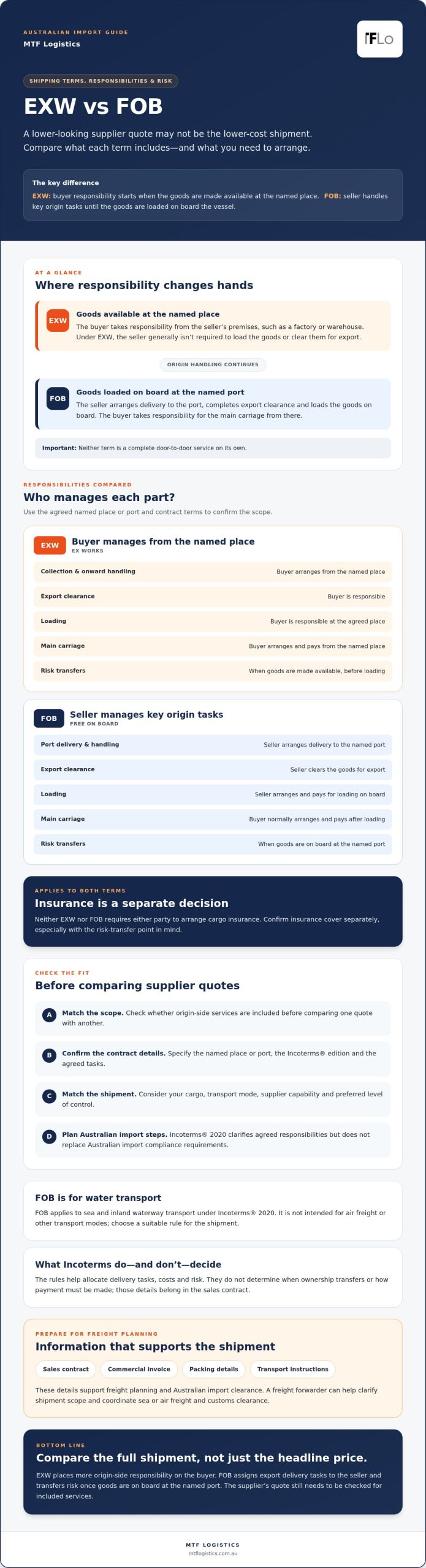
A cheaper EXW quote may not be the lower-cost option once you account for collecting the goods, loading them and arranging export clearance. Comparing EXW vs FOB shipping terms means looking beyond the supplier’s headline price to the responsibilities, costs and risks attached to the shipment.
When supplier quotes use different terms, it can be difficult to see what each includes and what you need to organise. Under EXW, the buyer takes responsibility from the seller’s premises. Under FOB, the seller handles key origin tasks until the goods are loaded on board the vessel. The right choice depends on the supplier’s capabilities, the transport mode and how much control you want over the shipment.
This guide explains how the terms divide responsibilities and risk, and how to compare offers on the same scope. It also covers freight planning, Australian customs clearance and onward logistics. Incoterms® 2020 helps define agreed responsibilities, but it doesn’t replace Australian import compliance requirements. Understanding the full shipment process can help you choose terms that suit your operation, not just the lowest-looking quote.
Who manages the shipment from the supplier’s premises to its destination in Australia? The answer depends on the agreed Incoterm, the named place or port and the tasks set out in your sales contract. EXW vs FOB shipping terms allocate specific delivery responsibilities, costs and risk between seller and buyer. Neither term describes a complete door-to-door service on its own.
Under Incoterms® 2020, the rules clarify how delivery responsibilities are divided. The Incoterms rules are standard trade terms, but they don’t determine when ownership transfers or how payment must be made. Those details belong in the sales contract. Neither EXW nor FOB requires either party to arrange insurance, so confirm cover separately. The terms also don’t replace Australian import compliance obligations.
With EXW, or Ex Works, the seller makes the goods available to the buyer at the agreed named place, such as a factory or warehouse. The seller generally isn’t required to load the goods onto the collecting vehicle or clear them for export. The buyer arranges and bears responsibility for collection, loading, export formalities and the transport that follows.
Specify the named place clearly. “EXW” alone doesn’t identify the collection point or mean the supplier will deliver the goods to an Australian destination. If you can’t manage export arrangements in the supplier’s country, clarify who will handle them before agreeing to the term.
FOB, or Free On Board, is for sea and inland waterway transport under Incoterms® 2020. The contract should identify the named port of shipment. The seller arranges delivery to that port, completes export clearance and loads the goods on board the vessel. The buyer takes responsibility for the main carriage from there.
Risk transfers when the goods are on board the vessel at the named port, not when they arrive in Australia. This matters when arranging insurance and deciding who bears the risk during the voyage. FOB isn’t intended for air freight or other transport modes, so choose a suitable rule for the shipment instead.
Neither term confirms what’s included in the supplier’s quote or who will coordinate every step to the final destination. Check the contract’s named place or port, the Incoterms edition and the agreed tasks. A freight forwarder can help clarify shipment scope, coordinate sea or air freight and plan Australian customs clearance. The Incoterm itself doesn’t replace compliance requirements.
Incoterms help define the responsibilities of sellers and buyers, but they aren’t freight quotes. A term sets default delivery tasks, cost allocation and the point where risk transfers. The named place or port, the sales contract and any separately arranged services also matter.
| Responsibility | EXW | FOB |
|---|---|---|
| Origin handling and delivery | Buyer arranges collection and onward handling from the named place. | Seller arranges delivery to the named port and handling needed to load the goods. |
| Export clearance | Buyer is responsible for export formalities. | Seller clears the goods for export. |
| Loading | Buyer is responsible for loading at the agreed place. | Seller arranges and pays for loading on board the vessel. |
| Main carriage | Buyer arranges and pays for transport from the named place. | Buyer normally arranges and pays for carriage after the goods are delivered on board. |
| Insurance | Neither party is required by the rule to arrange cargo insurance. | Neither party is required by the rule to arrange cargo insurance. |
| Risk transfer | When the goods are made available at the named place, before loading. | When the goods are on board at the named port. |
In brief: EXW places more origin-side responsibility on the buyer, while FOB assigns export delivery tasks to the seller. This affects who coordinates services and bears costs, but the term alone doesn’t confirm which services the supplier has included in its quote.
Under EXW, the buyer’s responsibility for export clearance and loading can be challenging if those tasks are difficult to arrange in the supplier’s country. Under FOB, the seller handles export clearance and delivery on board, while the buyer normally books the main carriage. Ask who will book each origin service, who pays the related charges and what the quote includes.
Risk transfer and freight payment are separate. With FOB, risk passes once the goods are on board, while the buyer’s main-carriage costs relate to transport from that point. Neither EXW nor FOB automatically requires either party to buy cargo insurance. Confirm in writing who will arrange cover, what exclusions apply and which part of the journey the policy covers.
Use the table as a starting point, then check the contract’s named place or port and any agreed variations. For help clarifying transport scope and Australian customs clearance, review freight forwarding and customs clearance support.
EXW isn’t automatically cheaper or easier for the buyer. A supplier’s EXW quote may leave collection, loading, export clearance and other origin-side services for you to arrange and pay for. Compare the full shipment scope, not just the quoted goods price. Ask the supplier to itemise what’s included, what’s excluded and which origin charges may be billed separately.
The Incoterms® rules allocate agreed delivery responsibilities between buyer and seller. They don’t cover every service in a freight quote or replace Australian import requirements. Your choice of term doesn’t determine whether goods are subject to customs clearance, duties, taxes or biosecurity measures. Those depend on the goods and applicable requirements, so plan for them separately.
Under EXW, the buyer is responsible for export formalities, but arranging them from outside the seller’s country may be impractical. Before accepting the term, confirm who can legally and operationally complete export clearance and whether the supplier can provide the necessary cooperation and documents. If the seller can manage export clearance, ask whether FCA may be a more workable option for the agreed shipment.
No. FOB covers the seller’s agreed export-side delivery tasks through loading on board at the named port. It doesn’t, by itself, include Australian import clearance, applicable duties or taxes, biosecurity requirements or delivery to your premises. Make a separate plan for destination-side freight, clearance and onward logistics, and confirm which services your quote includes.
For more detail on border processes and clearance planning, read this Australian customs clearance guide. It helps distinguish the Incoterm allocation from the steps involved in preparing an import. For broader shipment planning, see the guide to importing goods into Australia.
When comparing EXW vs FOB shipping terms, check whether you can manage the responsibilities assigned to you at each stage of the journey. A freight forwarder and customs broker can help clarify transport scope and coordinate freight and Australian customs clearance. The contract should state the named place or port, Incoterms edition and agreed services clearly.
Choose the term by matching each party’s responsibilities to the work they can manage. Use this decision process to assess the shipment before agreeing to a quote:
EXW can work when you have dependable origin-side logistics capability and can coordinate collection from the seller’s premises. Confirm that the supplier can make the goods accessible at the precise agreed place and establish who will load them. Before accepting EXW, verify who can complete export clearance in the origin country and how the required documents will be provided.
FOB may suit a sea shipment when the seller can manage export delivery and load the goods on board the vessel. With containerised cargo, however, the seller commonly hands the container to a carrier at a terminal before it is loaded onto the vessel. Ask whether FCA better reflects that handover or suits multimodal transport, and confirm the exact named delivery point.
Decision rule: Select the term whose allocated tasks each party can manage. A freight forwarder can help clarify transport scope and coordinate freight planning with Australian customs clearance. Discuss your import freight and customs clearance needs with MTF Logistics.
The right term is only one part of a workable import plan. Your choice should reflect who can manage origin tasks, the supplier’s export capability, the transport mode and the services included in the agreed scope. Once EXW or FOB is confirmed, make sure everyone involved understands the handover point and next steps.
Before requesting or confirming freight arrangements, gather the core documents and shipment information:
Check that the cargo description, dimensions and weights match across the documents, and confirm when the goods will be ready. Record the exact collection or delivery location, not just the supplier’s general address. Verify the Incoterms rule, named place or port and edition in writing. Also agree who supplies export documentation and who provides the information required for destination clearance.
A freight forwarder can help clarify where one party’s responsibility ends and the next begins, then coordinate sea or air freight within the agreed scope. Considering freight planning alongside Australian customs clearance can help identify missing shipment details before they disrupt coordination. The importer should still ensure the information and documents supplied for the shipment are accurate and complete.
Clear documents and instructions make it easier to put the EXW vs FOB shipping terms decision into practice. If you’re reviewing a supplier’s offer or preparing an import, discuss your international freight requirements with MTF Logistics.
The right choice between EXW and FOB depends on more than the supplier’s quoted price. Match the term to the transport mode, the seller’s export capability and the tasks your business can manage. Compare written quotes on the same scope, then confirm the named place or port and Incoterms® edition in your contract.
EXW vs FOB shipping terms allocate responsibilities for delivery, costs and risk, but they don’t replace Australian import compliance or define every service included in a freight arrangement. Clear documents and agreed handovers help you plan freight and destination requirements with fewer uncertainties.
MTF Logistics supports shipment planning with sea and air freight forwarding, customs clearance, export documentation, import transport project work and logistics management. Discuss your international freight requirements with MTF Logistics to clarify the shipment scope and next steps.
The main difference is where the seller’s delivery responsibility ends and the buyer’s begins. Under EXW, the seller makes goods available at the named place, and the buyer generally arranges collection, loading and export clearance. Under FOB, the seller handles export clearance and delivery to the named port, including loading the goods on board. Risk transfers at different points, so specify the named place or port in the contract.
Neither term is automatically better. The right choice depends on the supplier’s export capability, the transport mode and your ability to manage origin logistics. EXW may suit a buyer with reliable local support in the supplier’s country. FOB may be more practical for a suitable sea shipment if the seller can deliver the goods on board. Compare the full scope of both offers before choosing between EXW vs FOB shipping terms.
FOB is for sea or inland waterway transport, but it may not reflect the handover for containerised shipments. A container is often delivered to a carrier or terminal before it is loaded onto the vessel, while FOB delivery and risk transfer occur once the goods are on board. Ask whether FCA better matches the actual handover, and confirm the precise named delivery point and Incoterms® edition in the contract.
FOB doesn’t automatically include the main sea freight to Australia or cargo insurance. The seller arranges delivery to the named port, export clearance and loading on board. The buyer normally arranges and pays for main carriage after delivery on board. Neither party is required by FOB to buy insurance, so agree in writing who will arrange cover, what risks and exclusions apply, and which part of the journey is insured.
No. Under EXW, the buyer is responsible for export clearance, along with collection and loading, unless the parties separately agree otherwise. This can be difficult if you can’t readily arrange export formalities in the supplier’s country. Before accepting EXW, confirm who can complete clearance and provide the necessary documents. If the seller can handle export clearance, ask whether FCA would better fit the shipment and handover point.
No. Incoterms allocate delivery responsibilities, costs and risk between buyer and seller; they don’t set Australian duty or GST. Import charges depend on factors such as the goods and applicable customs requirements. GST of 10% applies to most goods imported into Australia and is calculated on the Value of the Taxable Importation, which includes customs value, duty, international freight and insurance. Check the requirements for your goods and ensure import information is accurate.


 Email
Email 1300 710 683
 Tariff Lookup
 HS Code Lookup
 Newsletter Signup