
Total Shipment Visibility, Simplified
Access all your shipment details in one place - track departures and arrivals, manage documents, notifications, invoices, and more.
Access all your shipment details in one place - track departures and arrivals, manage documents, notifications, invoices, and more.

Australia relies on overseas manufacturers for approximately 85% of its domestic medical devices, yet even a single documentation mismatch can halt sensitive diagnostic machinery at the wharf. Executing a compliant medical equipment import Australia strategy requires far more than standard freight booking; it demands seamless synchronisation between therapeutic regulatory oversight and physical transport execution.
If you find balancing Therapeutic Goods Administration (TGA) rules alongside strict Australian Border Force inspections demanding, you aren’t alone. Discrepancies between Australian Register of Therapeutic Goods (ARTG) inclusions, incorrect customs tariff codes, and biosecurity holds frequently cause unexpected cargo impoundments and costly project delays. You don’t have to leave border clearance to chance.
This guide equips you to master the end-to-end process of importing medical devices into Australia by combining rigorous regulatory compliance with dependable national logistics. We outline the essential classification requirements, import documentation protocols, and specialized freight controls necessary to ensure your high-value diagnostic shipments arrive safely and clear customs without delay.
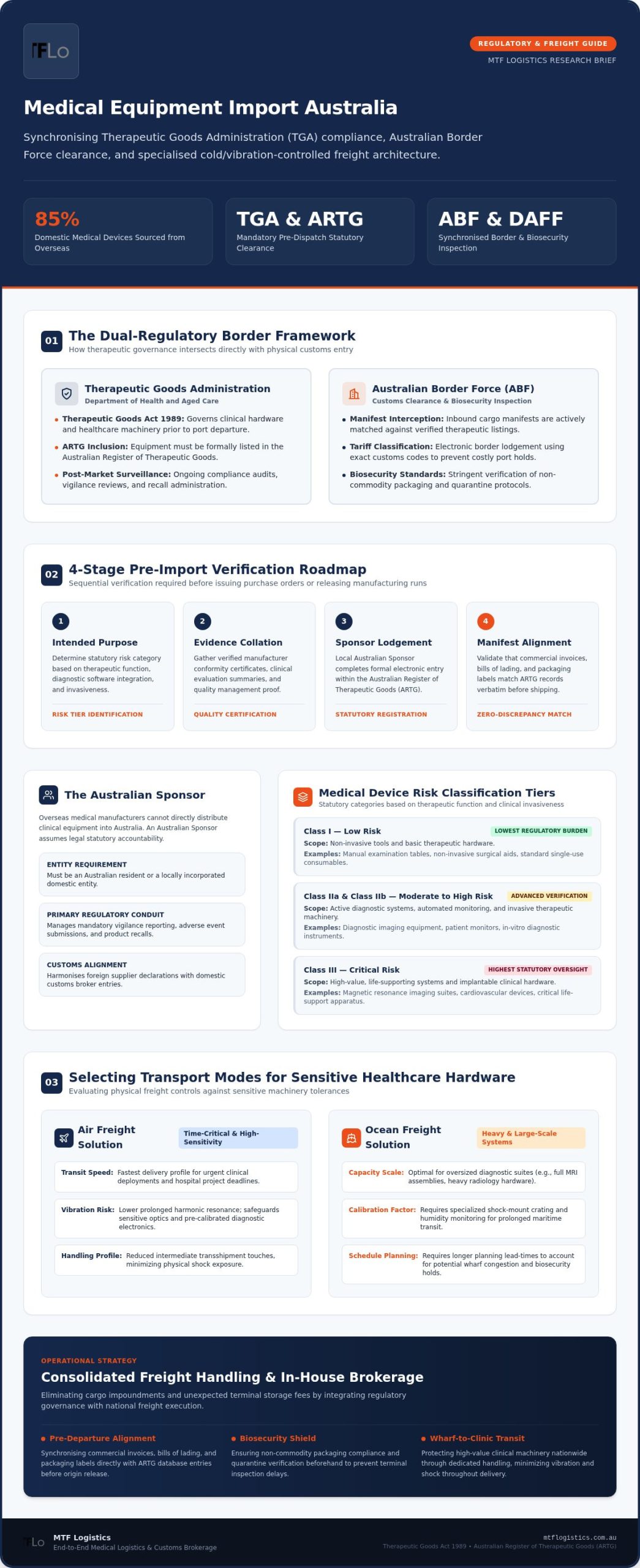
Successfully managing a medical equipment import Australia operation requires a clear understanding of the boundary between international logistics and federal healthcare legislation. Under the Therapeutic Goods Act 1989, clinical hardware and healthcare machinery face strict statutory controls before departing origin ports. The Australian Border Force works directly with federal health bodies, checking inbound cargo manifests against verified therapeutic listings. Because border officers hold shipments lacking authorized paperwork upon arrival, logistical coordination must begin months prior to physical departure. Establishing compliant trade documents early prevents terminal storage fees and protects delivery schedules.
Australian legislation categorizes equipment based on its intended clinical purpose rather than its physical design. Products qualify as medical devices if they are manufactured to diagnose, prevent, monitor, or treat human disease and injury. This legal scope covers everything from single-use consumables to high-value magnetic resonance imaging suites. General consumer electronics don’t carry these strict mandates; however, once hardware incorporates clinical diagnostic software, automated patient monitoring algorithms, or in-vitro diagnostic instruments, it enters the therapeutic regulatory framework.
Operating as a division of the Department of Health and Aged Care, the Therapeutic Goods Administration (TGA) assesses product efficacy, safety standards, and manufacturing quality across all therapeutic supply chains. The agency’s oversight extends past initial approvals through active post-market surveillance programs and routine compliance reviews. Attempting to bring unapproved therapeutic cargo through Australian ports triggers severe enforcement measures, including cargo impoundments, significant corporate penalty units, and commercial bans across national trade gateways.
Overseas medical manufacturers cannot directly distribute clinical equipment into the country without an Australian Sponsor. The sponsor must be an Australian resident or a locally incorporated entity assuming formal statutory accountability for the goods. This partner acts as the primary contact with regulatory officials, managing mandatory vigilance reporting, adverse event submissions, and potential recall actions. Aligning foreign suppliers, domestic sponsors, and experienced customs brokers ensures that commercial invoices match regulatory registries before shipments arrive.
Executing a medical equipment import Australia program requires completing regulatory clearances before issuing purchase orders or releasing manufacturing runs. Moving freight forward without verified certifications risks extended storage holds at Australian entry ports. To establish a dependable supply chain, importers follow a four-stage verification roadmap:
Australian regulations categorize hardware across progressive risk tiers. Class I encompasses low-risk therapeutic tools, such as manual examination tables and non-invasive surgical aids. Class IIa and Class IIb cover moderate-to-high risk systems, including complex imaging hardware, infusion pumps, and dialysis units. Class III and Active Implantable Medical Devices (AIMDs) carry the highest risk profile, requiring extensive pre-market clinical evaluation. The assigned tier dictates documentary scrutiny at customs checkpoints, where higher-tier units demand comprehensive proof of design validation.
Commercial shipments cannot legally enter Australian distribution without an active ARTG entry number. Customs authorities cross-reference import declarations directly against the national register upon arrival. Minor discrepancies between the physical manifest and the official therapeutic inclusion, such as mismatched model suffixes or omitted variant designations, cause immediate shipment impoundments. Coordinating with customs clearance specialists before dispatch ensures documentation matches federal records across every line item.
The TGA recognizes technical evaluations from designated international regulatory authorities to expedite inclusion pathways. Overseas manufacturers can leverage conformity assessments from the European Union (under MDR or IVDR standards), United States FDA 510(k) clearances, and Medical Device Single Audit Program (MDSAP) certifications. Importers must confirm that the manufacturer’s quality management system maintains active ISO 13485 certification. Concurrently, cross-referencing intended imports against Australian Border Force customs clearance and biosecurity clearance procedures on the BICON database ensures internal hardware components, such as biological calibration media, carry valid biosecurity permits prior to transit.
Transport mode selection directly influences the operational integrity of high-precision diagnostic machinery. Delicate therapeutic instruments cannot withstand standard commercial handling. Prolonged transit periods, rough ocean swells, or uncontrolled apron environments can disrupt internal calibrations before a machine reaches a clinical facility. Balancing transit speed against physical cargo stability is essential when structuring an international route for medical equipment import Australia shipments.
Aviation transport remains the standard method for delicate, high-value medical diagnostic machinery. Compressed transit times limit the window during which internal components experience shifting ambient conditions. Dedicated air cargo networks reduce physical touchpoints, which helps protect optical alignments and sensitive sensory arrays from mechanical stress. Importers moving urgent clinical units or temperature-controlled diagnostic systems can review transit profiles in our guide to Air Freight Australia.
Large infrastructure deployments, such as full-ward hospital beds, heavy architectural ceiling pendants, and non-sensitive clinic fit-out units, generally travel via maritime transport. Full container load (FCL) shipping offers dependable volume capacity for non-urgent inventory, provided protective measures are taken against humidity. Extended exposure to tropical shipping lanes can generate container sweat, which corrodes circuit boards if units lack industrial desiccants and vacuum-sealed barrier packaging. For broader container configurations, consult our reference on Reliable Sea Freight Services.
Complex medical equipment import Australia consignments require verifiable physical handling protocols to protect equipment functionality during border transit:
Clearing a medical equipment import Australia consignment demands methodical coordination within the Integrated Cargo System (ICS). The Australian Border Force (ABF) cross-references electronic import declarations against commercial manifests before cargo touches land. Because missing paperwork or tariff mismatches prompt automatic system holds, submitting complete documentary entries ahead of time keeps goods moving. A structured border strategy prevents terminal storage fees, detention penalties, and unnecessary physical examinations at commercial terminals.
Accurate tariff determination under Chapter 90 of the Working Tariff is mandatory for healthcare apparatus. Classifying an electrosurgical unit under generic electrical headings rather than specific medical device tariff lines invites immediate border audits and potential duty recalculations. Importers must establish the correct customs value based on the purchase price while accounting for international transport, transit insurance, and related ocean or air surcharges. For a practical breakdown of line-item entry requirements, review our detailed guide on Customs Clearance Australia.
Quarantine oversight focuses heavily on timber packaging materials and residual organic contaminants. Importers must ensure their suppliers satisfy essential biosecurity standards before dispatching cargo:
Mismatches between the physical commercial packing list, ocean bills of lading, and therapeutic registrations lead directly to red-line holds. When system discrepancies arise, experienced brokers resolve inquiries quickly by presenting technical product data sheets, manufacturer certificates, and sponsor declarations to border officers. For an end-to-end overview of documentation sequencing, explore our guide on How to Import Goods into Australia. To secure compliant border processing across all Australian commercial ports, partner with MTF Logistics for expert Customs Clearance services.
Fragmented supply chains create serious blind spots when moving high-value medical hardware. Handing cargo off between disconnected carriers, overseas agents, and separate brokerage firms increases the chance of documentation errors and physical damage. Consolidating your medical equipment import Australia operations under a unified provider eliminates handoff delays, giving you total visibility across every transport milestone.
Unifying international freight forwarding with customs clearance directly protects your delivery timeline. When the same operations team manages both transport bookings and border lodgements, trade manifests are audited against TGA regulations long before cargo arrives at origin docks. This coordinated process eliminates administrative finger-pointing between shipping lines and clearance agents. If an automated declaration issue arises, your broker can resolve it immediately without waiting for third-party responses, keeping clearance moving smoothly.
Transporting sophisticated clinical hardware demands strict technical care. Project cargo teams deploy dedicated Pharmaceuticals & Medical Logistics protocols tailored to the vulnerability of advanced health equipment. These procedures include:
Managing ongoing medical trade requires steady, established industry experience. Established in 2014, MTF Logistics operates as an Australian owned freight forwarder handling customs clearance for healthcare importers nationwide. With comprehensive coverage spanning sea and air freight across all Australian commercial ports, our team delivers seamless trade execution from origin pick-up to hospital site positioning. Whether you are importing routine diagnostic consumables or deploying multi-million dollar imaging suites, our specialists keep your cargo compliant, secure, and on schedule. Reach out to the team at MTF Logistics to structure your medical equipment import Australia strategy.
Navigating the intersection of therapeutic regulations and international freight execution doesn’t have to strain your operations. Success in managing a medical equipment import Australia program centers on proactive preparation. Verifying ARTG inclusions before departure, selecting shock-isolated transport modes for sensitive diagnostic machinery, and lodging precise customs declarations prevent costly port delays.
Unifying these complex processes under a single experienced provider safeguards your capital investments and protects critical delivery timelines. Established in 2014, MTF Logistics operates nationally across Australia as a privately owned freight forwarder that also handles customs clearance. Our specialists deliver dedicated support across air freight, sea freight, project logistics, and healthcare supply chains. Partner with MTF Logistics for precision medical freight and customs clearance to keep your healthcare supply chain moving with complete confidence.
Yes, almost all commercial medical equipment imports require an active entry on the Australian Register of Therapeutic Goods (ARTG) prior to customs clearance. Limited statutory exemptions exist under the Therapeutic Goods Act 1989, such as the Special Access Scheme, authorized prescriber pathways, or designated clinical trial approvals. For commercial distribution, however, arriving without an active ARTG inclusion number causes immediate border interception and potential re-export directives.
An Australian sponsor must be an individual residing in Australia or an incorporated company registered and conducting business within Australia. Foreign manufacturers cannot act as their own sponsor without an incorporated domestic entity. The sponsor assumes statutory legal accountability for the medical equipment import Australia supply chain, maintaining technical documentation, managing adverse event vigilance reports, and executing mandatory product recalls if required by the TGA.
Shipments arriving without verified TGA clearance face automatic border holds by the Australian Border Force. Border officers withhold clearance, shifting the cargo into bonded storage while initiating regulatory inquiries. The importer accrues compounding terminal storage and demurrage fees during this period. If compliance cannot be established, authorities issue a formal seizure notice, followed by mandatory commercial re-export or cargo destruction at the importer’s direct expense.
Licensed customs brokers evaluate the primary therapeutic function, engineering design, and working mechanism of the hardware to assign accurate tariff classifications under Chapter 90. For multi-component or modular systems, classification rules determine whether equipment clears as an integrated instrument or distinct components. Correct tariff determination prevents duty disputes, avoids commercial border audits, and verifies whether specific free trade agreement concessions apply to your medical equipment import Australia program.
Yes, refurbished and pre-owned medical devices can be imported, but they must satisfy the exact same safety and quality standards as brand-new equipment. The equipment requires a valid ARTG inclusion held by an Australian sponsor and complete calibration records. Additionally, second-hand units undergo strict biosecurity evaluation by quarantine authorities to ensure the hardware is completely free of biological fluids, organic residue, and hospital-acquired microbial contamination.
Packaging materials must satisfy strict biosecurity standards administered by the Department of Agriculture, Fisheries and Forestry. Solid timber packaging, including crates, skids, and bracing dunnage, must comply with ISPM 15 standards and display clear heat-treatment certification marks. Non-compliant timber packaging faces mandatory onshore chemical treatment or directed re-export. Using manufactured timber alternatives, like certified plywood or engineered plastics, significantly reduces the likelihood of packaging-related quarantine interventions.
Yes, reagents can travel with accompanying hardware, provided they are packaged to maintain their specified thermal band throughout transit. Importers generally utilize active or passive cold chain packaging, such as validated temperature-controlled containers with dry ice or phase-change materials, equipped with continuous data loggers. Reagents containing biological or animal-derived substances also require pre-approved biosecurity import permits before arrival to ensure seamless border clearance alongside the physical instruments.


 Email
Email 1300 710 683
 Tariff Lookup
 HS Code Lookup
 Newsletter Signup