
Total Shipment Visibility, Simplified
Access all your shipment details in one place - track departures and arrivals, manage documents, notifications, invoices, and more.
Access all your shipment details in one place - track departures and arrivals, manage documents, notifications, invoices, and more.

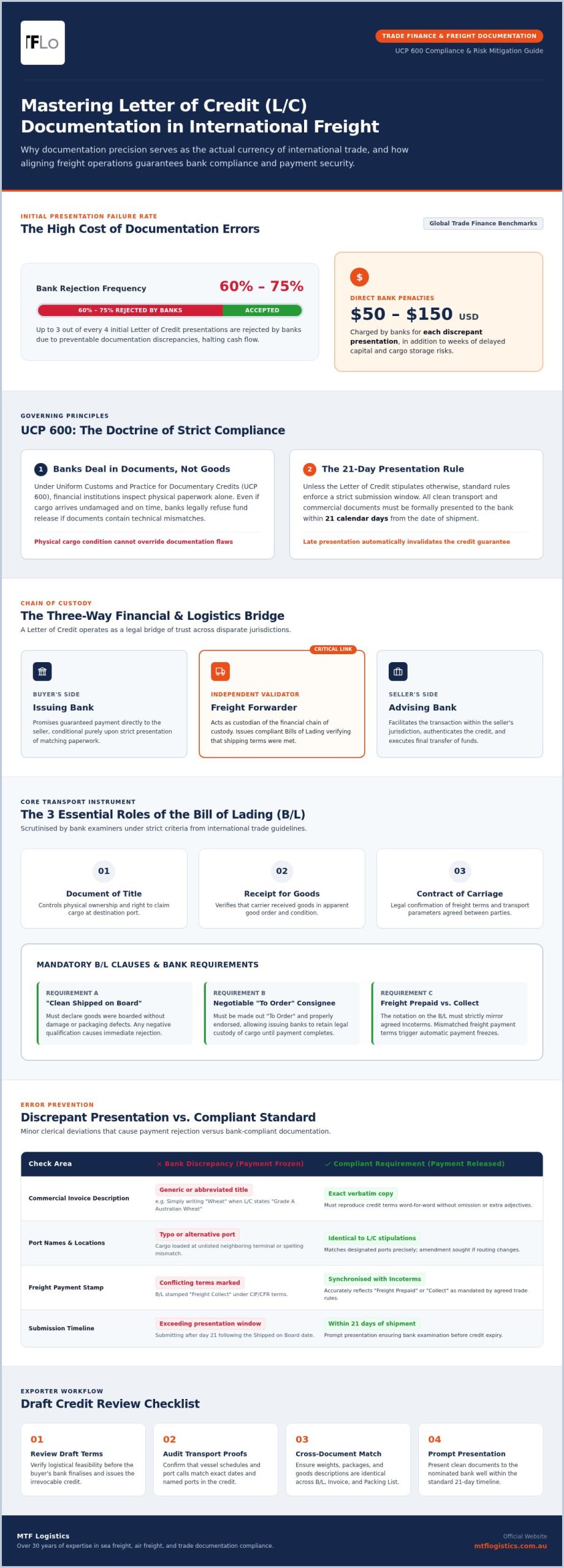
Between 60% and 75% of initial Letter of Credit presentations are rejected by banks due to documentation discrepancies. It’s a frustrating reality for exporters who’ve handled the logistics perfectly, only to face payment delays because of a minor typo or a mismatched port name. You’ve likely experienced the stress of deciphering complex bank instructions while your cargo sits at the border, awaiting clearance. Managing letter of credit documentation freight requirements shouldn’t feel like a gamble with your business’s cash flow.
We understand that precision isn’t just a goal; it’s the actual currency of the transaction. This guide will help you master the intersection of global finance and logistics, ensuring your documentation meets every bank requirement for guaranteed payment. You’ll learn how to align your transport documents with the latest UCP 600 standards and eUCP digital shifts. We’ll provide a clear checklist for seamless Australian customs clearance and show you how to eliminate the technical errors that lead to costly bank fees. By the end, you’ll have the steady hand needed to secure your international trade and ensure your revenue is protected.
A Letter of Credit (L/C) is a binding financial guarantee issued by a buyer’s bank to a seller. It ensures that payment will be made once specific conditions are met. In the context of letter of credit documentation freight management, these conditions are almost entirely defined by the physical paperwork generated during the transport process. For over a decade, we’ve seen how this mechanism provides a safety net for exporters, but it requires a high level of technical accuracy to function correctly.
Under the Uniform Customs and Practice for Documentary Credits (UCP 600), banks operate on a fundamental principle: they deal with documents, not the actual goods. Even if the cargo arrives at its destination in perfect condition, the bank won’t release funds if the paperwork is flawed. This global standard provides a predictable framework for commerce, yet it demands absolute precision. The freight forwarder acts as the custodian of this financial “chain of custody,” ensuring that the evidence of shipment matches the bank’s requirements exactly.
An L/C acts as a bridge of trust between parties who may be operating in different legal jurisdictions. The “Issuing Bank” (the buyer’s bank) promises payment, while the “Advising Bank” (the seller’s bank) facilitates the transaction. Within this structure, the freight forwarder serves as the essential third-party validator. By issuing the Bill of Lading and other transport proofs, the forwarder confirms that the exporter has fulfilled their shipping obligations. Understanding the legal nuances of letters of credit in international trade is vital because the bank relies on these independent records to trigger the transfer of funds.
When documents don’t perfectly match the L/C terms, banks flag them as “discrepancies.” This isn’t a minor administrative hurdle; it’s a legal reason for the bank to freeze payment. Industry data indicates that between 60% and 75% of initial presentations are rejected due to these errors. A single typo on a Bill of Lading can delay a million-dollar payment for weeks. Beyond the delay, you’ll face tangible costs. Banks typically charge between $50 and $150 USD for each discrepant presentation. These fees, combined with the risk of non-payment, make expert oversight of letter of credit documentation freight a non-negotiable requirement for modern exporters. We focus on being the steady hand in this process, ensuring that every detail aligns with the bank’s instructions to protect your cash flow.
Precision is the standard in trade finance. While standard shipping documents serve as a record of transport, letter of credit documentation freight requirements demand a much higher level of data alignment to satisfy banking auditors. Under the doctrine of strict compliance, even a minor discrepancy between the Bill of Lading and the Commercial Invoice can result in a notice of refusal. Mastering these documents is about ensuring every data point across your set is identical, leaving no room for bank interpretation.
The Bill of Lading (B/L) remains the most critical document in this set. It serves as a document of title, a receipt for goods, and evidence of the contract of carriage. Banks scrutinise the B/L to ensure it meets the specific criteria outlined in the International Trade Administration letter of credit guide, particularly regarding how the consignee is listed. If the credit stipulates a negotiable B/L, it must be issued “To Order” and properly endorsed to allow the bank to maintain control over the cargo until payment is secured.
Banks typically require a “Clean Shipped on Board” notation. This confirms the carrier received the goods in apparent good order and condition, without any noted damage to the packaging or containers. Additionally, the B/L must clearly indicate whether freight is “Prepaid” or “Collect” to match the agreed Incoterms. Any mismatch here is a common trigger for payment freezes. Ensuring these clauses are correctly applied requires close coordination with your carrier or forwarder before the vessel departs.
Commercial Invoices and Packing Lists must also mirror the L/C terms perfectly. The description of goods on the invoice should be a verbatim copy of the description in the credit. If the L/C specifies “Grade A Australian Wheat,” the invoice must not simply state “Wheat.” Similarly, the weights and volumes on the Packing List must align exactly with the figures shown on the transport documents. Discrepancies in these basic metrics are often what lead to the 60% to 75% rejection rate seen in initial bank presentations.
Insurance Certificates must be issued in the same currency as the credit and typically cover at least 110% of the CIF or CIP value. It is vital that the insurance is effective no later than the date of shipment. For Australian exporters, Certificates of Origin are also essential for meeting preferential tariff requirements. These documents, along with third-party inspection certificates, provide the final layer of validation the bank needs. Managing these moving parts can be complex, which is why many traders rely on professional export documentation services to ensure every page of the presentation is compliant before it reaches the bank’s desk.
The high failure rate of initial Letter of Credit presentations isn’t usually due to bad faith. Instead, it stems from a lack of technical precision. Statistics from the ICC Trade Register indicate that 60% to 75% of first-time presentations are rejected. These rejections often involve a mismatch between the physical reality of the shipment and the data recorded on the letter of credit documentation freight set. Banks don’t look for the “best effort” at accuracy; they require strict adherence to the standards set by the ICC Uniform Customs and Practice for Documentary Credits.
Timing is a frequent point of failure. Under UCP 600 Article 14(c), if your credit doesn’t specify a presentation period, you have a default window of 21 calendar days after the date of shipment to present documents. If your freight forwarder doesn’t release the original Bill of Lading promptly, or if administrative delays occur, you risk missing this window entirely. Similarly, a “Claused” Bill of Lading, which carries a notation of damage to the goods or packaging, is a fatal error in an L/C environment. Banks require a “Clean” document to ensure the collateral they’re financing is in good order.
In our experience managing complex global trade flows, five specific errors tend to recur more than others. Identifying these early in the process is the best way to prevent payment freezes and bank fees. These include:
The difference between a successful payment and a discrepancy notice often lies in verbatim alignment. While managing your export paperwork is vital for payment, ensuring your goods meet import regulations is equally critical. You can find more on this in our Customs Clearance Australia: 2026 Importer’s Guide. Below is a direct comparison of how document details should appear to remain compliant.
| Document Detail | Common Error (Discrepant) | L/C Compliant (Clean) |
|---|---|---|
| Goods Description | Generic terms (e.g., “Agricultural Equipment”) | Verbatim L/C wording (e.g., “Model X Tractor as per L/C #123”) |
| Shipping Date | Shipment after the L/C expiry date | On-board notation dated before the deadline |
| Presentation | Submitted 25 days after shipment | Submitted within the 21-day window |
| B/L Notation | “4 containers dented” (Claused) | “Clean Shipped on Board” (No damage noted) |
By treating your letter of credit documentation freight as a precise financial instrument rather than just shipping paperwork, you eliminate the ambiguity that banks use to justify payment delays. Accuracy in these details ensures your cash flow remains steady and predictable.
Success in trade finance isn’t accidental. It’s the result of a methodical workflow that begins long before the cargo is packed. To ensure your letter of credit documentation freight set passes bank scrutiny, you must integrate your financial requirements directly into your logistics planning. This proactive approach prevents the administrative bottlenecks that often lead to payment freezes or costly amendment fees.
The most important step is reviewing the draft Letter of Credit before the issuing bank finalises it. You should look for “impossible” clauses, such as requirements for specific vessels that are no longer in service or transshipment bans that conflict with standard sea freight routes. Ensure the terms align with Incoterms 2020, as these dictate who is responsible for the insurance and transport costs. If you’re also managing the buy-side of your business, our How to Import Goods into Australia: The Complete 2026 Business Guide offers additional insights into structuring compliant trade deals.
Once the credit is issued, communicate the requirements to your freight forwarder immediately. They need to know the “Latest Shipment Date” to book a vessel that fits your timeline. Relying on a schedule that cuts it too close to the deadline is risky, especially with current global port congestion. Your forwarder must also be aware of the specific consignee and notify party details required for the Bill of Lading to avoid discrepancies later.
After the vessel departs, the clock starts ticking on your “Period for Presentation.” Under UCP 600 Article 14(c), you typically have 21 days to get the full document set to the bank. During this phase, you must cross-check the final Bill of Lading against the L/C text before it’s signed and released. The Port of Loading must be typed exactly as it appears in the credit, as even a minor variation in spelling or the addition of a terminal name not found in the L/C will trigger a bank rejection.
If shipping schedules change due to unforeseen delays, you must request an amendment to the L/C through the buyer immediately. Don’t wait for the bank to find the discrepancy. Managing these technical details requires a partner who understands the high stakes of international trade finance. To protect your revenue and ensure document accuracy, contact our export documentation team today for expert assistance with your next shipment.
MTF Logistics provides the steady hand required to manage the complex intersection of global finance and logistics. With over a decade of industry experience since 2014, we understand that technical accuracy is the only way to protect your cash flow. Our letter of credit documentation freight services are designed to bridge the gap between bank instructions and physical shipping operations. We don’t just move cargo; we manage the entire data set to ensure every document in your presentation is beyond reproach.
Our national coverage across all major Australian trade hubs allows us to provide a high-level overview of your logistics while maintaining granular control over specific paperwork. We specialise in aligning sea and air freight services with strict export compliance standards. This includes proactive management of transshipment constraints and transit time windows. If an L/C prohibits transshipment, we select direct routes that satisfy the bank without compromising on delivery speed. Our customs clearance team further ensures that tariff classifications and export declarations are handled with the precision required for seamless border transit.
Managing the financial chain of custody requires an integrated approach. By choosing an experienced forwarder, you significantly reduce the risk of the 60% to 75% discrepancy rate common in the industry. Our team handles everything from initial tariff classification to the issuance of compliant transport documents. This is particularly vital for complex project logistics and industrial freight, where the volume of paperwork can be overwhelming. We ensure that our Reliable Sea Freight Services for Australian Business are backed by rigorous document audits before any vessel departs.
Partnering with a reliable guide allows you to focus on your core business while we handle the technicalities of international trade. We alleviate the stress of complex global logistics by providing transparency and data-driven insights at every stage. In a volatile market, having a partner committed to accuracy and stability is your best defence against payment delays. We provide the calm confidence you need to scale your exports without the fear of bank rejections. Contact MTF Logistics for expert freight and documentation support.
Maintaining technical precision in international trade finance ensures your business remains resilient in a volatile global market. The strategies discussed in this guide demonstrate that the difference between a successful payment and a costly discrepancy notice often hinges on verbatim accuracy across your document set. By prioritising a proactive review of draft credits and aligning your logistics timeline with strict presentation windows, you eliminate the operational risks that lead to payment freezes. Precision in your letter of credit documentation freight management is the ultimate safeguard for your cash flow.
With over a decade of Australian logistics expertise, MTF Logistics provides the steady hand needed to navigate these complexities. Our specialised export documentation team and comprehensive customs brokerage services ensure that every detail, from tariff classification to clean bills of lading, meets the highest standards of compliance. We’re here to manage the technicalities so you can focus on scaling your international reach with total confidence. Get a Professional Quote for Your Next Shipment and experience the reliability of a partner committed to your long-term success.
The Bill of Lading is the most critical document in a Letter of Credit set because it serves as a document of title, a receipt for goods, and evidence of the contract of carriage. Banks rely on this document to verify that the exporter has fulfilled their shipping obligations. Without a properly issued Bill of Lading that matches the credit’s terms exactly, the bank cannot secure the collateral required to release payment to the beneficiary.
An experienced freight forwarder provides a vital layer of protection by auditing your letter of credit documentation freight set before it reaches the bank. At MTF Logistics, we review transport documents against the L/C instructions to identify potential discrepancies early. This proactive management helps avoid the 60% to 75% rejection rate common in initial presentations, ensuring your paperwork is compliant and your payment remains secure during the entire process.
A “Clean Shipped on Board” notation confirms that the carrier received the cargo in apparent good order and condition, with no visible damage to the packaging or goods. It also verifies that the cargo has been physically loaded onto the vessel before the specified deadline. Banks require this notation to ensure the quality of the goods they’re financing hasn’t been compromised during the initial handling or loading phase at the port.
Under UCP 600 Article 14(c), the default period for presentation is 21 calendar days after the date of shipment. However, this window can be shorter if stipulated within the Letter of Credit itself. You must also ensure that documents are presented before the credit’s overall expiry date. Managing this timeline is essential, as presenting documents even one day late constitutes a discrepancy that can lead to a total payment freeze.
If a vessel delay pushes the actual loading date past the “Latest Shipment Date” in the credit, you must request an amendment from the buyer immediately. Banks strictly enforce shipment deadlines, and a late on-board notation is a non-waivable discrepancy without a formal L/C amendment. Early communication with your forwarder allows you to anticipate these delays and coordinate with the buyer before the documents are presented for formal examination.
Yes, the description of goods on the Commercial Invoice must be a verbatim match to the description provided in the Letter of Credit. While other documents like the Bill of Lading may use a more general description, the invoice is held to a standard of strict compliance. Even minor variations in terminology or spelling can trigger a bank rejection, making it vital to copy the L/C wording exactly when preparing your invoice.
Letters of Credit are frequently used for air freight shipments, though the primary transport document is an Air Waybill (AWB) rather than a Bill of Lading. Because an AWB is not a document of title, the consignee is often the issuing bank to ensure they maintain control over the goods until the buyer pays. We regularly manage letter of credit documentation freight requirements for high-value air cargo, ensuring all AWB notations satisfy banking auditors.
Banks reject documents for unauthorised transshipment if the Letter of Credit explicitly prohibits the movement of cargo between different vessels or aircraft during transit. If the transport document indicates that transshipment has occurred or will occur in violation of these terms, it’s flagged as a discrepancy. This is why it’s critical to review draft credits and ensure the shipping route selected by your forwarder aligns with the bank’s instructions from the outset.


 Email
Email 1300 710 683
 Tariff Lookup
 HS Code Lookup
 Newsletter Signup