
Total Shipment Visibility, Simplified
Access all your shipment details in one place - track departures and arrivals, manage documents, notifications, invoices, and more.
Access all your shipment details in one place - track departures and arrivals, manage documents, notifications, invoices, and more.

Your commercial invoice price is rarely the final word when it comes to the Australian Border Force. Many importers assume the amount on their bank transfer equals their declared value, yet this misunderstanding often triggers unexpected costs from production assists or royalties. Correctly applying customs valuation methods Australia requires a methodical approach to ensure every dollar is accounted for before your goods reach the wharf.
It’s natural to feel concerned about the gap between price paid and customs value, particularly with the risk of retroactive penalties during an ABF audit. This guide provides the organized expertise you need to manage these global processes with absolute control. You’ll master the six hierarchical valuation methods, learn how to calculate landed costs accurately, and gain a practical checklist for your next declaration. We’ll provide the transparency needed to turn complex regulations into a manageable, compliant workflow that protects your bottom line and ensures long term stability.
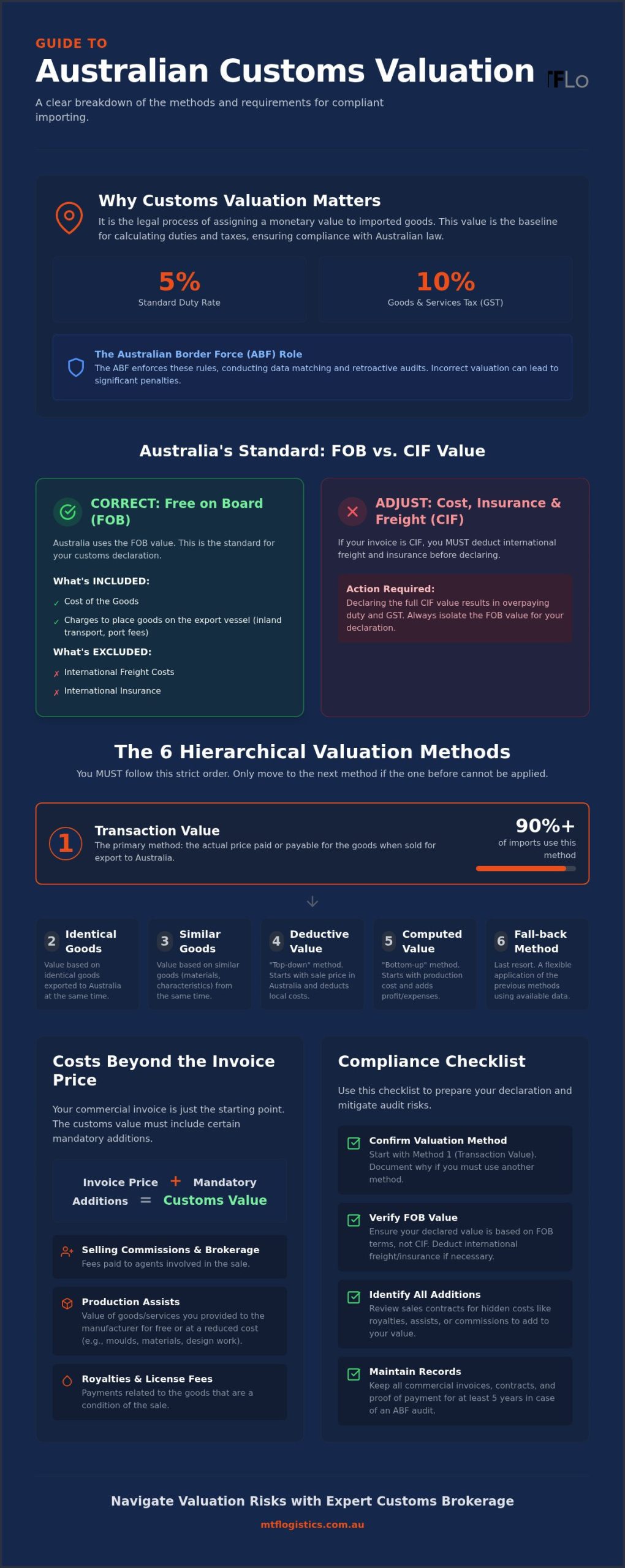
Customs valuation is the process of assigning a monetary value to imported goods to determine the revenue owed to the Commonwealth. Under Sections 154 to 161L of the Customs Act 1901, importers are legally required to declare an accurate value for every shipment. This figure serves as the baseline for calculating the 5% standard duty and the 10% GST. Even when goods qualify for duty-free entry through Free Trade Agreements, the valuation remains critical. An incorrect value impacts the Value of the Taxable Importation (VoTI), which can lead to underpaid GST or incorrect assessments of anti-dumping duties. Most declarations rely on Customs Valuation Methods established by the WTO, focusing primarily on the “price paid or payable” for the goods.
The Australian Border Force (ABF) acts as the primary agency responsible for customs and border protection, ensuring that trade flows remain secure and compliant as of 2026. Beyond simple border checks, the ABF utilizes sophisticated data-matching tools to conduct risk analysis on import declarations. They look for discrepancies between industry averages and declared values to identify potential revenue leakage. Valuation data isn’t just checked at the point of entry. The ABF has the authority to conduct retroactive audits years after a shipment has cleared. If an audit reveals under-valuation, businesses face significant penalties and back-payments that can disrupt cash flow and damage their reputation as a compliant trader. Using correct customs valuation methods Australia is the only way to mitigate these regulatory risks.
A common point of confusion for many importers is the distinction between Free on Board (FOB) and Cost, Insurance, and Freight (CIF) values. Australia utilizes the FOB value as the standard for customs declarations. This means the customs value includes the cost of the goods and all charges incurred up to the point of export, but it excludes international freight and insurance. If you receive a CIF invoice, you must deduct the international transport costs before lodging your declaration. Declaring the full CIF value results in overpaying duty and GST. Conversely, failing to include costs like inland transport in the country of origin leads to non-compliance. Precision at this stage ensures that your landed costs are calculated correctly without unnecessary expenditure. Understanding these customs valuation methods Australia helps maintain a transparent relationship with the authorities while protecting your profit margins.
Australia adheres to an international framework that requires importers to follow a strict sequential order when determining the value of their goods. This system, known as The 6 Hierarchical Customs Valuation Methods, ensures that the valuation process remains objective and predictable. You must attempt to use Method 1 before considering any subsequent options. If the conditions for Method 1 aren’t met, you move to Method 2, and so on, until a valid valuation is established. This hierarchy prevents importers from arbitrarily choosing a method that might result in a lower duty payment.
Method 1 relies entirely on a “sale” occurring. Certain importations, such as samples, gifts, or goods sent on consignment, don’t involve a transfer of ownership for a price. In these instances, the transaction value method is legally inapplicable. Another common hurdle involves related-party transactions. If a buyer and seller are related, the ABF may scrutinize whether that relationship influenced the price. To use Method 1 in these cases, you must demonstrate that the price was settled at an “arm’s length” basis, mirroring a transaction between unrelated parties. For complex corporate structures, engaging expert customs clearance services ensures these relationships are declared transparently to avoid audit triggers.
Finding comparable data for Methods 2 and 3 requires access to specific trade records that most individual importers don’t possess. When these fail, the focus shifts to internal costs. The Computed Value method is particularly relevant for bespoke manufactured items where no market equivalent exists. It requires detailed accounting of raw materials, labor, and manufacturer overheads. Because Method 6 is a last resort, it demands a high level of technical precision to satisfy ABF requirements. Navigating these customs valuation methods Australia requires a steady hand to maintain compliance while ensuring you aren’t overpaying on duty.
A commercial invoice price is a starting point, not the definitive customs value. Under customs valuation methods Australia, specific costs must be added to the price paid to arrive at the legal value for duty. These additions ensure the declared value reflects the total economic consideration given for the goods. Failing to account for these “hidden” costs is a primary reason for audit failures, even when the importer believes they’ve acted in good faith.
Differentiating between types of commissions is vital for accurate reporting. Selling commissions, which a seller pays to an agent to secure the deal, are dutiable and must be included. Conversely, buying commissions paid by the importer to their own agent for sourcing services are generally non-dutiable. Additionally, because Australia uses the FOB standard, all costs incurred prior to the goods leaving the country of export are included. This includes specialized packing materials and foreign inland freight. If your supplier charges a separate fee for transporting goods from the factory to the port, that cost is part of the customs value.
Royalties and license fees also require close scrutiny. If you’re required to pay a royalty as a condition of the sale for the imported goods, that amount must be added to the value. This often applies to branded apparel or patented technology where the right to use the IP is inextricably linked to the purchase of the physical product.
Assists include tools, dies, moulds, or specific materials provided by the importer to the manufacturer free of charge or at a reduced cost. If you supply the raw materials or the design blueprints used in production, the value of these items must be added back into the declaration. Importers have the option to amortise the cost of an assist over a specific production run or include the total value in the first shipment. This methodical approach ensures the ABF sees the total economic value of the goods, not just the assembly fee. Documentation for these assists is a high priority during compliance reviews.
Just as some costs are added, others can be legally excluded to avoid overpaying duty. International freight, insurance, and Australian inland transport are not part of the customs value. Similarly, charges for installation, assembly, or technical assistance performed after the goods arrive in Australia are non-dutiable. To protect your margins, it’s best practice to request that suppliers split invoices. This clearly separates the goods’ value from post-exportation services, providing the transparency required for a smooth customs valuation methods Australia assessment and preventing unnecessary duty spend.
Accuracy in reporting isn’t just about the numbers on your commercial invoice; it’s about the systematic process you use to arrive at those figures. To satisfy the Australian Border Force, you must demonstrate that you’ve applied the correct customs valuation methods Australia requires for your specific trade scenario. This methodical workflow helps you identify potential gaps before they become audit liabilities, ensuring your landed cost calculations remain precise and defensible.
Your review should begin with the Incoterms listed on the contract. Because Australia uses the FOB standard, an “Ex-Works” (EXW) invoice requires you to add inland transport costs from the factory to the port. Conversely, a “Cost, Insurance, and Freight” (CIF) invoice requires you to deduct international freight and insurance to avoid overpaying duty. You must also verify the currency conversion. The ABF requires the exchange rate applicable on the exact date the goods were exported, not the date of payment or arrival. Finally, identify any “retrospective” discounts. Customs typically only recognizes discounts that are available and documented at the time the goods are exported.
If the buyer and seller are related entities, you fall under the scrutiny of Section 154 of the Customs Act. You’re responsible for gathering evidence that proves the relationship didn’t influence the price. This often involves providing “test values” from similar transactions with unrelated parties to show the price is at an arm’s length. It’s also vital to disclose any transfer pricing adjustments to the ABF. Failing to report these year-end price adjustments can lead to significant retroactive penalties during a compliance review.
The strength of your declaration rests on your paper trail. You must maintain a comprehensive file for every shipment, including the Bill of Lading, the commercial invoice, and the actual Proof of Payment (such as a bank swift message). If you’ve provided assists like moulds or specialized materials to the manufacturer, keep a ledger showing how these costs were amortized. Under Australian law, you must maintain these records for a mandatory period of 5 years. Having these documents organized and readily available projects an image of organized expertise and simplifies the audit process. To ensure your documentation meets these rigorous standards, you can request a professional customs clearance review to identify and resolve potential risks.
Managing international trade requires a steady hand to navigate the nuances of government regulations. A professional customs broker serves as a vital partner, providing the organized expertise needed to manage customs valuation methods Australia effectively. This partnership alleviates the stress of potential audits by ensuring every declaration is technically sound and data-driven. By maintaining control over complex global processes, a broker ensures your business remains a compliant and reliable participant in the Australian trade environment.
The financial impact of a valuation error is dictated by your tariff rate. If an item is incorrectly classified, even a perfect valuation won’t save you from compliance failures. This is why HS code classification Australia is inextricably linked to the valuation process. A unified approach to customs clearance Australia ensures that both the “what” and the “how much” are reported with precision. Modern trade compliance leaves no room for “near enough” approximations. A small percentage error in value, multiplied by a high duty rate, can result in substantial financial penalties that the ABF will pursue retroactively. Conversely, accurate valuation prevents you from overpaying duties on costs that should be excluded, such as international freight or assembly charges incurred after arrival.
Since 2014, MTF Logistics has provided end-to-end support for businesses managing complex global systems. We act as a reliable guide, offering the visibility needed to track every cost from the point of origin to the final destination. A methodical, organized approach to logistics management Australia prevents the fragmentation that often leads to missing data or unrecorded assists. This visibility is essential for ensuring that customs valuation methods Australia are applied consistently across all shipments. By integrating technical tools with seasoned industry knowledge, we facilitate a transparent process that prioritizes your stability in a volatile market. Our team understands the intricacies of the Customs Act and works to simplify these difficult tasks for our clients. Ensure your customs valuation is compliant with MTF Logistics and gain the confidence that comes with professional oversight.
Accurate valuation is the foundation of a successful import strategy. By mastering the hierarchical customs valuation methods Australia requires, you protect your business from the financial and reputational risks of under-declaration. Success depends on moving beyond the invoice price to account for production assists, royalties, and foreign inland freight. Maintaining a rigorous 5-year record-keeping standard ensures you’re always prepared for scrutiny from the Australian Border Force while protecting your profit margins.
Managing these complexities doesn’t have to be a source of stress. Since 2014, MTF Logistics has acted as a steady hand for importers, providing expert customs clearance and comprehensive national logistics support. Our data-driven approach to compliance management provides the transparency you need for long-term stability in a volatile global market. Streamline your customs clearance with MTF Logistics to ensure your declarations are precise and defensible. With the right partnership, you can navigate the global market with confidence and focus on your business growth.
The Transaction Value Method is the most frequently applied of the customs valuation methods Australia uses, covering over 90% of all importations. It relies on the actual price paid or payable for the goods when sold for export. This method is only valid if a genuine sale has occurred and the price isn’t influenced by a relationship between the buyer and seller. If these conditions aren’t met, you must move sequentially through the remaining five methods.
You don’t include international shipping or insurance costs because Australia bases its valuation on the Free on Board (FOB) value. This means the customs value only accounts for the goods and costs incurred up to the point of export from the origin country. However, you must include foreign inland freight and packing costs that happen before the goods leave the export port. Accurately splitting these costs on your invoice prevents you from overpaying duty.
Under-declaring the value of your goods, even by accident, exposes your business to retroactive audits and significant financial penalties from the Australian Border Force. The ABF uses sophisticated data-matching tools to identify discrepancies between declared values and industry benchmarks. If an error is found, you’ll be required to pay the short-fallen duty and GST plus interest. Maintaining a transparent relationship with your broker helps mitigate these risks and ensures your declarations remain compliant.
Royalties and license fees are part of the customs value if they’re paid as a condition of the sale for the imported goods. This often occurs with branded merchandise or items involving patented technology. If the manufacturer requires you to pay these fees to acquire the goods, the ABF considers them part of the total economic consideration. You must declare these amounts clearly to ensure your customs valuation methods Australia calculations reflect the full legal value.
Transfer pricing affects valuation when a buyer and seller are related entities, as the ABF must ensure the relationship didn’t influence the price. You’re required to demonstrate that the transaction occurred on an arm’s length basis, similar to a deal between unrelated parties. Any year-end transfer pricing adjustments must be disclosed to the authorities. Failing to report these changes can lead to compliance issues and unexpected duty assessments during a post-clearance audit.
You cannot choose a different valuation method simply for convenience because the Australian system follows a strict legal hierarchy. You’re legally obligated to attempt the Transaction Value Method first. Only if Method 1 is inapplicable, such as in a non-sale importation like a gift or sample, can you proceed to Method 2. This sequential process continues until a valid value is found. Skipping steps in this hierarchy is a direct violation of the Customs Act.
Production assists are items like tools, dies, moulds, or raw materials that an importer provides to a manufacturer for free or at a reduced cost. Because these assists contribute to the goods’ production, their value must be added to the price paid to determine the true customs value. You can choose to amortise these costs over a single shipment or a full production run. Correctly documenting assists is vital for passing an ABF compliance review.
Importers are legally required to keep all records related to their customs valuations and import declarations for a mandatory period of five years. This documentation includes commercial invoices, bills of lading, proof of payment, and any contracts regarding royalties or assists. The ABF can request these files at any time during an audit to verify the accuracy of your past declarations. Organized record-keeping is the best defense against retroactive penalties and ensures long-term trade stability.


 Email
Email 1300 710 683
 Tariff Lookup
 HS Code Lookup
 Newsletter Signup