
Total Shipment Visibility, Simplified
Access all your shipment details in one place - track departures and arrivals, manage documents, notifications, invoices, and more.
Access all your shipment details in one place - track departures and arrivals, manage documents, notifications, invoices, and more.

A single missing digit on a commercial invoice can cost your business thousands in port storage fees and missed delivery windows. Many importers treat the border as a final hurdle to clear, yet the most successful logistics managers know that customs clearance is actually a documentation event that begins weeks before a vessel arrives. In 2026, with the Australian Border Force utilizing advanced data-matching tools, the margin for error has never been smaller.
It’s frustrating to deal with unpredictable timelines and the confusing communication that often flows from government agencies during a cargo hold. These delays lead to stockouts and unnecessary financial penalties that erode your profit margins. This guide provides a definitive strategy on how to avoid customs delays Australia by implementing a professional checklist that eliminates document errors. We will outline a repeatable workflow to ensure your cargo moves through the Integrated Cargo System with zero-penalty compliance and predictable release dates. By mastering these complexities, you can transform the border from a point of uncertainty into a streamlined part of your supply chain.
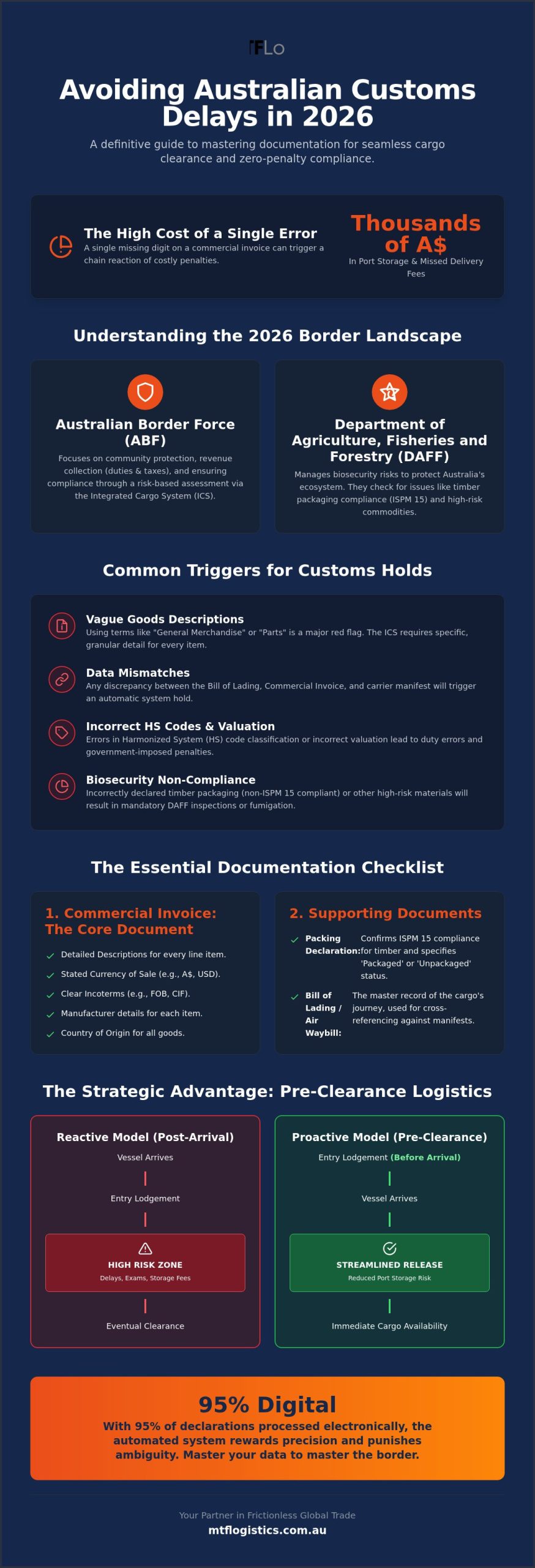
The Australian border is managed by two primary entities: the Australian Border Force (ABF) and the Department of Agriculture, Fisheries and Forestry (DAFF). While the ABF focuses on community protection and revenue collection, DAFF manages biosecurity risks to protect Australia’s unique ecosystem. Understanding their distinct roles is the first step in learning how to avoid customs delays Australia. Historically, these functions evolved from the Australian Customs and Border Protection Service, and today they operate with a highly integrated, risk-based methodology.
Customs clearance is the legal permission for goods to enter the Australian commerce stream. The Integrated Cargo System (ICS) uses complex algorithms to assess every shipment against established risk profiles. If your data triggers a flag, your cargo may be diverted for X-ray or physical examination. These interventions aren’t just time-consuming; they’re expensive. Delays often result in demurrage fees (port storage) and detention fees (container hire), which can quickly escalate into thousands of A$ per day if not resolved immediately.
Holds are rarely random events. They usually stem from data discrepancies between the Bill of Lading and the Commercial Invoice. One of the most frequent red flags for the ABF is the use of vague descriptions like “General Merchandise” or “Parts.” In 2026, the ICS requires specific, granular detail to verify that goods match their declared value and classification. Learning how to avoid customs delays Australia requires a meticulous approach to data entry, as even a minor typo can trigger a system-wide hold. While random compliance checks do occur, targeted profile audits based on past errors or high-risk origin ports are far more common.
The regulatory landscape has become more complex this year. Importers now face stricter reporting requirements regarding modern slavery and sustainability within their supply chains. Increased automation in the ICS means that errors are identified instantly, often before the cargo even leaves the origin port. Even with the trend toward near-shoring, the need for rigorous documentation remains absolute. Digital lodgement is now the standard, with approximately 95% of declarations processed electronically. However, this automation rewards precision and punishes ambiguity. A steady hand in managing these digital submissions is essential for maintaining a predictable supply chain and ensuring your cargo moves through the border without unnecessary friction.
Achieving a seamless border transition is less about the physical arrival of goods and more about the digital accuracy of the paperwork submitted days prior. Understanding how to avoid customs delays Australia begins with a meticulous review of your transit documents. Importers are legally required to declare all goods arriving in Australia, and any mismatch between your Bill of Lading (BOL) and your Commercial Invoice will trigger an automatic system flag in the Integrated Cargo System.
The Commercial Invoice is your most critical document. In 2026, compliance requires more than just a total price; you must provide detailed descriptions for every line item to avoid generic terms that invite scrutiny. You’re required to state the exact Currency of Sale (e.g., A$) and clear Incoterms. Manufacturer details and the country of origin are mandatory for each item to satisfy ABF data-matching protocols.
For businesses using reliable sea freight services, this document is vital for biosecurity. It confirms ISPM 15 compliance for timber packaging and specifies if cargo is ‘Packaged’ or ‘Unpackaged’. Incorrectly answering these questions often leads to mandatory fumigation or physical inspections, which are primary causes of avoidable port delays and additional handling costs.
Beyond biosecurity and valuation, your Bill of Lading or Air Waybill serves as the master record of your cargo’s journey. In 2026, the ABF cross-references these against carrier manifests to identify unauthorized transshipments or hidden transit risks. Don’t overlook the importance of Certificates of Origin, either. These are the only way to unlock duty concessions under Australia’s various Free Trade Agreements. Without a valid certificate, you’re often forced to pay the full 5% duty rate on items that could otherwise enter duty-free. Managing these documents through a professional customs clearance service ensures every concession is captured and every compliance box is ticked before your ship hits the horizon.
The Harmonized System (HS) code acts as the universal language for the Australian Border Force. It determines the duty rate, the necessity for specific permits, and the application of Goods and Services Tax (GST). HS Code accuracy is the primary factor in automated clearance speed. When these codes are entered precisely, the Integrated Cargo System (ICS) can process declarations in seconds. If the code is incorrect, the system flags the entry for manual review, which is a primary reason why businesses seek professional advice on how to avoid customs delays Australia.
Mis-classification carries heavy financial risks. Underpaying duty leads to back-taxes and significant penalties; overpaying results in lost capital that’s difficult to recover from the government. In 2026, the ABF has increased its scrutiny on tech and renewable energy imports, where new tariff sub-headings have been introduced to manage evolving global supply chains. Ensuring your classification matches the current 2026 schedule is essential for maintaining a predictable delivery timeline.
A frequent error involves selecting ‘Parts’ codes when a ‘Whole’ code is required. If you’re importing a complete assembly in multiple shipments, the ABF often expects it to be classified under the finished product code rather than individual components. You shouldn’t rely solely on your supplier’s suggested HS code. Suppliers often use codes specific to their domestic market that don’t align with the Australian Customs Tariff. This discrepancy is a common trigger for audits and is a hurdle you must clear to understand how to avoid customs delays Australia.
Accurate valuation is just as critical as classification. The ‘Transaction Value’ is the price actually paid or payable for the goods, but it can be challenged if the ABF suspects the relationship between the buyer and seller has influenced the price. To calculate the Value of the Taxable Import (VoTI), you must include the customs value plus any duty payable, international transport, and insurance costs. This total serves as the basis for GST calculation.
You also need to account for ‘assists’ like tooling or dies provided to the manufacturer for free, along with royalties and selling commissions. These must be added to the customs value to ensure legal compliance. For a deep dive into customs clearance Australia, it’s vital to recognize that the ABF operates on a strict liability basis. This means errors result in penalties regardless of whether they were intentional. Precise valuation and classification are the steady hands that guide your cargo safely through the border.
While the ABF focuses on revenue and legality, the Department of Agriculture, Fisheries and Forestry (DAFF) manages biological threats. Australia’s isolated geography makes its biosecurity standards among the strictest in the world. For many importers, a “customs hold” is actually a biosecurity hold. Understanding how to avoid customs delays Australia requires recognizing that DAFF operates independently of the ABF; even if your duty is paid, your cargo won’t move if it poses a biological risk.
Before purchasing stock, you must consult the Biosecurity Import Conditions (BICON) database. This system dictates whether you need an import permit or specific offshore treatments. High-risk commodities that require extra vigilance include:
Failing to check BICON before your goods depart is a leading cause of cargo being re-exported or destroyed at the importer’s expense.
The most common biosecurity failure involves wood packaging material (WPM). All timber pallets, crates, or dunnage must meet the ISPM 15 standard, which requires heat treatment or fumigation. In 2026, offshore treatment certificates are under high scrutiny. You must ensure your provider is on the DAFF-approved list, particularly during the Brown Marmorated Stink Bug (BMSB) season. This high-risk period runs from September to April, requiring mandatory treatment for goods arriving from designated target risk countries. There are specific air freight vs sea freight biosecurity considerations during this window, as transit times and storage environments affect treatment validity.
Non-commodity issues frequently cause the most significant bottlenecks. This occurs when the container itself, rather than the goods inside, is contaminated with soil, seeds, or live insects. In 2026, national wait times for non-commodity inspections can span several days depending on port congestion. Booking these inspections requires precise timing; if your documentation is incomplete, you can’t even enter the queue. To maintain control over your supply chain, you should utilize a specialized customs clearance service that manages these DAFF interactions proactively. Knowing how to avoid customs delays Australia involves more than just filling out forms; it’s about ensuring every physical and digital requirement is met before the container hits the wharf.
The most effective strategy for how to avoid customs delays Australia is to adopt a pre-clearance model. This approach involves lodging import declarations through the Integrated Cargo System (ICS) well before the vessel or aircraft enters Australian territory. When documentation is submitted early, the ABF and DAFF can complete their initial risk assessments while the goods are still in transit. If a “line hold” or request for information occurs, it can be resolved before the cargo hits the wharf, preventing the immediate onset of port storage charges.
A licensed customs broker acts as your essential legal liaison with the ABF. They don’t just translate your commercial data into the technical language of the ICS; they monitor the system in real-time to catch and rectify errors before they become formal compliance breaches. This proactive management is the hallmark of a steady hand in logistics. By linking freight forwarding with professional brokerage, you gain end-to-end visibility that ensures the physical movement of your goods is always synchronized with their legal status.
Professional brokerage significantly reduces your business’s risk profile in the eyes of border agencies. One of the strongest tools available is a formal Customs Ruling. Your broker can apply for a binding classification or valuation ruling from the ABF before you even place an order with a supplier. This provides absolute legal certainty and is a definitive answer for how to avoid customs delays Australia caused by classification disputes. Additionally, managing the “last mile” involves ensuring that duty and GST payments are processed the moment the entry is cleared. Even a few hours of delay in funds transfer can cause a container to miss its transport window, leading to unnecessary detention fees.
To achieve consistent, fast clearance, your internal workflow should mirror the precision of the agencies involved. Reliability is built on a repeatable documentation process. Before your next shipment departs, perform a final review using this strategic summary:
Partnering with an expert for national logistics management ensures these steps aren’t just one-off checks but part of a comprehensive compliance culture. This organized expertise allows your business to navigate the complexities of the 2026 trade environment with calm confidence.
Mastering the complexities of the Australian border requires a shift from reactive troubleshooting to proactive compliance. By prioritizing the “Golden Three” documents and ensuring absolute precision in HS code classification, you eliminate the data discrepancies that trigger costly audits. You should also treat biosecurity as a primary logistical pillar by verifying BICON conditions before your cargo leaves the origin port. This methodical approach ensures that your cargo moves through the Integrated Cargo System without the friction of manual interventions.
Understanding how to avoid customs delays Australia is ultimately about maintaining control through rigorous preparation. MTF Logistics has provided expert customs clearance since 2014, covering all Australian ports and industry-leading project logistics management. To ensure your documentation meets every 2026 regulatory standard and to protect your business from unnecessary storage fees, Request a Customs Compliance Audit from MTF Logistics. With a steady hand managing your digital lodgements, you can turn the border into a predictable gateway for your ongoing business growth.
Electronic lodgements through the Integrated Cargo System (ICS) are often processed within minutes or hours if all documentation is accurate. However, if a shipment is flagged for manual review or physical examination, the timeline can extend to several business days. In 2026, air cargo generally clears faster than sea cargo due to lower volumes and different biosecurity screening processes. Pre-lodging your entry before arrival is the best way to ensure same-day release.
You aren’t legally required to use a licensed broker, but it’s the standard practice for commercial importers due to the complexity of Australian customs law. Brokers possess the expertise to navigate the Integrated Cargo System and ensure accurate classification. Given that the ABF operates on a strict liability basis, even accidental errors can lead to heavy penalties. Most businesses find that the risk of self-lodgement outweighs the cost of professional representation.
Incomplete or inaccurate documentation remains the most frequent cause of cargo holds at the Australian border. Discrepancies between the commercial invoice and the packing list often trigger system alerts in the ICS. Vague descriptions, such as “spare parts” or “general merchandise,” are also major red flags. Ensuring your paperwork is granular and matches the physical cargo is the most effective way regarding how to avoid customs delays Australia and maintain a predictable timeline.
You should contact your customs broker or freight forwarder to obtain a real-time status update from the Integrated Cargo System. They can check for specific status codes that indicate whether the delay is due to a document request, a biosecurity hold, or a physical examination by the ABF. If you’re a high-volume importer, you may also have direct visibility through your logistics provider’s digital tracking portal, which integrates directly with government systems.
Delays often result in escalating costs, including port storage fees and container detention charges, which can exceed A$300 per day. You might also face Import Processing Charges for manual interventions and Biosecurity Cost Recovery Charges if DAFF requires an inspection. These financial penalties are in addition to the indirect costs of stockouts and supply chain disruptions. Proactive management is essential to prevent these avoidable expenses from eroding your profit margins.
The Australian Border Force (ABF) manages revenue collection, trade compliance, and border security, while the Department of Agriculture, Fisheries and Forestry (DAFF) handles biosecurity risks. ABF ensures you pay the correct duty and GST; DAFF ensures your cargo doesn’t introduce pests or diseases into Australia. Both agencies operate independently. Your shipment must receive clearance from both entities before it can be legally released into the Australian commerce stream.
You can reduce or eliminate customs duty by utilizing Free Trade Agreements (FTAs) or the Tradex scheme, provided you have the correct certificates of origin. Most goods valued at A$1,000 or less are exempt from duty and GST under the de minimis threshold. However, commercial shipments above this value almost always attract GST at 10%. Working with a professional is key to discovering how to avoid customs delays Australia while maximizing legitimate tax concessions.
Using the wrong HS code can lead to the underpayment of duty, which triggers significant fines and potential audits of your previous shipments. Even if the error results in an overpayment, recovering those funds from the ABF is a complex and time-consuming process. In 2026, the Integrated Cargo System uses advanced data-matching to identify classification errors instantly. Accurate coding is vital for maintaining a clean compliance record and avoiding legal complications.


 Email
Email 1300 710 683
 Tariff Lookup
 HS Code Lookup
 Newsletter Signup