
Total Shipment Visibility, Simplified
Access all your shipment details in one place - track departures and arrivals, manage documents, notifications, invoices, and more.
Access all your shipment details in one place - track departures and arrivals, manage documents, notifications, invoices, and more.

What if the most expensive part of your import isn’t the freight, but the three-day delay caused by a single misclassified HS code? Deciding when to use a customs broker is a critical choice that affects your bottom line long before your goods reach the wharf. It’s understandable to feel a sense of anxiety when cargo hits the Australian border. You’ve likely worried about unexpected storage fees or the strict eye of biosecurity inspections; these are valid concerns for any business trying to maintain predictable landing costs.
This guide clarifies the specific triggers that necessitate professional intervention, from legal requirements for goods over $1,000 to the commercial advantages of expert tariff classification. We’ll explore how a licensed broker ensures full compliance with the latest regulations, helps you navigate new digital systems like the TradeClear portal, and secures zero-delay clearance for your international trade operations. By understanding these requirements, you can transform the customs process from a source of stress into a streamlined part of your supply chain.
A customs broker is a licensed intermediary who ensures revenue protection and community safety by facilitating the lawful entry of goods into Australia. In the local trade environment, this isn’t merely a logistical convenience; it’s a regulated necessity. Under the Customs Act 1901, the authority to lodge an import declaration is strictly limited to the owner of the goods or a licensed customs broker. This legal framework exists to maintain the integrity of the border, ensuring that individuals managing sensitive trade data are vetted, qualified, and held to rigorous professional standards.
The Australian Border Force (ABF) issues two primary types of licenses to maintain this standard. A Corporate License is granted to a business entity, while a Nominee License is held by an individual practitioner who works on behalf of a corporate broker. This dual-layer structure ensures that both the company and the individual handling your cargo have demonstrated the required technical competency. Deciding when to use a customs broker often comes down to the need for this specialized knowledge, especially when dealing with complex tariff schedules that undergo frequent updates.
Many importers assume that delegating tasks to a professional removes their own legal liability. However, the importer remains ultimately responsible for the accuracy of all information provided to the ABF. If a shipment is misclassified or undervalued, the business owner faces the resulting fines and delays. A broker acts as a vital shield against these risks by providing a layer of technical oversight. They utilize the Integrated Cargo System (ICS) to submit declarations, ensuring that your data is formatted correctly and compliant with current laws. This partnership allows you to maintain visibility while relying on a steady hand to manage the intricacies of border logic.
The government mandates high standards for brokerage licenses because these professionals are responsible for calculating the correct duty and GST. Their goal is to ensure you pay exactly what is required, no more and no less, by applying the correct tariff concessions or Free Trade Agreements. Beyond financial accuracy, brokers protect the community by acting as a filter for prohibited or dangerous goods. They verify that your cargo meets strict biosecurity requirements and doesn’t violate tightening controls on specific origins. This protective role prevents restricted items from entering the domestic supply chain, making the broker an essential partner for safe and compliant international trade.
Identifying the exact moment when to use a customs broker is vital for maintaining a lean supply chain. While casual online shoppers rarely interact with the Australian Border Force (ABF), commercial importers operate under a different set of rules. The transition from a simple parcel delivery to a regulated commercial entry happens at very specific tipping points. Understanding these triggers helps you avoid the high-pressure environment of border delays and unexpected costs.
For any consignment with a value exceeding $1,000 AUD, the ABF requires a Formal Import Declaration (FID). This is a complex legal document where the accuracy of multiple tax lines is paramount. You must account for Customs Duty, GST, and depending on the commodity, Luxury Car Tax (LCT) or Wine Equalisation Tax (WET). Professional Customs Brokers and Freight Forwarders manage these calculations to ensure you don’t overpay or trigger an audit. Many new importers fall into the “Self-Assessed Clearance” (SAC) trap. They assume small commercial shipments don’t need formal entry; however, if the goods are intended for resale or business use, the level of scrutiny increases significantly. A broker ensures your commercial importation is handled with the correct declaration type from the outset.
Australia’s island status makes our quarantine procedures uniquely rigorous. Biosecurity inspections are a common cause of delay for those unfamiliar with the system. A broker plays a critical role in managing seasonal measures, such as the Brown Marmorated Stink Bug (BMSB) requirements. These rules apply to specific goods and origins during high-risk months and require strict treatment certifications. Failing to provide the correct evidence can lead to your cargo being exported or destroyed at your expense. For more detailed insights into these regulations, you can review our comprehensive guide on customs clearance Australia. Managing these risks requires a steady hand and a deep understanding of Department of Agriculture standards. If you are handling complex cargo or regulated goods, the experts at MTF Logistics can facilitate a smooth transition through the border.
Professional intervention is also essential for goods in prohibited or restricted categories. This includes items that require specific permits before they even leave the country of origin. A broker verifies these permits and ensures all paperwork aligns with the latest 2026 regulatory updates. This proactive approach eliminates the anxiety of border inspections and keeps your landing costs predictable. By engaging an expert early, you secure the end-to-end visibility needed for a successful international trade operation.
The distinction between a freight forwarder and a customs broker is often blurred, yet their roles are fundamentally different. A freight forwarder acts as the architect of transport, managing the physical movement of goods across oceans and continents. In contrast, a customs broker is a legal specialist who manages the relationship between your cargo and the Australian Border Force (ABF). While one ensures your goods arrive, the other ensures they are legally allowed to enter. Understanding this division is the first step in building a resilient international trade strategy.
Freight forwarders coordinate the complex journey of your cargo. They specialize in booking cargo space, managing Less than Container Load (LCL) or Full Container Load (FCL) shipments, and tracking movement through every transit point. This role involves deep expertise in sea freight services, where they negotiate with carriers to secure the most efficient routes. Beyond booking, forwarders handle essential transport documentation and the critical details of cargo insurance. Their focus is on the efficiency of the supply chain, ensuring that the physical logistics of sea, air, and land transport remain seamless and cost-effective.
A customs broker operates in the world of legal compliance and technical classification. Their primary tool is the Harmonized System (HS) Code. This ten-digit number determines the duty rates and taxes applicable to your goods. A single digit error in this classification can lead to thousands of dollars in penalties or missed savings. Brokers also look for opportunities to legally reduce your overhead by applying for Tariff Concession Orders (TCOs). These orders allow for duty-free entry if no local Australian industry produces a substitutable good. By managing the communication bridge with the ABF, a broker ensures your business remains in good standing while optimizing your tax position.
Successful importers typically choose an integrated “End-to-End” logistics partner that provides both services under one roof. There are significant risks in using a forwarder who “outsources” brokerage to an unknown third party. This often leads to a lack of visibility and fragmented communication during critical border inspections. Knowing when to use a customs broker who is part of your freight team allows for a steady hand to manage both movement and compliance simultaneously. This integrated approach at MTF Logistics ensures that data flows directly from the transport documents into the customs entry, reducing the risk of data entry errors and providing a transparent path through the border.
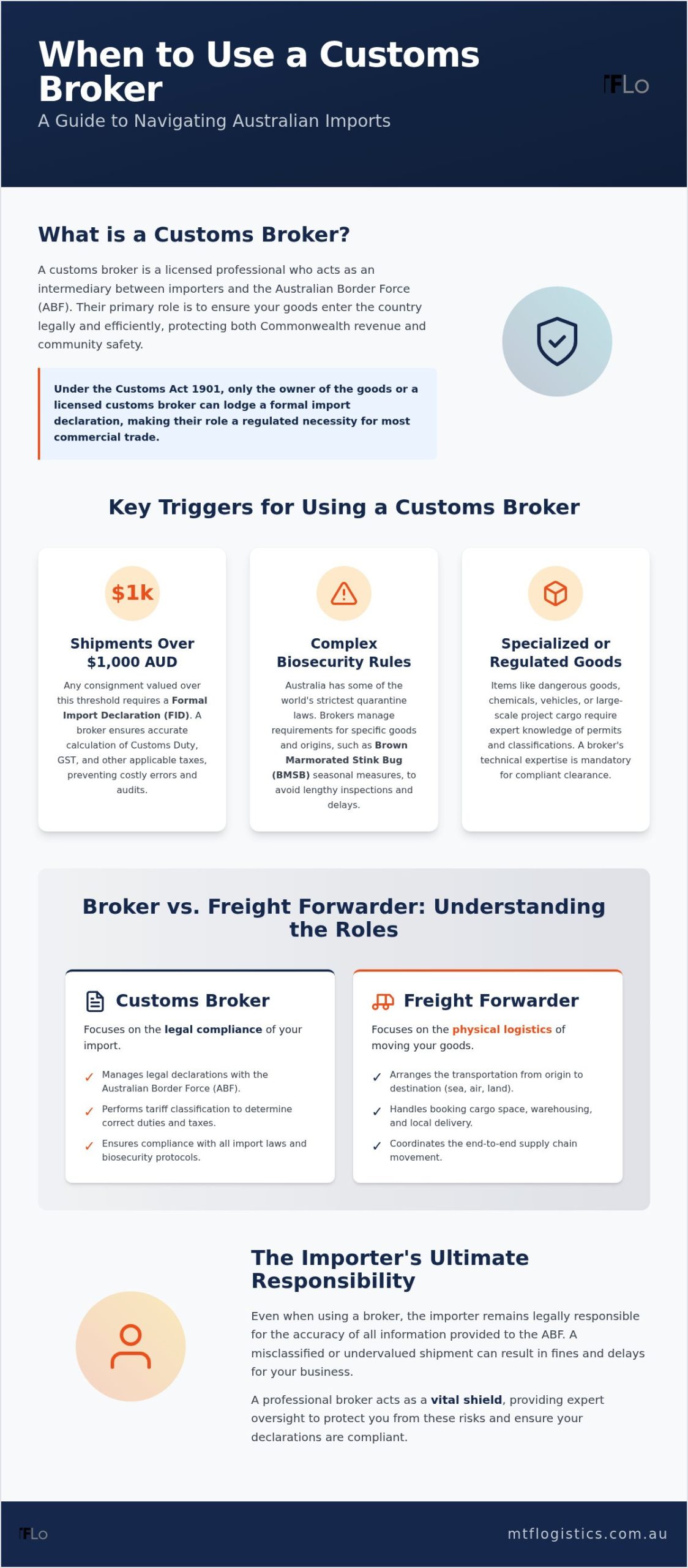
Certain cargo types move well beyond standard clearance procedures. Importing Dangerous Goods (DG) or hazardous materials requires specialized documentation and strict adherence to international safety protocols. Similarly, leveraging Free Trade Agreements (FTAs) is a strategic task that demands professional oversight. While these agreements can eliminate import duties, the burden of proof lies entirely with the importer. A broker verifies the complex Origin Criteria and ensures the Certificate of Origin meets the exact requirements of the relevant treaty, preventing the risk of back-dated duty assessments.
Industrial projects often involve oversized freight that won’t fit in a standard container. This project logistics environment is a primary indicator of when to use a customs broker. These shipments require months of pre-arrival planning to ensure the border doesn’t become a bottleneck. Managing heavy-lift cargo involves coordinating with port authorities and managing “split shipments.” This is where one large machine arrives in multiple parts across different vessels or dates. A broker ensures these components are declared correctly under a single tariff heading, which is essential for both legal compliance and cost control. Without this coordination, industrial importers often face massive demurrage costs and assembly delays.
Different industries face unique border hurdles that require sector-specific expertise. In the fashion world, managing high volumes and rapid seasonal shifts requires a partner who understands garment industry logistics and the nuances of textile classification. For pharmaceutical importers, the stakes are even higher. You must ensure that Therapeutic Goods Administration (TGA) regulations are met while protecting cold-chain integrity throughout the clearance process. Food imports present a third challenge, navigating the strict intersection of biosecurity inspections and mandatory labeling laws. Each of these scenarios carries a high risk of cargo seizure or destruction if the paperwork is not perfect. Professional intervention ensures that these industry-specific regulations are managed with precision, allowing for a predictable flow of goods.
If you are managing high-stakes cargo or complex industrial equipment, the specialized team at MTF Logistics provides the steady hand needed to navigate these mandatory triggers.
Selecting a customs broker is a strategic decision that defines the security of your international supply chain. It’s not just about filing paperwork; it’s about finding a partner who understands the specific regulatory hurdles of your industry. Verification is the first step. You must ensure the professional is currently licensed by the Australian Border Force (ABF). An active license is your guarantee that the broker stays current with mandatory professional development and the latest 2026 regulatory updates. Knowing when to use a customs broker is only half the battle; choosing one with a proven track record ensures that your compliance remains beyond reproach.
Industry-specific expertise is equally vital. A broker who specializes in general freight might struggle with the nuances of pharmaceutical cold-chain requirements or the complexities of dangerous goods handling. Ask potential partners about their experience with your specific commodity. You should also prioritize technology and visibility. In a modern trade environment, you need real-time status updates on your clearance. A broker who provides data-driven insights allows you to manage your inventory with confidence. This “steady hand” approach is built on long-term stability; a broker who has navigated decades of market volatility offers a level of calm expertise that newer entities simply cannot match.
A broker with a national presence offers a level of consistency that smaller, localized operations often lack. National coverage ensures that your service standards remain high regardless of which Australian port your cargo enters. This reach is supported by established relationships with local port and biosecurity officers, which can be the difference between a quick resolution and a costly delay. MTF Logistics has provided reliable brokerage and end-to-end logistics support across all major Australian ports since 2014. This longevity reflects a deep-rooted understanding of the local regulatory environment and a commitment to transparent, reliable service.
If you’re currently managing imports yourself, transitioning to a managed professional service is a significant step toward scalability. The process typically begins with a pre-import consultation. This allows your broker to identify potential “red flags,” such as missing origin certificates or incorrect labeling, before your goods ever leave the supplier. Identifying these issues early prevents the “DIY” trap where small errors lead to large fines. Deciding when to use a customs broker for a comprehensive audit of your current processes can uncover duty-saving opportunities you might have missed. To secure your border operations and ensure full compliance, contact the expert team at MTF Logistics for a customs consultation.
Managing the intersection of global logistics and local regulations requires more than just administrative effort; it’s a strategic commitment to compliance. You’ve learned that professional intervention is essential for shipments exceeding the $1,000 threshold and for cargo subject to strict biosecurity inspections. By integrating brokerage with freight services, you eliminate the communication gaps that often lead to border delays and unexpected storage fees.
Understanding when to use a customs broker allows you to move away from the uncertainty of DIY clearance and toward a model of predictable landing costs. Whether you’re handling high-volume garment logistics or complex heavy-lift project cargo, the right partner ensures your business remains compliant with the latest Australian Border Force standards. This proactive approach protects your reputation and your bottom line.
MTF Logistics has served as a steady hand for Australian importers since 2014. Our team specializes in comprehensive sea and air freight integration, providing the end-to-end visibility you need to scale your operations with confidence. Simplify your imports with MTF Logistics expert customs clearance. Your path to a more resilient supply chain starts with professional, licensed oversight.
It isn’t a legal requirement for you to hire a professional, but the Customs Act 1901 dictates that only the owner of the goods or a licensed customs broker can lodge an import declaration. Most businesses find the technical complexity of the Integrated Cargo System (ICS) and the risk of non-compliance too high to manage internally. Engaging a professional ensures that your business meets all Australian Border Force (ABF) standards without the burden of self-lodgement.
Industry service fees vary depending on shipment complexity and the number of tariff lines. While costs are tailored to individual cargo requirements, you must also budget for mandatory government fees. For instance, in 2026, the Import Processing Charge (IPC) is AUD 50 for consignments valued between $1,000 and $10,000. A professional provides a clear breakdown of these predictable landing costs, ensuring your business isn’t surprised by unexpected border expenses upon arrival.
A freight forwarder that offers customs clearance does so through a licensed customs broker. This integrated model is often the most efficient choice for importers. It allows for seamless data transfer between transport documents and customs entries. When deciding when to use a customs broker, choosing an integrated partner like MTF Logistics provides end-to-end visibility and ensures that both movement and compliance are managed by a single, steady hand.
Lodging an incorrect declaration can lead to significant financial penalties, cargo seizures, and increased scrutiny in future regulatory audits. The Australian Border Force has tightened controls as of July 2026, placing a greater focus on accurate tariff classification and valuation. Even unintentional errors can result in expensive storage fees or biosecurity delays. A broker acts as a shield, verifying your data against current regulations to ensure full compliance before submission.
The customs clearance process typically takes between 24 and 48 hours for standard sea or air freight when all documentation is correct. However, this timeframe can extend if the cargo is flagged for biosecurity (AQIS) inspections or if additional permits are required. A professional broker speeds up this process. They ensure your declaration is lodged before the vessel arrives, facilitating a zero-delay transition through the border once the goods land.
You need to provide several core documents to facilitate a smooth clearance. These include the commercial invoice, a detailed packing list, and the Bill of Lading or Air Waybill. Depending on the goods, you might also need a Certificate of Origin to claim Free Trade Agreement benefits or specific permits for regulated items. Providing these documents early allows your broker to identify when to use a customs broker for specialized pre-arrival planning.
Yes, a licensed broker identifies legal avenues to minimize your duty and GST obligations. They do this by applying the correct tariff classifications and leveraging Free Trade Agreements (FTAs) or Tariff Concession Orders (TCOs). If no substitutable goods are produced in Australia, a TCO can reduce the duty rate to zero. This technical expertise ensures you don’t overpay the government while remaining fully compliant with the Customs Regulation 2015 and its successors.
While you can manage the import of personal items yourself, using a broker for Unaccompanied Personal Effects (UPE) can simplify the transition. Personal items are often subject to strict biosecurity inspections, especially if they include wooden furniture or outdoor equipment. A broker manages the quarantine paperwork and ensures you meet the criteria for duty-free entry. This service alleviates the anxiety of moving international household goods and prevents unexpected storage fees at the wharf.


 Email
Email 1300 710 683
 Tariff Lookup
 HS Code Lookup
 Newsletter Signup