
Total Shipment Visibility, Simplified
Access all your shipment details in one place - track departures and arrivals, manage documents, notifications, invoices, and more.
Access all your shipment details in one place - track departures and arrivals, manage documents, notifications, invoices, and more.

For many Australian wholesalers, the landed cost of an import shipment can be 20% to 40% higher than the initial factory price. It’s a common frustration to see a projected profit margin disappear once customs duties, GST, and local port fees are finally tallied. Mastering how to calculate landed cost is the only way to ensure you aren’t surprised by a customs bill that erodes your earnings. You need a precise understanding of every dollar spent from the factory floor to your warehouse door to maintain a competitive edge and protect your business from margin compression.
We understand that navigating Australian Border Force charges and complex GST calculations can feel overwhelming. This guide provides a reliable, step-by-step formula to help you factor in freight, insurance, and the often-hidden local charges that catch importers off guard. We’ll examine the specific components of the Value of the Taxable Importation (VoTI) and show you how to apply specialised knowledge of local logistics to protect your bottom line while ensuring total trade compliance. By the end of this article, you’ll have a clear framework for pricing your goods accurately every time.
Landed cost is the total price of a product once it has moved from the factory floor to your warehouse door. While the supplier invoice provides the base price, the landed cost encompasses every financial obligation incurred during the journey. This includes international freight, insurance, customs duties, taxes, and local handling fees. For Australian importers, this figure represents the true Cost Price of their inventory. Understanding this metric is vital for any business that wants to maintain a sustainable and transparent supply chain.
Many importers mistakenly rely on the Free on Board (FOB) price to estimate their margins. However, the FOB price only covers the cost of getting the goods onto the vessel at the port of origin. It ignores the significant expenses that follow. Relying solely on freight quotes often leads to “profit leak” because it fails to account for the secondary costs that occur after the ship leaves the dock. When you know how to calculate landed cost accurately, you can set retail prices that ensure every sale contributes to your bottom line rather than just covering expenses.
Unexpected port fees are one of the most common reasons a seemingly profitable shipment turns into a financial loss. Between terminal handling charges, biosecurity inspections, and storage fees, the final bill can be much higher than anticipated. Currency fluctuations also play a major role. Since most international trade is conducted in USD, a slight shift in the exchange rate can significantly increase your final Australian Dollar (AUD) cost before the goods even arrive. For high-volume importers, “roughly right” estimates aren’t sufficient. A discrepancy of even a few cents per unit can result in thousands of dollars in lost revenue over a year.
Landed cost is a critical component of your broader accounting, specifically within the Cost of Goods Sold (COGS) framework. While COGS includes all direct costs of producing or purchasing goods, the landed cost provides the granular detail needed for precise inventory valuation. Finance teams that prioritise these metrics enjoy much better cash flow visibility because they can anticipate the timing and scale of customs and tax payments. To put it simply, the unit price is what you pay the supplier, but the landed unit cost is what you actually pay to have that product ready for sale—a distinction that helps retailers like Mega Office Supplies maintain healthy margins across their inventory.
Establishing a methodical approach to tracking these figures allows you to identify which products are truly profitable and which are being weighed down by excessive logistics overheads. This level of detail is what separates successful international traders from those struggling with unpredictable margins.
To understand how to calculate landed cost effectively, you must categorise every expense into a structured formula. We use a master calculation: Product + Shipping + Insurance + Customs + Risk + Overhead. The “Product” component includes the unit price, export packaging, and any supplier-side handling fees required to deliver goods to the port of origin. Shipping costs cover inland haulage, the main sea or air freight leg, and fuel surcharges like the Bunker Adjustment Factor (BAF). Marine insurance is a non-negotiable addition. It protects your capital against transit damage or loss, which is a vital part of the cost of importing goods that many new businesses overlook. Without this protection, a single lost container could jeopardise your entire operation.
Your choice between FCL vs LCL shipping significantly impacts the per unit cost. Full Container Loads (FCL) generally offer better economies of scale, while Less than Container Loads (LCL) allow for smaller, more frequent shipments at a higher per cubic metre rate. You must also account for peak season surcharges and port congestion levies, which fluctuate based on global demand and local port conditions. While air freight offers speed, its cost structure is based on volumetric weight. This makes it significantly more expensive for dense or bulky items compared to the volume-based pricing of sea freight. Understanding these variables helps you decide which mode of transport aligns with your margin targets.
Hidden overheads often reside in the small print of financial transactions. Bank fees for international telegraphic transfers and the spread on currency conversion rates can add 1-2% to your total costs. Payment terms also create a “cost of capital” if your funds are tied up for weeks during transit. When learning how to calculate landed cost, we recommend adding a 3-5% buffer margin to your estimate to account for logistics volatility, such as unexpected detention, demurrage, or biosecurity delays. These risk factors are what often cause profit leak in uncoordinated shipments. If you don’t have the internal resources to resolve these variables for a specific route, our customs clearance experts can provide a detailed breakdown of local requirements and potential exemptions.
Mastering how to calculate landed cost requires a precise understanding of how the Australian Border Force (ABF) assesses your shipment. Duty is generally calculated as a percentage of the Customs Value (CV), which is the amount paid for the goods in Australian Dollars, excluding international freight and insurance. While a 5% duty rate is common, the true complexity arises with the Goods and Services Tax (GST). Unlike a standard domestic transaction, import GST is 10% of the Value of the Taxable Importation (VoTI). This figure is the sum of the Customs Value, the duty payable, and the costs of international transport and insurance. Failing to include these additional layers in your tax estimate is a frequent error that leads to significant profit erosion.
Local Australian fees also impact the final tally. Terminal Handling Charges (THC) and Port Service Charges are fixed costs applied by port operators for moving containers. These are separate from your freight quote and must be factored in to avoid unexpected invoices upon arrival. When these regulatory and port-side costs are combined, they often represent the largest variance between a supplier’s quote and the final price of the goods in your warehouse.
Your duty rate is directly tied to the correct HS code classification of your products. A minor error in this ten-digit code can shift your duty from 0% to 5% or even higher for protected industries. Misclassification carries heavy risks beyond just higher costs; it can lead to customs audits, significant fines, and the requirement to back-pay duties on previous shipments. Engaging a professional customs broker is essential for HS code accuracy, as they possess the technical expertise to navigate the complex Australian Customs Tariff and identify applicable concessions. This specialised oversight ensures you aren’t paying more than necessary while maintaining total trade compliance.
Australia maintains some of the world’s strictest biosecurity standards, which introduces additional variables to your landed cost. Cargo containing timber, organic materials, or perishables often requires mandatory AQIS inspections or fumigation. These biosecurity fees are charged by the Department of Agriculture, Fisheries and Forestry (DAFF) and can increase if your shipment requires extra handling or storage. Finally, you must account for the “Last Mile” delivery. Transporting goods from the terminal to your Australian warehouse involves fluctuating costs based on distance, fuel levies, and potential waiting time charges at the port. These local charges are often the most volatile part of the equation when determining how to calculate landed cost for a specific shipment.
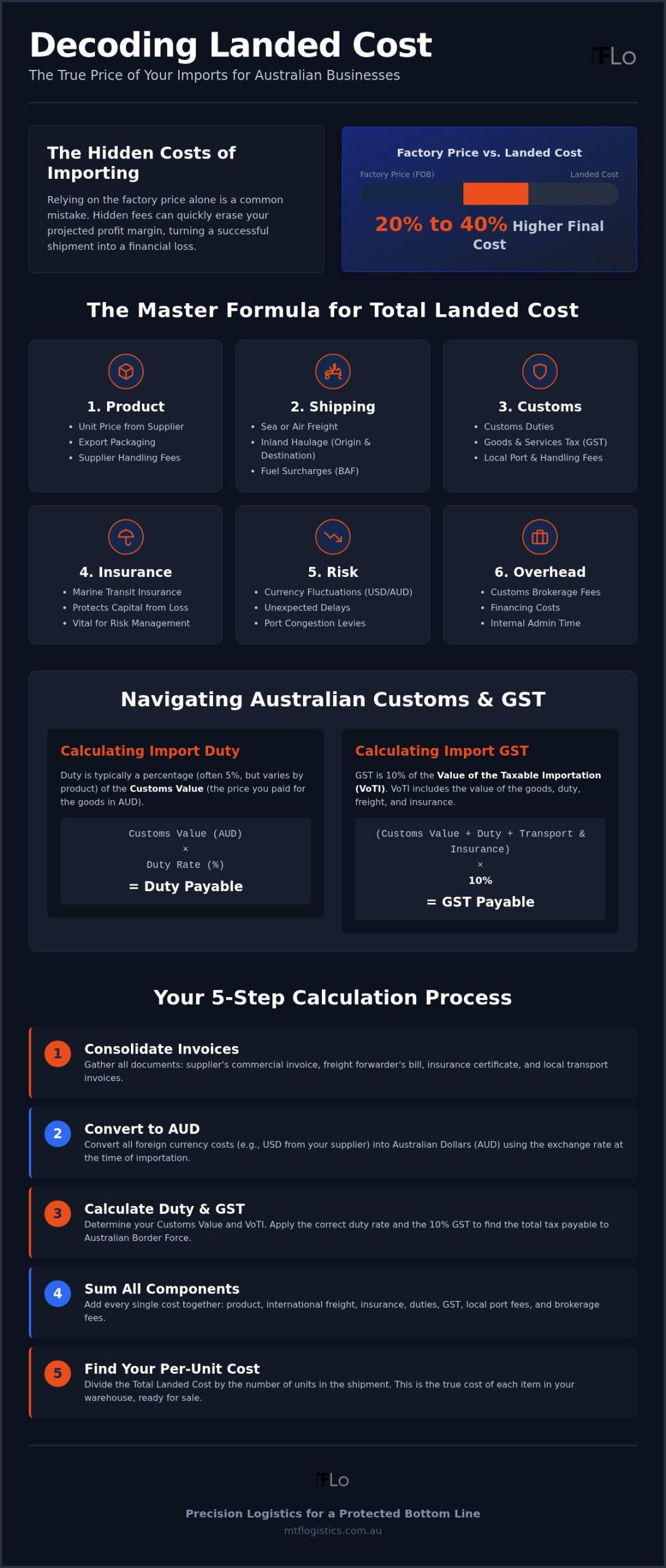
Moving from the theoretical components of importing to the practical application requires a methodical approach. This step-by-step process clarifies how to calculate landed cost by consolidating fragmented data into a single, actionable figure. By following this sequence, you ensure that no hidden port fee or currency shift remains unaccounted for in your final unit pricing.
The method you use to distribute shared costs can significantly alter your margins. For shipments of heavy, low-value goods, apportioning freight by weight is the most accurate approach. Conversely, if you are importing lightweight but expensive electronics, allocating costs based on the value of each item is more appropriate. In a mixed container with multiple product types, a hybrid approach may be necessary. We recommend using a structured spreadsheet to automate these calculations. This reduces human error and allows you to quickly adjust variables if freight rates or exchange rates shift unexpectedly during transit.
Consider a shipment with a Customs Value of $10,000 AUD. If the goods attract a 5% duty, you’ll pay $500 in duty. Assuming international freight and insurance cost $1,500, your VoTI becomes $12,000 ($10,000 + $500 + $1,500). The GST at 10% would be $1,200. Finally, adding $400 for local port fees and brokerage brings the total landed cost to $13,600. While the initial factory price was $10,000, the true cost is 36% higher. When you understand how to calculate landed cost using this methodical approach, you can see exactly where your capital is going. If you are managing a complex shipment with multiple HS codes, you can request a detailed cost analysis from our team to ensure your pricing remains profitable.
Mastering how to calculate landed cost is a significant achievement for any Australian importer, but the true business value lies in how you manage the variables that drive those numbers. End-to-end logistics management reduces the variance between your projected budget and the final invoice. When you control the entire movement of goods from origin to destination, you eliminate the communication gaps where hidden fees often hide. This methodical approach provides the visibility needed to make informed decisions about inventory levels and retail pricing strategies.
Specialised knowledge is your best tool for cost reduction. A professional customs broker does more than just lodge declarations; they actively search for duty concessions and trade exemptions that can lower your total tax obligation. These savings directly improve your net profit. Additionally, having granular landed cost data gives you a powerful lever when negotiating with global suppliers. You can identify exactly which parts of your supply chain are underperforming and decide whether to shift from EXW to FOB terms to better control your international freight expenses.
Transparency and real-time tracking are no longer optional for modern Australian businesses. The ability to see exactly where your cargo is located and anticipate arrival times allows for better warehouse planning and customer communication. When you integrate high-level logistics data into your daily operations, you move from a reactive state to one of organized expertise and control.
MTF Logistics provides the certainty required to navigate an unpredictable global market. By choosing a single partner to manage sea freight, air freight, and customs clearance, you create a seamless flow of information that reduces administrative overhead. We act as a steady hand in the volatile logistics sector, ensuring that all documentation is consolidated and compliant with Australian regulations. This “One Partner” model simplifies complex global processes and allows you to focus on growing your business while we handle the intricate details of your shipment’s journey.
The path to better margins begins with a thorough audit of your current import processes. Look for “hidden leaks” such as excessive storage fees, incorrect HS code applications, or currency spreads that are eating into your profits. We recommend setting up a standardised landed cost template for your team to use for every shipment. This ensures consistency and prevents the “roughly right” estimates that lead to financial surprises. To get a clear picture of your potential savings and trade compliance, you can request a comprehensive quote from MTF Logistics to see your true landed cost.
Mastering how to calculate landed cost is the foundation of a resilient import business. You’ve learned that moving beyond factory-gate pricing and accounting for the complexities of Australian GST, customs duties, and local port handling is the only way to gain total control over your profit margins. Accuracy in these figures ensures your pricing strategy remains competitive while protecting your bottom line from the volatility of international trade.
Visibility into every expense allows for more strategic decision-making and better negotiations with global partners. You don’t have to manage these intricacies alone. With over a decade of Australian logistics expertise and national coverage for sea and air freight, MTF Logistics provides the steady hand needed to navigate these variables. Our specialised customs brokerage ensures your shipments remain compliant and cost-effective.
Get a Professional Landed Cost Estimate from MTF Logistics to take the guesswork out of your next shipment. Your business deserves the transparency and reliability that comes with expert end-to-end management.
Yes, the Goods and Services Tax is a core component of the total landed cost because it represents a major cash outflow at the border. While GST-registered businesses can often claim this back as an input tax credit, it must be factored into your initial capital requirements. The 10% tax is calculated on the Value of the Taxable Importation, which includes the product value, duty, and international transport costs.
You must use an apportionment method to distribute shared costs like freight and insurance across different SKUs. For heavy items, allocate these costs by weight; for lightweight but expensive goods, allocate by value. This systematic approach allows you to determine how to calculate landed cost for each individual unit, ensuring your retail pricing remains accurate across your entire product range.
Freight quotes typically only cover the transportation from point A to point B. They often exclude mandatory government charges like customs duty and GST, along with local Australian fees such as Terminal Handling Charges (THC) and biosecurity inspections. These additional layers can increase the final price by 20% to 40%, making it essential to look beyond the initial logistics quote when budgeting for your shipment.
A specialised customs broker identifies legal avenues to reduce your tax burden, such as duty concessions and Free Trade Agreements. By ensuring your goods are classified under the most accurate HS code, they help you avoid overpaying duties. Their expertise also prevents costly delays and storage fees, which can quickly inflate your total expenses if the clearance process isn’t managed with professional precision.
The most frequent error is calculating GST based solely on the supplier’s invoice price. In Australia, GST is applied to the Value of the Taxable Importation, which includes the customs value plus duty and the cost of international transport and insurance. Overlooking these additional components leads to an underestimation of your tax liability and can result in unexpected bills at the port that erode your profit margins.
Exchange rates determine the Australian Dollar (AUD) value of your foreign currency invoices. The Australian Border Force uses the exchange rate prevailing on the day the goods were exported. If the AUD weakens against the USD between the time you place an order and the date of export, your duty and GST liabilities will increase, directly impacting your final margins and making how to calculate landed cost more complex.
While marine insurance isn’t a legal requirement for customs entry, it’s a vital part of the landed cost formula for risk management. Without it, you carry the full financial burden of any transit damage or loss. From a calculation perspective, the cost of insurance is included in the GST base, so it must be accounted for to ensure your tax estimates and total investment figures are accurate.
Using an incorrect HS code can lead to significant financial penalties and legal complications. It may result in paying the wrong duty rate, leading to either overpayment or a future liability for back-paid duties. Customs may also issue fines for non-compliance and flag your organisation for more frequent audits, which increases administrative costs and causes shipment delays at the border.


 Email
Email 1300 710 683
 Tariff Lookup
 HS Code Lookup
 Newsletter Signup