
Total Shipment Visibility, Simplified
Access all your shipment details in one place - track departures and arrivals, manage documents, notifications, invoices, and more.
Access all your shipment details in one place - track departures and arrivals, manage documents, notifications, invoices, and more.

Choosing a freight mode first can be the wrong starting point for a complex shipment. In project logistics Australia, the cargo, delivery site, handling needs and required milestones should shape the transport plan before you decide how it moves.
If freight, handling and delivery requirements aren’t clear, coordinating suppliers, carriers and other parties can quickly become difficult. Customs or documentation issues can add further uncertainty. That’s why a workable plan needs to connect the shipment’s requirements from the outset, rather than treating each transport stage as a separate task.
This guide explains how to plan complex project freight in Australia, identify key risks and assess whether a logistics partner is suited to your shipment. You’ll learn what information to establish early, how to clarify responsibilities and milestones, and why freight forwarding and customs brokerage can support connected import planning. MTF Logistics, an Australian freight forwarder founded in 2014, provides sea and air freight, customs clearance, export documentation and import transport project work. The right approach starts with the cargo and delivery requirements, then coordinates the steps needed to move it with greater visibility and control.
Project logistics is the planning and coordination of freight movements that have requirements beyond routine cargo handling. Rather than arranging a single freight booking, it connects cargo details, transport decisions, documentation, handling needs and delivery milestones into one workable plan. For project logistics Australia, that planning should begin with the shipment and its destination, not with an assumed freight mode.
Project cargo can include large, heavy, high-value or critical equipment. Industrial machinery and infrastructure components are common examples, but a shipment doesn’t automatically require specialist handling because of its cargo category alone. Dimensions, gross weight, packaging, sensitivity, required sequence and delivery location all influence what needs to be confirmed. Actual handling and transport requirements depend on the cargo specifications.
A shipment becomes more complex when one requirement affects another. Unusual dimensions may influence transport options; sensitive cargo may need particular handling instructions; and equipment needed in a specific installation sequence may depend on coordinated arrival dates. These factors can create dependencies between collection, export readiness, international transit, customs clearance and final delivery. Confirm cargo measurements, packaging and handling requirements with the relevant parties before settling the plan.
Early planning helps identify gaps while there’s still time to resolve them. For example, the supplier’s cargo-ready date needs to align with the chosen transport arrangements, while documentation must be prepared to support the shipment’s progress. A freight booking covers a movement; a shipment plan also sets out what must happen before and after that leg, who is responsible, and which milestones depend on it.
The importer provides shipment and delivery requirements, while the supplier confirms cargo details and export readiness. A freight forwarder coordinates freight arrangements, and a customs broker supports the clearance process. Carriers and delivery stakeholders handle their respective transport stages. Responsibilities vary by shipment, so establish who supplies information, prepares documents, tracks milestones and resolves issues before the movement begins.
Map the key handovers in sequence:
This shared view makes responsibilities clearer and helps teams spot schedule or information gaps before they affect the next milestone. An Australian freight forwarder and customs broker such as MTF Logistics may be considered for import transport project coordination, with the specific scope agreed against the shipment’s requirements.
A dependable plan starts with verified cargo information, then works outward to transport, documentation and delivery. For project logistics Australia, this sequence helps reveal constraints before a booking or milestone depends on assumptions. Australia’s freight network provides the wider operating context, but the appropriate route and arrangements must be assessed against each shipment’s specifications.
Ask the supplier for current measurements and gross weight, plus packaging details and any lifting points or handling instructions relevant to the cargo. Confirm the origin, destination, cargo-ready date, collection arrangements and delivery constraints. If items must arrive or be delivered in a particular sequence, record that dependency in the brief.
Use the information to assess potential transport modes, routes and equipment requirements. Don’t assume a route or equipment option is suitable based on a broad cargo description. Any specialist equipment or engineering requirements need review against verified specifications and confirmation by the relevant provider or carrier. If details are incomplete, identify what is unknown and who will confirm it before plans are finalised.
For broader import preparation, see this guide to how to import goods into Australia. The Australian Government’s overview of Australia’s national freight system also offers useful context for understanding the freight network in which a project movement takes place.
Turn the shipment brief into a sequence of actions. For each milestone, name an owner, the information or decision required, and the next handover. A practical workflow might be:
Build contingencies around the points most likely to affect the sequence, such as a changed readiness date, revised cargo data or an incomplete document. Agree how changes will be communicated and which dependent milestones need review. Importers developing a complex movement may consider discussing the shipment brief with a forwarder and customs broker, such as MTF Logistics, whose services include import transport project work. A clear brief gives that conversation a practical starting point.
Choose a freight mode by testing it against the shipment’s deadline, specifications and delivery requirements, not by assuming one option is always faster, more suitable or less costly. In project logistics Australia, even cargo of similar size can call for different plans if its handling needs, route or arrival sequence differs.
| Option | Urgency to assess | Cargo characteristics to review | Planning needs |
|---|---|---|---|
| Sea freight | Consider when the project schedule can accommodate the selected sailing and connected transport stages. | Check dimensions, weight, packaging and compatibility with the proposed container or handling arrangements. | Confirm routing, cargo readiness, handling and the delivery plan against the shipment specifications. |
| Air freight | Assess when timing is a key requirement, then confirm whether the option fits the shipment and schedule. | Review size, weight, sensitivity, handling needs and any applicable restrictions. | Check available arrangements, documentation and how arrival timing connects to clearance and delivery. |
The comparison is a starting point, not a booking decision. Review the complete movement, including any transport before departure and after arrival, and confirm the applicable requirements with the relevant providers. For further mode-specific considerations, read about reliable sea freight services and air freight in Australia.
Sea freight may be worth assessing when cargo is compatible with ocean transport and the project timeline can accommodate its planned movement. Container suitability, handling arrangements and routing depend on verified measurements, weight, packaging and other cargo details. Confirm these before choosing an option. The sea freight guide above provides more detail on shipment planning and service considerations.
Assess air freight against urgency alongside cargo characteristics, handling requirements and applicable restrictions. A tight deadline alone doesn’t establish suitability. For heavy or oversized cargo, check whether its dimensions and weight affect transport, handling or delivery arrangements. These movements may require additional planning, with requirements confirmed by relevant providers and carriers. See the guide to heavy haulage logistics in Australia for specialist considerations.
Before committing to a mode, compare each option against the same verified shipment brief and project milestones. That makes trade-offs easier to identify and helps keep the freight decision connected to clearance and final delivery.
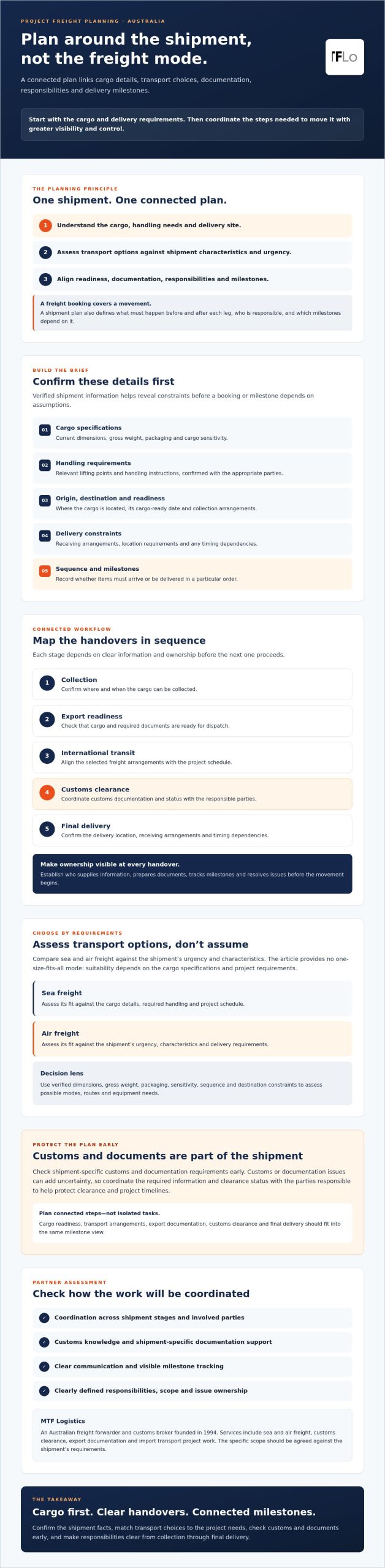
Customs and documentation are connected parts of the shipment plan, not final tasks to leave until cargo is ready to move. In project logistics Australia, missing or inconsistent information can create uncertainty around clearance and affect decisions about onward transport and delivery. Confirm the documents, responsibilities and submission deadlines for the specific shipment before locking in dependent milestones.
Depending on the cargo and circumstances, document categories may include a commercial invoice, packing information, transport documents and supporting permits. This is an indicative list, not a checklist for every import. Verify the current requirements for the goods with relevant Australian official guidance and the parties handling the shipment. Biosecurity conditions, tariff classification and customs declaration details should be checked against current rules and the cargo’s actual specifications.
Consistency matters across the shipment information. Compare descriptions, quantities, values and cargo identifiers between documents, and resolve differences with the supplier before lodgement. Also confirm who is responsible for preparing, reviewing and supplying each document, and when it is needed. A customs broker can help coordinate clearance-related information, but the importer should understand its responsibilities and verify that information provided for the declaration is accurate.
If documents arrive late, contain conflicting details or omit information needed for review, the status of clearance and the timing of onward arrangements may become uncertain. That uncertainty can affect receiving plans or other project milestones. Avoid assuming a fixed clearance timeframe. Instead, map document deadlines to the shipment schedule and identify which decisions or delivery arrangements depend on clearance progress.
Set a clear owner for each document and handover. For example, the supplier may provide commercial and packing information, while the importer, forwarder and customs broker agree who checks details and coordinates the clearance process. Establish how updates or corrections will be shared, and what plans need review if information changes. Recheck shipment-specific requirements before dispatch, particularly if cargo details or the planned movement have changed.
For more detailed guidance, read about customs clearance requirements in Australia. MTF Logistics provides customs clearance and freight forwarding, which can support connected import planning. Discuss your project shipment and customs requirements with a logistics partner.
A capable project logistics partner should make responsibilities and dependencies easier to see, not add another layer of uncertainty. For project logistics Australia, assess how a provider will coordinate the freight and customs tasks relevant to your shipment, what information it needs to evaluate the movement, and where its responsibilities begin and end.
Ask practical questions before agreeing on a plan:
Look for clear answers rather than assumptions about coverage or capability. The provider should identify information gaps and explain which details must be confirmed with carriers or other parties before a transport plan can be assessed.
Give potential providers a concise brief that describes the movement and highlights what is known, pending or uncertain. Include:
A complete brief helps a provider ask focused follow-up questions and consider the shipment in context. MTF Logistics is an Australian freight forwarder, founded in 2014. Its services include sea and air freight, customs clearance, export documentation and import transport project work. Discuss the intended scope, responsibilities and shipment requirements directly so the proposed coordination fits the movement.
If you’re preparing an import project, discuss your project logistics requirements with MTF Logistics. Share the available cargo information and delivery priorities, including any details that still need verification, to start a practical conversation about the next steps.
Complex freight is easier to manage when the plan begins with accurate cargo information and connects transport choices, documentation, responsibilities and delivery milestones. The key is to assess sea or air freight against the shipment’s actual requirements, then confirm customs and handling details before dependent steps are set in motion.
A clear brief also gives a potential logistics partner the information needed to discuss coordination, clarify responsibilities and identify details that still need confirmation. That structure helps keep the shipment and its project milestones in view from planning through delivery.
For businesses planning project logistics Australia, MTF Logistics has operated since 2014. Its services include sea freight, air freight, customs clearance and import transport project work, supporting connected freight planning for complex import movements.
Share your cargo details, dates and delivery requirements to start a practical conversation. Discuss your project logistics requirements with MTF Logistics and take the next step with a clearer plan.
Project logistics in Australia coordinates complex cargo movements from planning through delivery. It may involve choosing a freight mode, confirming cargo specifications, arranging documentation and customs coordination, reviewing handling requirements, and managing transport handovers. The exact scope depends on the shipment and agreed responsibilities. Share accurate cargo and schedule information early so a logistics provider can assess requirements, identify dependencies and discuss a workable plan before key milestones are confirmed.
Cargo may need project-level planning when its size, weight, sensitivity, handling needs, timing or delivery sequence makes routine freight coordination insufficient. Industrial equipment and infrastructure components are possible examples, but the cargo category alone doesn’t determine the required service. Confirm dimensions, gross weight, packaging, lifting or handling needs, and destination constraints. A provider can use these details to assess what transport arrangements may be appropriate for the specific shipment.
Compare sea and air freight against the shipment’s urgency, cargo characteristics, handling needs, route options and delivery plan. Neither mode is automatically suitable for every project, and the full movement matters beyond the international freight leg. Provide accurate cargo specifications and required dates to a freight provider for assessment. Avoid deciding on a single factor, such as urgency or cargo type, before checking how each option fits the project’s overall requirements.
It can include customs coordination when clearance is part of the agreed service scope, but confirm who is responsible for each task with your provider. Import requirements and documentation depend on the goods and shipment circumstances, so check current official guidance. Agree who prepares, reviews and submits relevant documents, and make clearance dependencies visible in the wider freight and delivery plan. MTF Logistics provides customs clearance alongside freight forwarding services.
Provide a cargo description, dimensions, gross weight, packaging details, origin, destination, readiness date and delivery requirements. Include known handling constraints and available commercial or transport documents, plus permit information if relevant. Mark unconfirmed details as estimates or unknowns rather than presenting them as final. This gives a provider a clearer basis to assess feasibility, identify information gaps and determine which shipment requirements need further verification before a transport plan is confirmed.
Start planning early by confirming cargo specifications, readiness, documentation responsibilities and milestone owners. Check customs, biosecurity and other applicable requirements against current official guidance, as requirements depend on the goods and circumstances. Keep suppliers, freight partners and delivery stakeholders informed when dates or cargo details change. Planning can’t guarantee a specific outcome, but accurate information, clear ownership and timely decisions help teams identify dependencies and respond to changes in the shipment plan.
One provider may coordinate freight forwarding and customs brokerage when those services are available and included in the agreed scope. Confirm which freight legs, documents, clearance tasks and delivery dependencies it will manage, and what remains with your business or another party. MTF Logistics provides sea and air freight, customs clearance and import transport project work. Share the shipment details and confirm responsibilities before relying on a coordinated plan.


 Email
Email 1300 710 683
 Tariff Lookup
 HS Code Lookup
 Newsletter Signup