
Total Shipment Visibility, Simplified
Access all your shipment details in one place - track departures and arrivals, manage documents, notifications, invoices, and more.
Access all your shipment details in one place - track departures and arrivals, manage documents, notifications, invoices, and more.

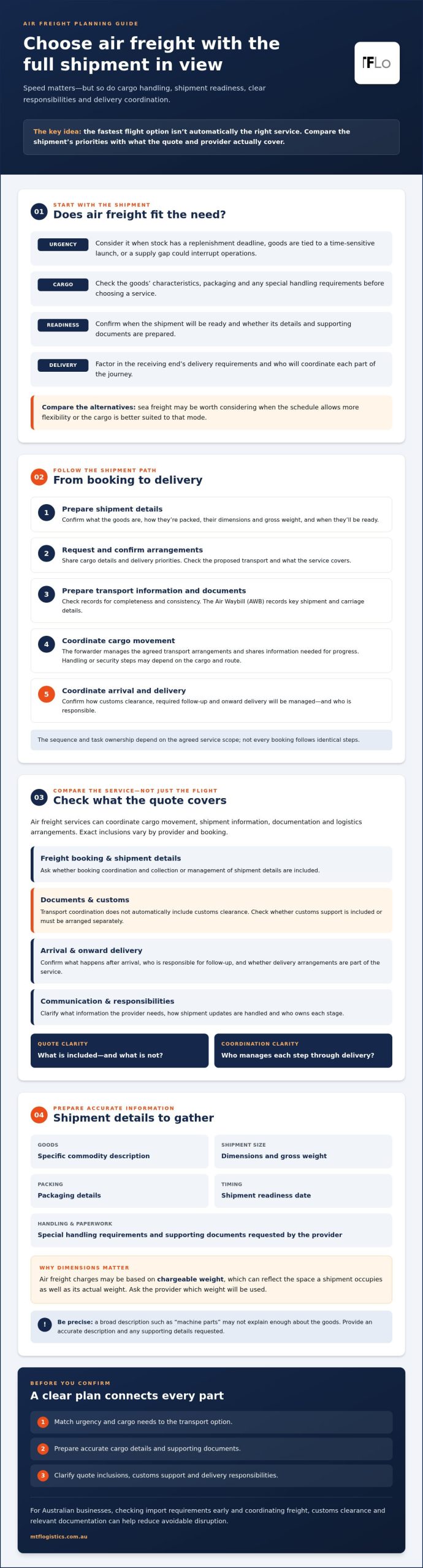
The fastest flight option isn’t always the right choice for a business shipment. The fit depends on more than transit speed: what the quoted air freight services include, how the goods need to be handled, and whether the documents and border requirements are ready can all affect the delivery plan.
It’s reasonable to want a clear answer before booking. Air freight can suit urgent or time-sensitive cargo, but comparing options is difficult when charges, responsibilities and customs support aren’t clear. For Australian businesses, preparing accurate shipment details and checking import requirements early can help reduce avoidable disruption.
This guide explains how air freight works and what to assess before choosing a service, including shipment urgency, handling needs, chargeable weight and the scope of a quote. It also outlines the information and documents to prepare, and how freight and customs coordination can support the process. With a clear view of each step, you can assess whether air freight fits your priorities and discuss your shipment requirements with a provider more confidently.
Air freight services coordinate the movement of cargo by aircraft, along with the shipment information, documentation and logistics arrangements needed to move it through the supply chain. The exact steps included depend on the provider and booking. For a broader introduction to the transport mode and its role in global logistics, see Air cargo.
Businesses may consider air transport when stock needs to be replenished against a deadline, commercial cargo is tied to a time-sensitive launch, or a supply gap could interrupt operations. Speed is only one part of the decision. A workable plan also depends on cargo characteristics, handling requirements, shipment readiness and delivery priorities at the receiving end.
A provider may coordinate the freight booking, collect and manage shipment details, and support the preparation or handling of relevant transport documents. These steps help align cargo information with the arrangements being made. Because service scope varies, check exactly what the quotation covers.
Transport coordination does not automatically include customs clearance or delivery arrangements after the cargo arrives. Ask who is responsible for each stage, what information they need from your business, and whether customs support is included or must be arranged separately.
Air freight may suit a business facing a replenishment deadline, moving goods for a scheduled commercial launch, or trying to maintain continuity when other supply options won’t meet its priorities. Urgency is a useful starting point, not a complete decision. Consider the goods’ handling needs, readiness, documentation and final delivery requirements before selecting a service.
Sea freight may be worth comparing when the shipment schedule allows more flexibility or the cargo is better suited to that transport mode. Review the trade-offs in this guide to reliable sea freight services alongside your operational needs. Choose the option that fits the shipment and delivery priorities, with responsibilities clear at each stage.
For Australian businesses, discussing cargo requirements with a freight provider before booking can help clarify what coordination is needed. MTF Logistics offers air freight and customs clearance, which businesses can discuss when planning a suitable shipment service.
A clear shipment process starts with accurate cargo information. It helps a freight forwarder assess booking options, handling needs and documentation, then coordinate the relevant steps. The sequence and who performs each task depend on the agreed service scope.
Use this sequence as a planning guide. Not every booking follows identical steps:
Before requesting a proposal for air freight services, assemble the commodity description, dimensions, gross weight, packaging details and shipment readiness date. Identify any special handling requirements, too. A description such as “machine parts” may not explain enough about the goods. Provide an accurate, specific description and any supporting details the provider requests.
Dimensions matter as well as weight because air freight charges may be based on chargeable weight, which can reflect the space a shipment occupies as well as its actual weight. Ask the provider which weight will be used for the quote and check that the measurements supplied match the packed cargo. Incomplete or inconsistent information can complicate booking, handling decisions and document preparation, so raise uncertainties before the cargo is ready to move.
A freight forwarder coordinates transport and relevant shipment information under the agreed scope. Customs clearance is a connected but distinct process. A forwarder or customs broker may provide support, but this doesn’t remove the importer’s responsibility to provide accurate information and meet applicable requirements. Confirm who will prepare or submit information, what you must supply, and how any questions will be resolved.
For more detail on the Australian import process, read this guide to Australian customs clearance requirements. If the roles or document responsibilities aren’t clear, discuss your shipment requirements with MTF Logistics before confirming the arrangements.
A proposal can describe the flight but leave important coordination unclear. Compare providers using the same shipment details and required stages, not just the headline service description. This makes it easier to see whether each option fits your cargo and business responsibilities.
| What to compare | Questions to ask |
|---|---|
| Service scope | Which stages are included, from booking coordination to arrival and delivery arrangements? What needs to be arranged separately? |
| Communication | Which milestones will be communicated, who is your contact, and how will changes or missing information be raised? |
| Customs support | Is customs clearance included, offered separately, or outside the provider’s scope? What information will your business need to supply? |
| Special cargo capability | If relevant, can the provider assess the shipment’s handling requirements, such as those for dangerous goods, perishables, or medical cargo? |
Look for clear experience coordinating international freight and relevant documentation. A provider should be able to explain shipment milestones, responsibilities and the updates you can expect under the proposed arrangement. Ask how cargo information will be used and who to contact if details change.
Assess special cargo capability if your shipment needs it. For example, a business shipping temperature-sensitive goods should explain the handling requirements and confirm whether the provider can support them. Don’t assume a general air freight offering covers every cargo type or handling arrangement.
Ask providers to base proposals on your actual commodity, dimensions, weight, packaging, readiness and delivery requirements. If they assess different assumptions, the proposals won’t be directly comparable. Clarify which logistics stages are covered and whether customs clearance and final delivery need separate arrangements.
Read exclusions and responsibilities as carefully as inclusions. Check who supplies documents, who coordinates each stage, and what could change if the cargo details differ from those provided. This gives your team a practical basis for comparing air freight services without relying on an unclear headline or assuming every provider includes the same support.
Preparation starts before you request a booking. Complete cargo information helps a provider assess handling, transport coordination and documentation needs. It also gives your team a clearer basis for confirming what the proposed service includes.
Use descriptions that accurately identify the goods, and check that the invoice, packing information and other supporting records are consistent. A broad or conflicting description may leave a provider without enough information to plan the shipment or determine what documentation needs attention.
Document requirements can vary with the commodity, origin, destination and transaction. Don’t rely on a general checklist as a substitute for shipment-specific advice. Confirm current requirements using relevant Australian Government guidance, and ask your freight or customs provider what information they need for your particular shipment.
Dangerous goods, perishables, and pharmaceutical or medical cargo can involve additional handling considerations. Raise the product type and any known requirements before booking, rather than assuming a standard arrangement will suit. The provider needs enough detail to assess whether the proposed service and handling arrangements are appropriate.
Confirm capability, documentation needs and responsibilities before proceeding. Don’t assume acceptance, a particular temperature range or a specific handling outcome without direct confirmation for your cargo and route.
Once your checklist is ready, discuss your air freight requirements with MTF to clarify the coordination and customs support your shipment may need.
The right provider should fit the cargo, explain the service scope and communicate clearly across shipment stages. Use these points to compare options, then check that the proposed arrangements match your delivery priorities and the information you’ve prepared.
Clear answers make it easier to understand who is responsible at each stage. They can also reveal gaps between transport coordination and the customs, documentation or delivery support your business expects.
Freight forwarding and customs clearance are connected, but they involve distinct tasks. A provider coordinating both can help clarify how shipment information and responsibilities pass between transport and clearance stages. Your business still needs to provide accurate information and understand its own responsibilities as the importer.
MTF Logistics is an Australian freight forwarder and customs broker offering air freight, customs clearance and export documentation services. These are relevant capabilities to discuss when assessing how your shipment should be coordinated. Confirm the precise scope, required information and responsibilities for your cargo rather than assuming every stage is included.
For broader preparation, see this guide on how to import goods into Australia. Businesses reviewing supply chain processes more widely can also explore Australian logistics management guidance.
Choosing air freight services with clear ownership, suitable cargo handling and defined communication can make complex coordination easier to manage. To discuss your shipment requirements, contact MTF about your air freight requirements.
Choosing suitable air freight services starts with matching the cargo and delivery priorities to a clearly defined service scope. Accurate shipment details, complete supporting documents and early discussion of special handling needs help a provider assess the arrangements. Before booking, confirm who coordinates transport, customs clearance and delivery, and how updates will be communicated.
MTF Logistics has operated since 2014 and offers air freight, customs clearance and export documentation services, as well as import transport project work. These services give Australian businesses a partner to discuss freight and customs coordination with, while confirming the specific support each shipment requires.
Bring your cargo information, timing priorities and delivery requirements into the conversation. Discuss your air freight requirements with MTF Logistics and take the next planning step with greater clarity.
Air freight services coordinate cargo movement by aircraft and may include booking coordination, shipment information management and transport documentation support. The exact scope varies between providers and proposals. Customs clearance, special cargo handling and arrangements after arrival may be separate services, so confirm what’s included before booking. An Air Waybill records key shipment and carriage details, but it doesn’t replace other documents that may be relevant to the goods or transaction.
An Australian business provides cargo details, including the goods’ description, dimensions, weight, packaging and readiness. A freight provider uses this information to assess arrangements and clarify the proposed service. After booking, the cargo moves through the agreed transport stages, with documents and responsibilities coordinated according to the service scope. For imports, customs clearance and onward delivery need to be planned as well. The importer should provide accurate information and confirm its responsibilities.
Consider air freight if a shipment’s urgency, replenishment deadline or supply continuity needs make faster transport a priority. Compare it with sea freight based on the cargo, handling requirements, delivery schedule and business priorities, rather than urgency alone. Air freight isn’t automatically the right fit for every shipment. Check whether the cargo is ready, whether it needs special handling and whether the proposed service includes the coordination your business requires.
Documents commonly relevant to an air shipment include an Air Waybill, commercial invoice and packing details, but the required paperwork depends on the goods, origin, destination and transaction. Some commodities may require additional information or documents. Make sure product descriptions and shipment records are consistent, then verify current import and biosecurity requirements through relevant Australian Government guidance, including the Australian Border Force and Department of Agriculture, Fisheries and Forestry. Don’t assume one checklist applies to every cargo type.
Yes, some freight providers also offer customs clearance, but it’s a distinct service and may not be included in every air freight proposal. Ask who will manage clearance, what information and documents your business must supply, and which responsibilities remain with you as the importer. MTF Logistics offers both air freight and customs clearance. Confirm the scope for your shipment before booking so transport and clearance responsibilities are clear.
Compare providers using the same cargo details and delivery requirements. Ask what stages are included, who coordinates milestones, how changes are communicated, and whether customs clearance, documentation or final delivery arrangements are covered. Check exclusions and responsibilities as carefully as inclusions. If your shipment has special handling needs, confirm the provider can assess them. A clear, shipment-specific proposal makes it easier to judge whether the service fits your operational priorities.
Some air freight providers handle dangerous goods or temperature-sensitive cargo, but acceptance and arrangements depend on the goods, applicable requirements and the provider’s confirmed capabilities. Disclose the exact commodity and handling needs before requesting a booking. Ask what supporting information is required and confirm the proposed handling plan before proceeding. MTF Logistics lists dangerous goods handling, perishable goods logistics, and pharmaceuticals and medical logistics among its services. Discuss your shipment to confirm its specific requirements.


 Email
Email 1300 710 683
 Tariff Lookup
 HS Code Lookup
 Newsletter Signup