
Total Shipment Visibility, Simplified
Access all your shipment details in one place - track departures and arrivals, manage documents, notifications, invoices, and more.
Access all your shipment details in one place - track departures and arrivals, manage documents, notifications, invoices, and more.

A shipment can include familiar export documents and still be missing a requirement tied to its product or destination. That’s why export documentation Australia is not a universal checklist. It is a coordinated shipment record, and consistency across its details matters. If you’re unsure which documents apply or who should prepare them, you’re not alone.
This guide helps you identify likely documents and confirm requirements before cargo moves. It explains how commercial records, transport documents and regulatory approvals fit together, and why goods descriptions, quantities and consignee information need to align.
We’ll cover common documents, including invoices, packing lists and transport records, alongside export declarations and product or destination-specific certificates and permits where applicable. You’ll also learn how responsibilities can be shared between exporters, freight forwarders and customs brokers, what to check in a shipment file, and when to confirm current requirements with the relevant authorities or seek specialist support.
Export documents form a connected record of an international shipment. They describe the goods and sale, support transport arrangements and, where required, provide information or approvals for regulatory processes. A commercial invoice or packing list records transaction and cargo details. A permit or certificate is conditional and applies only when relevant rules or destination requirements call for it.
There is no single document set for every exporter. The records you need depend on the goods, destination, transport mode and transaction terms. An air shipment may use a different transport document from a sea shipment, while regulated goods or a buyer’s destination requirements may call for additional documents. Use this guide to organise your file, then confirm shipment-specific requirements with the relevant Australian and destination-country authorities.
Documents work best when they tell the same story. Check that goods descriptions, quantities, packaging details, consignee information and shipment references align across records. This gives the carrier and other parties a consistent basis for handling the cargo and processing the information they need.
A mismatch, omission or unclear description can prompt questions or requests for corrections. Resolving those issues may affect shipment coordination or processing time. Review the documents together rather than checking each one in isolation. Verify any specific regulatory consequence with the responsible authority instead of assuming what an error will trigger.
Responsibilities depend on the sales contract and agreed shipping arrangements. The exporter commonly supplies accurate goods, transaction and consignee information, and checks which product and destination requirements apply. The buyer can provide destination instructions or clarify information needed for their import process. A carrier issues the transport document using shipment details supplied through the agreed process. When a permit or certificate is required, the relevant issuing authority sets its requirements and issues it when applicable.
A freight forwarder can coordinate shipment information with transport bookings and milestones. A customs broker can assist with customs-related processes and documentation when engaged. These roles support coordination, but they do not remove the exporter’s responsibility to verify supplied information and confirm applicable requirements. Agree early on who prepares, lodges and reviews each record, and who will resolve questions if details change.
Build the file around each document’s purpose, not a fixed checklist. In export documentation Australia, commercial records describe the sale and cargo, transport documents support movement, and regulatory records apply only when a product, destination or transaction requires them. Confirm the required fields and documents for the specific shipment.
| Document | Purpose | Typical preparer | Conditional? |
|---|---|---|---|
| Commercial invoice | Records the parties, goods, quantities and agreed transaction values. | Exporter | Commonly requested; confirm requirements with the buyer and relevant parties. |
| Packing list | Details package counts, contents, weights and dimensions. | Exporter or party packing the goods | Often useful; check what the buyer, carrier or destination process requires. |
| Bill of lading or air waybill | Records transport details for the cargo. | Carrier, using shipment information supplied by the parties | Depends on transport mode and arrangements. |
| Certificate of origin | Provides origin information when requested or needed for a trade or destination requirement. | Exporter or relevant issuing body, depending on the requirement | Yes. |
| Insurance record | Documents cargo insurance arrangements, where applicable. | Party arranging the cover | Yes, depending on contract and cover arrangements. |
| Permit or product certificate | Shows an applicable approval or product-related certification. | Exporter applies; responsible authority issues where required | Yes, based on goods and applicable rules. |
The invoice describes the commercial transaction: who is selling and buying, what is being sold, the quantities and the agreed values. The packing list focuses on the physical cargo, including the number of packages and their contents, weights and dimensions. These records serve different purposes, so one should not be treated as a substitute for the other.
Before sharing the file, compare the goods descriptions and quantities across both documents. Check names and addresses, package totals and measurement units, and confirm any required fields with the buyer, carrier or broker. Consistent information helps each party work from the same shipment details.
Sea shipments commonly use a bill of lading; air shipments commonly use an air waybill. Each records key transport information, but the document and its handling depend on the mode and shipment arrangements. For mode-specific planning, see this guide to sea freight services and the air freight guide. Confirm any exceptions with your carrier or forwarder.
Other records depend on the shipment. A buyer may request a certificate of origin, a contract may specify insurance, or the goods and destination may require a permit or certificate. The Export Council of Australia is another resource for exporters seeking practical trade information. For help coordinating export paperwork with freight arrangements, explore MTF Logistics’ export documentation services.
Commercial paperwork describes the sale and cargo, but it does not automatically meet Australian export reporting obligations or satisfy controls on specific goods. General shipping documents record a transaction and its movement; permits and certificates apply only when particular goods, rules or destination conditions trigger them. Keeping that distinction clear helps you identify what to check without assuming every shipment needs the same approvals.
Requirements can depend on what you’re exporting and the rules that apply to those goods. Controlled or restricted products, agricultural goods, dangerous goods and pharmaceuticals may involve additional checks. Requirements vary, so assess the actual product and destination rather than relying on a generic checklist. This is a planning guide, not a substitute for advice from the relevant authority about your shipment.
Before arranging shipment, consult the Australian Border Force (ABF) for current guidance on whether an export declaration is required, who must lodge it and what timing applies. Do not assume a requirement, exemption or deadline based on a previous shipment. Confirm the current rules for the goods and circumstances in question.
If you engage a freight forwarder or customs broker, they may help coordinate declaration information with transport arrangements and shipment milestones. Confirm who is responsible for preparing, lodging and checking the information, and provide accurate details about the goods, parties and destination. Their support does not replace your need to verify the applicable requirements.
For goods subject to product-specific controls, check with the relevant Australian agency whether an export permit, inspection or certificate is required. Agricultural or other goods with biosecurity considerations may need additional verification. Dangerous goods and pharmaceutical products can also have requirements tied to their nature, handling or destination. Treat each as a prompt to investigate, not as proof that a particular permit applies.
Export clearance is only one side of the shipment. Ask the buyer or a destination-side adviser to confirm import permits, product standards and market-entry conditions in the receiving country. A buyer’s instructions can be useful, but verify regulatory requirements with the responsible destination authority where needed.
These checks make export documentation Australia specific to the shipment and help distinguish routine commercial records from conditional regulatory paperwork. Revisit them if the product, destination or shipping arrangements change.
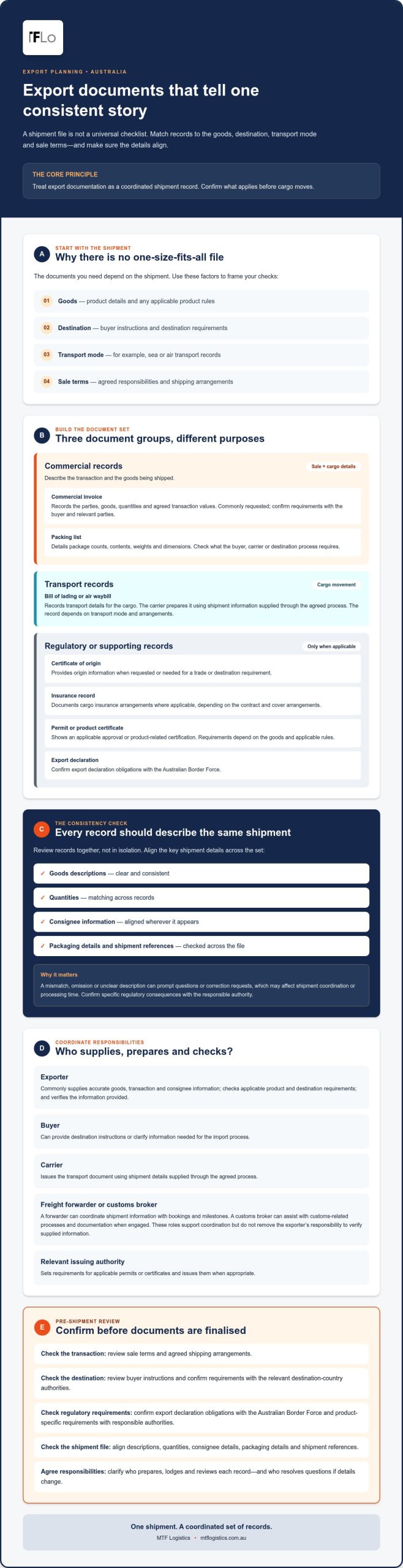
A final review works best as a sequence, with each record checked against the sale and the actual shipment. Use this workflow to organise export documentation Australia without treating the checklist as a substitute for confirming requirements that apply to your goods and destination.
Keep the contract or order, invoice, packing details, transport instructions and supporting records together as a shipment file. Comparing them side by side can expose differences that are easy to miss when reviewing documents separately. Pay particular attention to whether the documents reflect the agreed sale terms and the buyer’s destination instructions.
Pause for clarification if the goods description or classification is uncertain, a permit or certificate may apply, or declaration responsibilities are unclear. Check current requirements with the relevant authority, and agree with your broker or forwarder who will coordinate any required review. If the cargo, route or shipment date changes, check which documents are affected and revise them before the file is used.
Before cargo moves, provide the final set to the relevant broker, carrier or issuing authority for the checks within their role. Confirm unresolved questions and responsibility for corrections. Exporter review remains essential. For additional context, see this international trade documentation guide. If you need support preparing shipment records, ask MTF Logistics about export documentation services.
Document checks are most useful when they connect to the shipment plan. A freight forwarder can coordinate information with the booking, carrier instructions and key shipment milestones, helping identify where updated cargo or routing details may affect the paperwork. This creates a clearer handoff between the people arranging transport and those preparing or reviewing documents.
Customs brokerage support can help with customs-related documentation and processes when engaged. It does not replace the exporter’s role in providing accurate goods and transaction information or confirming product and destination requirements. For export documentation Australia, clarify the scope of support early. Coordination is valuable, but each party should know which checks remain theirs.
Consider discussing support when a route involves several parties, the goods may be regulated, or your team is working through an unfamiliar export process. Before cargo is booked, agree who supplies shipment details, who prepares or lodges each document, and who reviews it. Also confirm relevant submission deadlines with the parties involved so document preparation can be planned alongside transport arrangements.
Clear roles can reduce uncertainty as information moves between exporter, buyer, carrier, broker and any issuing authority. They do not guarantee customs clearance, compliance outcomes, delivery dates or delay-free transport. Requirements and decisions remain specific to the shipment and the responsible authorities.
Before requesting support, bring together the core facts that help others understand the shipment and identify open questions:
Then map the document workflow. Ask who prepares each record, who lodges it if required, who checks the information, and who receives the final version. If cargo, routing or timing changes, confirm which parties need an update and make sure affected documents reflect the revised details before they are used.
MTF Logistics provides export documentation alongside sea freight, air freight and customs brokerage. Discussing the shipment plan and document responsibilities together can help establish a practical handoff, while authority-specific requirements should still be confirmed with the relevant agencies. Discuss your export documentation requirements.
Reliable export documentation Australia starts with a shipment-specific plan. Match each document to its purpose, verify current declaration and product requirements with the responsible authorities, and check that the final records reflect the same shipment details. Clear responsibilities between your business, buyer, carrier and any broker or forwarder help keep the process coordinated.
For shipments with unfamiliar requirements or multiple parties, early coordination can help clarify what information is needed and who will handle each step. MTF Logistics provides export documentation alongside sea freight, air freight and customs brokerage, bringing these areas of support together around your shipment.
Prepare your goods, destination, preferred mode and open document questions, then discuss your export documentation requirements. A clear handoff and careful checks can help you approach your next shipment with greater confidence.
Required export documents depend on the goods, destination, transport mode, sales contract and current regulations. Common records may include a commercial invoice, packing list and transport document, while permits or certificates apply only in certain cases. Check Australian export reporting obligations with the Australian Border Force and confirm destination-country rules before shipping. Ask the buyer and carrier about their document expectations, then verify product-specific requirements with the responsible authority.
Not every shipment has the same declaration or reporting requirements, so a blanket yes or no is not reliable. The answer depends on the shipment and current Australian rules. Consult the Australian Border Force for authoritative, up-to-date guidance on whether a declaration applies and what steps are required. If one is needed, agree with your freight forwarder or customs broker who will prepare or lodge it, and confirm responsibilities before dispatch.
A commercial invoice records the sale, identifying the parties and describing the goods, quantities and agreed values. A packing list focuses on the physical shipment, including package counts and relevant weights or dimensions. For example, the invoice may show the quantity sold, while the packing list breaks down how those goods are arranged across packages. Check that the documents describe the same shipment consistently, and verify required fields with the buyer or receiving parties.
No, a certificate of origin is not automatically required for every Australian export. A buyer or destination authority may request one, or a particular trade arrangement may make origin evidence relevant. Whether it applies depends on the goods, destination and applicable rules. Before preparing the document, confirm the required format, issuing process and eligibility with the relevant authority or a qualified trade adviser. Do not assume that having a certificate automatically qualifies goods for a particular trade benefit.
Responsibility varies by document, contract and agreed service scope. Exporters commonly provide accurate information about the transaction, goods and parties. A freight forwarder or customs broker may prepare, review or coordinate specific records if this is part of the agreed support. Before shipment, agree who handles each document, any lodgement, relevant deadlines and destination-specific checks. Keep the exporter’s verification role clear, since another party coordinating paperwork does not replace checking that the supplied information is correct.
Commercial information may be similar for both modes, but the transport document commonly differs. Sea freight generally uses a bill of lading, while air freight generally uses an air waybill. Other documents depend on the cargo, destination, buyer’s instructions and carrier requirements. Before cargo is tendered, ask your freight forwarder and receiving party to confirm the shipment-specific document list, including any required formats or supporting records. Check current product controls separately with the relevant authorities.
Incorrect or inconsistent information can lead to questions, document corrections or shipment disruption, depending on the issue and the parties involved. The outcome is not the same for every error, so do not assume a particular consequence or penalty. If you find a discrepancy, notify affected parties promptly and provide corrected information. Ask the broker, carrier or relevant authority whether a formal amendment process applies, and check that related records are updated to match.


 Email
Email 1300 710 683
 Tariff Lookup
 HS Code Lookup
 Newsletter Signup