
Total Shipment Visibility, Simplified
Access all your shipment details in one place - track departures and arrivals, manage documents, notifications, invoices, and more.
Access all your shipment details in one place - track departures and arrivals, manage documents, notifications, invoices, and more.

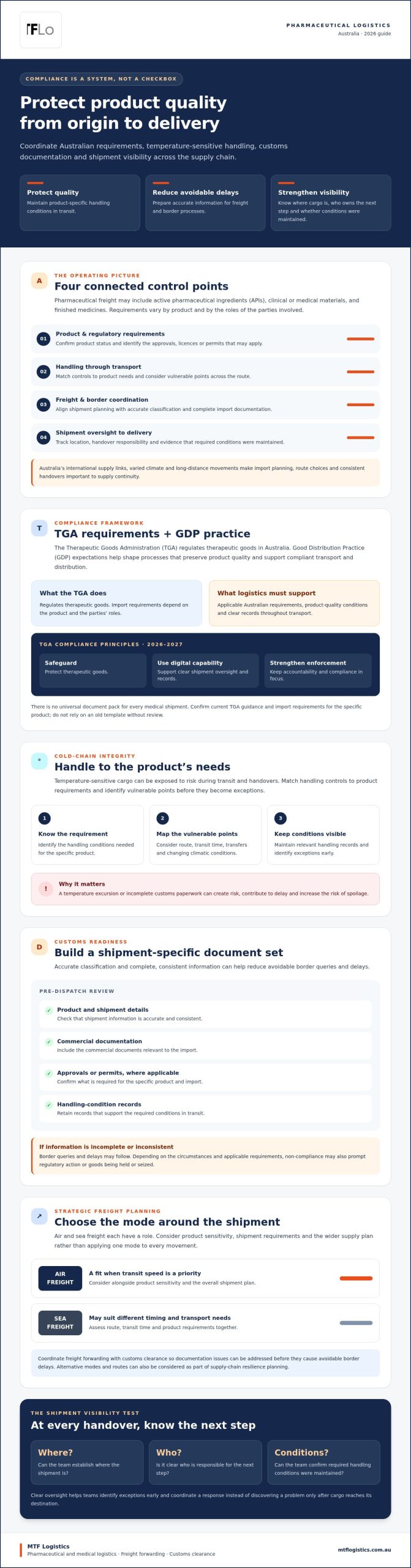
Compliance isn’t a checkbox. In pharmaceutical logistics Australia, it means putting practical controls in place to help protect product quality, reduce avoidable delays and support confidence across the supply chain. TGA and GDP expectations, temperature-sensitive cargo and detailed import documentation all need attention from origin to delivery.
If you manage pharmaceutical shipments, you know how quickly a temperature excursion or incomplete customs paperwork can create risk. The challenge is to coordinate regulatory requirements, cold-chain handling and freight movements while keeping a clear view of each shipment.
This 2026 guide explains how to manage those moving parts. It covers Australian compliance considerations, cold-chain integrity and customs documentation, with practical steps to strengthen shipment visibility and reduce the risk of spoilage or delay. You’ll also see how specialized pharmaceutical freight forwarding can work alongside customs clearance to support a more coordinated process. MTF Logistics offers pharmaceutical and medical logistics, freight forwarding and customs clearance services to help businesses manage complex supply chains across Australia.
Australia’s pharmaceutical supply chain depends on international links for finished medicines and components such as active pharmaceutical ingredients (APIs). That reliance makes import planning, transport coordination and border documentation central to supply continuity. A shipment delay can affect inventory schedules. For products with specific handling requirements, time and conditions in transit can also influence product quality and patient outcomes.
In 2026, logistics teams must also work within a changing compliance environment. The TGA’s compliance principles for 2026 and 2027 emphasize safeguarding therapeutic goods, digital capability and stronger enforcement. For importers, this reinforces the need to connect careful handling with accurate records and clear shipment oversight. Pharmaceutical logistics Australia is not simply about moving freight. It requires controls that follow cargo through transport and border processes.
General freight processes may not address the product-specific requirements of medical cargo. Pharmaceutical logistics can cover the movement of APIs, clinical or medical materials, and finished medicines, each with its own handling and documentation considerations. The broader concept of pharmaceutical distribution includes the supply chain and regulatory principles that help protect products between manufacture and use.
For high-value cargo, visibility at each handover matters. Importers should be able to establish where a shipment is, who is responsible for the next step and whether required handling conditions have been maintained. This helps teams identify exceptions early and coordinate a response, rather than discovering a problem only after cargo reaches its destination.
Australia’s scale and varied climatic conditions make consistent planning important across a national supply chain. Consider how route, transit time, transfer points and product requirements interact instead of treating each leg as a separate movement. A national provider can help apply consistent freight and customs processes across Australian operations.
Air and sea freight each have a role. Air freight can suit shipments where transit speed is a priority, while sea freight may suit cargo with different timing and transport needs. The right mode depends on product sensitivity, shipment requirements and the wider supply plan. Coordinating freight forwarding with customs clearance can also help address documentation issues before they cause avoidable border delays.
When assessing a logistics partner, ask about its pharmaceutical and medical logistics capability, customs clearance expertise and approach to shipment updates. MTF Logistics provides pharmaceutical and medical logistics, freight forwarding and customs support across Australia, helping businesses coordinate international medical cargo and import requirements.
The Therapeutic Goods Administration (TGA) regulates therapeutic goods in Australia, while logistics processes help preserve product quality and support compliant import and distribution. For pharmaceutical logistics Australia, requirements depend on the product and the parties’ roles. Importers and distributors should confirm any applicable approvals, licences or permits with the relevant authority before shipping. Don’t assume one set of requirements applies to every medicine.
For logistics providers in 2026, supporting TGA compliance means handling therapeutic goods in line with applicable Australian requirements and maintaining the conditions and records needed to protect product quality throughout transport.
There isn’t a universal document pack for every medical shipment. Before dispatch, confirm the product’s regulatory status and identify the documents required for that specific import. A working checklist may include product and shipment details, commercial documentation, import approvals or permits where applicable, and records supporting required handling conditions. Check current TGA guidance and import requirements for the product. Don’t rely on an old template without reviewing it.
Incomplete or inconsistent information can lead to border queries and delays. Depending on the circumstances and applicable requirements, non-compliance may also prompt regulatory action or result in goods being held or seized. The TGA’s 2026 to 2027 compliance principles include safeguarding therapeutic goods, leveraging digital capability and strengthening enforcement. Accurate records and clear accountability are practical priorities.
GDP provides a framework for maintaining the quality and integrity of medicines as they move through the supply chain. In practice, procedures should address cleanliness and hygiene, security, suitable handling, and temperature control appropriate to each product. The framework for pharmaceutical storage and transport in Australia includes TGO 100 and the PIC/S Guide to Good Manufacturing Practice. The exact controls must match the product’s requirements.
Records make those controls verifiable. Keep an auditable trail of shipment handovers, handling instructions, temperature information where relevant, exceptions and the actions taken in response. Clear records help teams investigate deviations and establish what happened at each stage, rather than relying on assumptions after delivery.
Documentation should connect the importer, freight forwarder and customs process. Align shipment details across records, confirm responsibilities before cargo moves and resolve gaps early. Industry context also matters: Medicines Australia represents Australia’s research-based pharmaceutical industry, part of the broader ecosystem that depends on reliable supply chains.
For shipments with complex handling or import requirements, consider coordinating specialized pharmaceutical freight forwarding with customs clearance. MTF Logistics provides pharmaceutical and medical logistics alongside customs support across Australia, helping businesses bring freight and documentation processes together.
Cold-chain performance depends on keeping a product within its specified temperature range through every transport leg and handover. The correct range is product-specific: refrigerated medicines such as vaccines, biologics, insulin and blood products commonly require +2°C to +8°C; some medicines use controlled ambient conditions of +15°C to +25°C. Certain frozen products need -15°C to -25°C or lower, while some biologics and cell therapies may require -60°C or below. Confirm the product’s requirements before selecting packaging or a route.
For pharmaceutical logistics Australia, a shipment’s risk profile includes more than the main journey. Exposure can occur during loading, transfers between carriers, customs or port delays, and while cargo waits for collection. An insulated shipper or temperature-controlled container can help manage exposure, but packaging must match the product, expected transit conditions and planned duration. Monitoring provides evidence of conditions in transit. It doesn’t replace suitable packaging or an agreed response plan.
Start with route and packaging decisions. Map each handover, estimate planned transit time, identify potential dwell points and select a qualified container appropriate to the required range. Make handling instructions clear to everyone responsible for the cargo.
Use temperature monitoring and data logging suited to the shipment. Confirm that devices are placed and activated correctly, and agree who will review readings and what happens if a deviation is detected. Before dispatch, document a contingency plan for delays or equipment failure, including escalation contacts and instructions for protecting or assessing the product. Clear records help teams investigate an excursion and make informed decisions about cargo disposition.
Air freight may suit urgent medical shipments where shorter transit is a priority, but transfers and waiting time still need careful management. Review Air Freight Australia when weighing planning considerations for time-sensitive cargo.
For bulk pharmaceutical imports, Sea Freight Services may fit where longer transit can be planned around product stability and inventory requirements. Compare speed with the needs of the whole shipment, not just the transport leg. A longer route can increase exposure to handovers and delays, while air transport still requires appropriate temperature controls. Select the mode that matches product tolerance, shipment urgency and a credible contingency plan.
Integrating freight forwarding with customs clearance can help teams coordinate documentation and handling milestones, reducing the chance that an avoidable process gap adds time to a temperature-sensitive shipment.
Pharmaceutical imports can be difficult to classify because a product’s intended use, composition and form may affect its tariff treatment. Medicines, active ingredients and medical devices don’t necessarily fall under the same classification. An incorrect HS code can lead to a customs query, reassessment of duty and taxes, possible penalties where applicable, or delays while shipment details are reviewed.
The Australian Customs Tariff provides the framework for classifying imported goods and determining applicable import measures. Use the product’s technical description and supporting documents to assess the appropriate classification, rather than relying on a broad label such as “medicine” or “medical supply.” Accurate HS code classification for medical devices is essential because it helps determine tariff treatment and supports consistent declarations at the border.
Before shipment, check that the tariff classification aligns with the invoice description, product specifications and other import records. If a product’s classification is uncertain, resolve the question before lodging the import declaration. Accurate customs clearance Australia depends on consistent information across the declaration and supporting documents. This helps reduce preventable follow-up and border delays.
Customs clearance and biosecurity are related but distinct processes. The Department of Agriculture, Fisheries and Forestry (DAFF) oversees relevant biosecurity controls. Requirements can depend on the goods, their ingredients, origin, packaging and intended use. This matters for biological products such as vaccines and blood products, as well as other human therapeutics. Don’t assume one product’s permit or documentation requirements apply to another.
Build a product-specific checklist before dispatch. Confirm whether permits or supporting information are required, who is responsible for obtaining them, and whether the shipment description matches the product’s actual contents. Check current DAFF guidance for the specific goods, including any applicable biosecurity conditions. Early verification supports a more orderly clearance process, but no documentation approach can guarantee rapid release.
An integrated customs broker can coordinate declaration details with the freight process, flag missing information and help resolve classification questions before they become shipment issues. For pharmaceutical logistics Australia, this coordination is particularly useful when product handling, import documentation and border clearance need to be managed together. Keep records of classification decisions, permits, declarations and communications so the rationale can be reviewed if questions arise.
For support coordinating medical freight and customs clearance, discuss your pharmaceutical import requirements with MTF Logistics.
Pharmaceutical supply chains work best when freight decisions are part of a coordinated plan, not isolated bookings. Strategic logistics management Australia means aligning shipment priorities, regulatory responsibilities, transport modes and visibility needs before cargo moves. This gives teams a clearer basis for responding to changing capacity, route disruption or documentation issues.
Resilience comes from having practical alternatives. Review whether shipments could use different freight modes or routes, and assess the effect of each option on transit time, product requirements and border processes. Shipment milestones and temperature records can help identify recurring bottlenecks, compare planned with actual movement and inform future routing decisions. In pharmaceutical logistics Australia, these insights support better control of sensitive cargo without treating every shipment as identical.
Freight forwarding and customs brokerage involve connected decisions, so fragmented communication can leave gaps in shipment information or responsibility. Coordinating these activities can give the importer a more consistent view of cargo progress and documentation. When assessing a provider, ask how updates are shared, who handles exceptions and whether a clear contact is responsible for coordinating complex international movements.
MTF Logistics brings pharmaceutical and medical logistics together with customs clearance and freight forwarding across Australia. When discussing a shipment, ask how these services can support coordination between freight movements and import documentation. Clear responsibilities and updates can make complex movements easier to oversee.
Technology is creating new options for supply chain visibility, including real-time tracking and connected monitoring tools. Assess whether these tools provide useful, actionable information across handovers, rather than simply producing more data. Sustainability is also shaping logistics decisions. Consider packaging choices and energy-efficient temperature control where they suit product protection and shipment requirements.
Personalized medicines may require logistics plans that account for specific product handling, documentation and delivery coordination. Prepare by involving logistics partners early, confirming product requirements and reviewing whether existing processes can accommodate shipments with distinct needs. MTF Logistics pharmaceutical and medical logistics support can be part of that planning, alongside air freight, sea freight and customs clearance. You can discuss your pharmaceutical cargo requirements with MTF Logistics.
Strong pharmaceutical logistics Australia depends on coordinated decisions, not isolated shipping tasks. Clear documentation and accurate product classification support smoother import processes, while shipment visibility helps teams track sensitive cargo and respond when plans change.
Cold-chain controls must match each product’s requirements from dispatch through every handover. Strategic freight planning also means choosing air or sea freight based on urgency, handling needs and the wider supply plan, then connecting those decisions with customs clearance.
MTF Logistics offers pharmaceutical and medical logistics alongside freight forwarding and customs clearance across Australia. Coordinating these services can help businesses manage complex international movements with clearer responsibilities and shipment information.
Discuss your pharmaceutical freight requirements with MTF Logistics to plan your next shipment.
There isn’t one regulation that covers every part of pharmaceutical logistics. The TGA oversees therapeutic goods, while storage and transport requirements include Therapeutic Goods Order 100 (TGO 100) and the PIC/S Guide to Good Manufacturing Practice. Which requirements apply depends on the product and activity. Importers should check current TGA guidance and confirm product-specific obligations before shipping, including any approvals, permits or handling conditions that may apply.
Cold-chain integrity relies on matching packaging and handling controls to the product’s required temperature range, then managing those controls across every handover. Before dispatch, confirm the route, select suitable temperature-controlled or insulated packaging, and define monitoring and escalation responsibilities. Temperature loggers can document conditions in transit. A contingency plan should address delays or equipment problems, while shipment records help teams assess any readings outside the specified range.
Whether a permit or approval is required depends on the product, its regulatory status, intended use and applicable import conditions. Don’t assume all medicines follow the same process. Before shipping, confirm requirements with the TGA and, where biosecurity controls may apply, the Department of Agriculture, Fisheries and Forestry. Check the product’s documentation and any relevant conditions early, so missing approvals or supporting information can be addressed before cargo is dispatched.
A temperature excursion may affect a product’s quality, but the impact depends on the medicine, the duration and degree of the excursion, and its stability information. Don’t assume the shipment is safe to use or automatically unusable. Record the event, protect the cargo according to the handling plan, and escalate it to the responsible quality team or product manufacturer for assessment. Keep monitoring data and decisions in the shipment’s records.
A customs broker helps coordinate import declarations and supporting information, including product descriptions and tariff classification. For medicines and medical goods, accurate details matter because classification and import requirements can vary by product. A broker can identify documentation gaps, coordinate with freight forwarding and help address customs queries. The importer remains responsible for confirming product-specific approvals and providing accurate information, so align broker instructions and shipment documents before dispatch.
Yes. MTF Logistics lists Dangerous Goods Handling and Pharmaceuticals & Medical Logistics among its services. Whether a particular medical shipment can be handled depends on its classification, documentation and transport requirements. Provide the product’s details and relevant handling information when discussing a shipment, so requirements can be reviewed before arrangements are made. This helps align dangerous goods handling with the wider freight and customs process without assuming every medical product is classified as dangerous goods.
Good Distribution Practice (GDP) focuses on maintaining medicine quality and integrity during storage, handling and distribution. Good Manufacturing Practice (GMP) relates to controls for manufacturing and production. They address different stages, but both contribute to the quality framework for therapeutic goods. In logistics, GDP considerations include appropriate handling, security, temperature controls where required, and records that make shipment conditions and decisions traceable across the supply chain.
For shipments with correct documentation, Australian customs clearance typically takes 1 to 3 business days, though timing can vary with the shipment and any additional checks or information requests. Air freight is generally faster than sea freight overall, but transport time and customs processing are separate stages. Confirm product-specific import requirements and prepare consistent documents before dispatch. A customs broker can help coordinate declarations and address information gaps that may otherwise delay processing.


 Email
Email 1300 710 683
 Tariff Lookup
 HS Code Lookup
 Newsletter Signup