
Total Shipment Visibility, Simplified
Access all your shipment details in one place - track departures and arrivals, manage documents, notifications, invoices, and more.
Access all your shipment details in one place - track departures and arrivals, manage documents, notifications, invoices, and more.

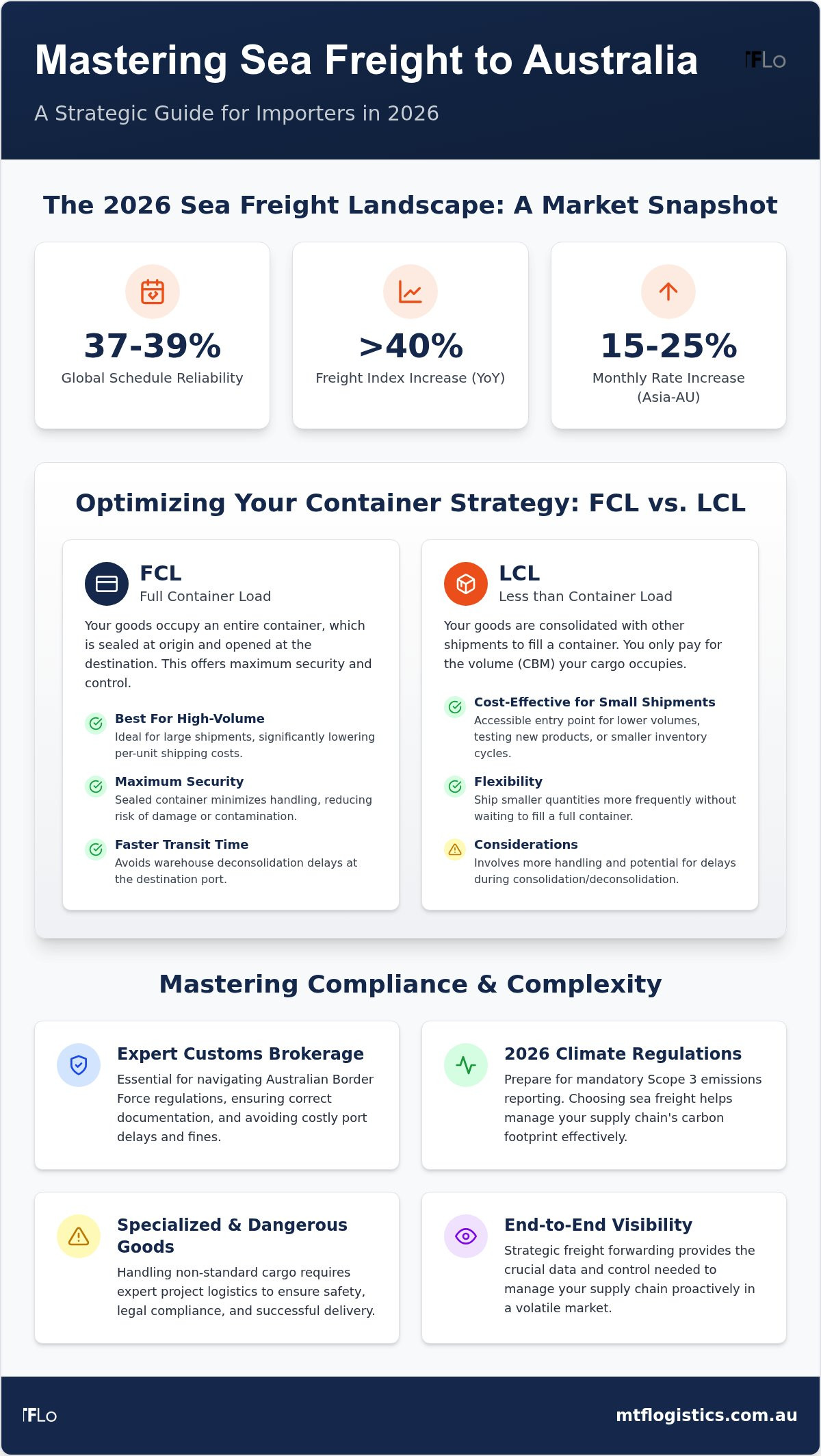
With global schedule reliability hovering between 37% and 39% as of mid-2026, the traditional approach to international shipping is no longer a viable strategy for Australian importers. You’ve likely felt the pressure of the Shanghai Containerised Freight Index climbing over 40% year-on-year, alongside the frustration of unpredictable transit times that stall your inventory. It’s difficult to maintain a steady hand when hidden customs costs and the complexity of international trade documentation threaten your bottom line.
We understand that a reliable supply chain is the backbone of your business success. This 2026 strategic guide is designed to help you master sea freight Australia by providing expert insights into container shipping, strict customs compliance, and proactive freight management. You’ll learn how to manage the new mandatory climate disclosures for Scope 3 emissions and optimize your logistics for maximum cost-efficiency. This overview provides a clear roadmap for achieving a predictable, fully compliant, and high-performing ocean logistics operation in even the most volatile global markets.
Sea freight Australia serves as the essential lifeline for the nation’s economy, carrying approximately 99% of our international trade by volume. As an island nation, our connection to global markets depends entirely on the efficiency of our maritime corridors. For businesses managing high-volume imports, ocean transport is not just a logistical choice; it’s a strategic necessity that balances massive capacity with manageable costs. This sector remains the primary method for moving bulk commodities and consumer goods into the country due to its unique ability to handle scale that air transport simply cannot match.
The Australian transport network relies heavily on a series of major national ports to process millions of TEUs (Twenty-foot Equivalent Units) annually. These vital maritime gateways, strategically located across the continent, serve as critical hubs for the national supply chain, facilitating the flow of goods to and from all regions. They collectively handle the bulk of containerized and general cargo, acting as the primary entry and exit points for international trade.
While these ports are primary hubs for cargo, they also serve as vital entry points for international travelers and cruise passengers. If you are coordinating ground logistics for staff or visitors arriving at Sydney’s maritime terminals, you can learn more about Get U There Shuttles for specialized private transport and cruise ship transfers.
In 2026, the maritime landscape is defined by volatility and a shift toward data-driven orchestration. Global schedule reliability currently sits around 37% to 39%, while FCL rates from major Asian lanes into key Australian import destinations saw 15% to 25% month-on-month increases in June 2026. These figures highlight why a steady hand in logistics management is required to navigate transit expectations that can change weekly.
Ocean transport remains the primary choice for high-volume trade because of its superior cost-per-tonne ratio. When compared to air freight, sea freight Australia offers a significantly lower entry point for bulk commodities and large-scale inventory replenishment. It’s built for scalability. As your business grows, the ability to transition from small LCL (Less than Container Load) shipments to full 40-foot containers provides a clear path for reducing unit costs. Additionally, with mandatory climate disclosures for Group 2 entities starting July 1, 2026, the lower carbon footprint of maritime vessels compared to aircraft makes it an essential component of sustainable supply chain management.
Mastering the vocabulary of the industry is the first step toward regaining control over your shipments. The Bill of Lading is your most critical document. It acts as a title to the goods and a contract of carriage. Understanding its legal significance ensures you’re protected throughout the transit. Similarly, Incoterms 2020 remain the standard for defining responsibilities between buyers and sellers. Whether you’re operating under FOB (Free on Board) or CIF (Cost, Insurance, and Freight), knowing where your liability starts and ends is vital. A seasoned freight forwarder, such as MTF Logistics, acts as your logistics architect, translating these technical requirements into a functional, end-to-end strategy that mitigates risk at every port of call.
Choosing between Full Container Load (FCL) and Less than Container Load (LCL) is a pivotal decision for your sea freight Australia operations. This choice dictates your landing costs, security protocols, and total transit time. While volume is the primary driver, strategic importers also consider the nature of their cargo and the urgency of the delivery when selecting a container strategy. Understanding current sea freight rates Australia benchmarks for both FCL and LCL is essential to making an informed decision that protects your margins.
FCL offers the highest level of security and control. Your goods are loaded into a dedicated container that remains sealed until it reaches its final destination. This lack of intermediate handling is a major advantage; it virtually eliminates the risk of cross-contamination or damage from other shippers’ cargo. FCL is also generally faster. Once the vessel berths, the container can be moved directly to your facility without waiting for deconsolidation at a third-party warehouse. By maximizing cube utilization in a 20-foot or 40-foot unit, you can significantly lower your unit costs as your business scales.
For smaller shipments, LCL provides an accessible entry point through consolidation. You only pay for the space you use, with pricing typically calculated per cubic metre (CBM). LCL remains a vital component of sea freight Australia for businesses testing new product lines or managing smaller inventory cycles. However, LCL involves more physical handling at Container Freight Stations (CFS) where goods are sorted. This increased touchpoint frequency makes high-quality export packing essential. If you are unsure which method suits your current volume, consulting with a specialist in sea freight services can help clarify the most cost-effective path forward.
The strategic “switch” from LCL to FCL typically occurs when your shipment volume reaches 12 to 15 CBM. Beyond this point, the cost of a dedicated 20-foot container often becomes more competitive than the cumulative fees of a shared one. For larger shipments, 40-foot containers provide double the capacity for a relatively modest price increase, making them the standard for high-volume consumer goods.
While 40ft containers are the standard for commercial furniture shipments, international relocations require a more specialized logistics approach.
Treating sea freight and customs clearance as independent silos is a common error that often results in significant port storage fees and supply chain bottlenecks. In 2026, the efficiency of sea freight Australia is measured as much by the speed of border processing as it is by the vessel’s transit time. The Australian Border Force (ABF) continues to refine its enforcement of trade regulations, making it vital for importers to integrate their logistics and compliance strategies. When these two elements are synchronized, goods can often be cleared before the vessel even berths, allowing for immediate transport upon discharge.
Customs clearance for sea freight typically requires 3 to 7 business days, though shipments requiring biosecurity inspection through the Department of Agriculture, Fisheries and Forestry (DAFF) can extend this to 10 days or more. By initiating pre-arrival clearance, you minimize the risk of your container sitting at the terminal beyond its free-time period. This proactive approach is the hallmark of a steady supply chain, ensuring that documentation issues are resolved while the cargo is still in transit across the ocean.
Accurate documentation is the foundation of a smooth entry into the Australian market. For every shipment, you must provide a commercial invoice, a detailed packing list, and the bill of lading. Additionally, certificates of origin are essential for claiming preferential duty rates under various Free Trade Agreements. Beyond standard customs, biosecurity remains a high priority. Importers should consult the Biosecurity Import Conditions (BICON) database to understand specific treatment requirements for their goods before they leave the port of origin. For high-volume importers, achieving Australian Trusted Trader status offers a streamlined path through the border, providing prioritized service and reduced administrative friction.
The financial health of your import operation depends on precise tariff classification. Every item entered into Australia must be assigned an HS Code, which determines the applicable duty rate, usually ranging from 0% to 5% for manufactured goods. Incorrect classification can lead to two equally damaging outcomes: overpaying duty and eroding your margins, or underpaying and facing heavy penalties from the ABF. Utilizing Free Trade Agreements (FTAs) is a powerful way to reduce landed costs, but these benefits are only accessible if your documentation is flawless. A professional customs broker acts as a strategic shield, ensuring your goods are classified accurately to prevent overpayment and regulatory penalties while streamlining the path to market.
Project logistics represents the pinnacle of maritime coordination, moving beyond the standard box to manage cargo that is oversized, hazardous, or extremely sensitive. In the context of sea freight Australia, this often involves industrial machinery for the mining sector or infrastructure components for renewable energy projects. These movements require more than just space on a vessel; they demand a comprehensive engineering plan that accounts for every nautical mile and every transfer point. Managing this complexity ensures that even the most difficult shipments arrive without incident or unexpected cost.
Handling Dangerous Goods (DG) is a matter of strict legal compliance and safety. Maritime law, specifically the IMDG Code, dictates how hazardous materials must be stowed and segregated. In Australia, failing to declare DG correctly or using improper packaging can lead to severe penalties and vessel delays. Expert facilitation ensures your documentation is accurate and your cargo meets all safety standards before it leaves the wharf. Similarly, perishable goods require a seamless cold chain. We utilize advanced reefer containers to maintain precise temperature ranges, protecting the integrity of food and pharmaceutical products across the ocean.
When cargo exceeds the dimensions of a standard container, it’s classified as Out-of-Gauge (OOG) or breakbulk. OOG shipments often utilize flat racks or open-top containers, while breakbulk refers to cargo loaded directly onto the vessel. Success in this area depends on meticulous site-to-site planning. This includes coordinating specialized lifting equipment at the port and managing the last mile delivery. In Australia, this often requires specific road permits and pilot escorts for oversized loads to ensure safe passage from the terminal to the final site.
Different industries require bespoke maritime configurations to maintain product value throughout the sea freight Australia journey. For the pharmaceutical sector, cold chain integrity is non-negotiable. We use temperature-controlled reefers with real-time monitoring to protect sensitive medical supplies. The fashion industry benefits from Garment-on-Hanger (GOH) container configurations. This allows apparel to be transported on racks, eliminating the need for expensive off-site pressing upon arrival. High-value goods are protected through enhanced security protocols and end-to-end tracking to mitigate risk. If you are managing complex or non-standard cargo, contact us for specialized project logistics services to ensure your shipment is handled with expert care.
In 2026, the value of sea freight Australia lies not just in the physical movement of containers, but in the transparency of the data surrounding them. With global schedule reliability remaining under 40%, businesses can’t afford to be reactive. True end-to-end management requires a shift toward predictive orchestration. This means using location intelligence and AI to anticipate delays before they impact your warehouse schedule. It’s about moving from a state of uncertainty to one of organized control, where every stakeholder has a clear view of the cargo’s journey.
Choosing the right freight partner is a decision that impacts your ability to scale nationally. You need a provider that understands the nuances of all major Australian ports and possesses the technical infrastructure to provide real-time updates. MTF Logistics combines this tech-forward approach with the grounded expertise of a team that has managed maritime volatility since 2014. We act as your steady hand, ensuring that while the global market remains unpredictable, your specific supply chain remains visible and manageable.
Managing your international trade becomes significantly simpler when you consolidate air and sea freight under a single management umbrella. This integration reduces administrative friction by centralizing your export documentation and customs records. Instead of juggling multiple points of contact, you gain a streamlined workflow where information flows seamlessly between departments. Proactive communication is the core of this approach. We don’t just report on where your shipment is; we provide the context needed to make informed business decisions during transit.
Successful logistics in 2026 requires moving beyond transactional shipping and into a strategic partnership. A reliable guide doesn’t just book space on a vessel; they help you simplify complex global systems and adapt to new regulatory requirements like mandatory climate disclosures. MTF Logistics focuses on building these resilient frameworks for Australian businesses, ensuring your logistics operations are an asset rather than a source of stress. If you’re ready to optimize your supply chain, contact our team for a tailored sea freight strategy.
Success in the current market requires more than just booking a vessel. It demands the seamless integration of expert customs clearance and data-driven visibility to navigate the complexities of sea freight Australia. By optimizing your container strategy and ensuring strict compliance with evolving border regulations, you can transform your supply chain from a source of volatility into a predictable competitive advantage. Whether you’re managing standard FCL shipments or complex industrial project cargo, having a steady hand at the helm is essential for long-term growth.
MTF Logistics has provided expert customs clearance and export documentation services since 2014. With comprehensive national coverage across all major Australian ports and a specialized team for project logistics, we’re committed to simplifying your global trade processes. We don’t just move cargo; we provide the clarity and control you need to succeed in a demanding global environment. Request a Comprehensive Sea Freight Consultation today to secure your supply chain’s future. We look forward to helping your business thrive through organized expertise and reliable service.
Transit times for sea freight to Australia vary significantly based on the port of origin. Shipments from major Asian hubs like Shanghai typically arrive at East Coast ports in 20 to 25 days, while transit from Europe or North America often takes 45 to 60 days. In 2026, global schedule reliability remains between 37% and 39%, so it’s vital to factor in potential buffer times for your inventory planning.
Sea freight is usually the most cost-effective choice for shipments exceeding 0.5 cubic metres or weighing over 100 kilograms. While air freight is faster for small parcels or urgent documents, the cost-per-tonne for ocean transport is much lower for high-volume commercial goods. For businesses moving inventory, sea freight Australia offers the necessary scalability to maintain healthy profit margins as your total shipment volumes increase.
A freight forwarder acts as the architect of your shipment’s journey, coordinating the physical movement of goods across carriers and transport modes. A customs broker is a legal specialist who ensures your cargo complies with Australian Border Force regulations and tariff classifications. While their roles are distinct, integrating both services allows for a more stable and seamless transition from the international wharf to your local warehouse facility.
Marine insurance is highly recommended because carrier liability is strictly limited under international maritime laws like the Hague-Visby Rules. These legal limits often fall far below the actual value of your commercial goods. Insurance protects your business against damage during transit, total loss, and the significant financial risks of “General Average” claims, where all shippers on a vessel share the costs of a maritime emergency.
You can ship dangerous goods provided they are correctly declared, packaged, and labeled according to the IMDG Code. Hazardous materials, including chemicals, batteries, and flammable liquids, require specialized handling and specific stowage on the vessel. It’s essential to provide a current Safety Data Sheet and a Dangerous Goods Declaration to ensure your cargo meets all safety and legal requirements before it arrives at an Australian port.
LCL rates are calculated based on volume in cubic metres or weight, whichever is greater. This is known as the “revenue ton” model, where 1,000kg is typically treated as 1 CBM. Beyond the base ocean freight, your total cost includes port handling charges, deconsolidation fees at the destination warehouse, and customs clearance. Accurate measurements are vital to avoid unexpected adjustments to your final landing costs during the consolidation process. For a detailed breakdown of how these charges stack up against current market benchmarks, our guide to sea freight rates Australia provides a comprehensive overview of the full cost structure.
If cargo remains at a port beyond the allotted “free time,” which is usually three days, you will incur expensive demurrage and detention fees. These charges accrue daily and can quickly erode your profit margins. To mitigate this risk, we utilize pre-arrival clearance strategies to ensure the Australian Border Force processes your documentation while the vessel is still at sea, allowing for immediate collection upon discharge.
The primary documents required for customs clearance include a commercial invoice, a detailed packing list, and the bill of lading. You should also provide a Certificate of Origin to access preferential duty rates under Australia’s various Free Trade Agreements. For specific commodities, you may need additional permits or treatment certificates to satisfy biosecurity requirements managed by the Department of Agriculture, Fisheries and Forestry before the goods are released.


 Email
Email 1300 710 683
 Tariff Lookup
 HS Code Lookup
 Newsletter Signup