
Total Shipment Visibility, Simplified
Access all your shipment details in one place - track departures and arrivals, manage documents, notifications, invoices, and more.
Access all your shipment details in one place - track departures and arrivals, manage documents, notifications, invoices, and more.

Did you know that the base ocean cargo quote often accounts for only 40% of your total landed cost? While many importers focus solely on volatile sea freight rates Australia, the real financial drain usually hides in the fine print of wharf ancillary charges and biosecurity levies. It’s understandable if you feel frustrated by the current climate; with FCL rates from China climbing up to 25% in a single month during mid-2026, maintaining a predictable budget can feel like a moving target.
This guide provides the clarity you need to regain control. We’ll help you master the complexities of Australian shipping, moving from base pricing into the technical details of customs compliance and strategic consolidation. You’ll learn how to anticipate General Rate Increases and manage the July 2026 fee hikes with professional precision. We will examine current market benchmarks, explain the critical break-even points for container loading, and outline a step-by-step strategy for seamless customs clearance and reliable transit times in a volatile global environment.
To manage a logistics budget effectively, you must recognize that sea freight rates Australia aren’t a single, static figure. Instead, they function as a composite price comprising the base ocean freight and a series of local surcharges. This base rate covers the port-to-port movement, but the final cost is heavily influenced by terminal handling, wharfage, and documentation fees. In the current market, these additional layers can often exceed the base freight itself, making a granular understanding of your quote essential.
Global carrier alliances play a decisive role in determining route availability and vessel frequency for the global sea freight industry. Because Australia is a thinner trade lane compared to the major East-West corridors, alliance decisions to blank sailings or reallocate vessels can cause immediate capacity shortages. This structural reality means that Australian importers must remain agile; supply and demand dynamics can shift with very little notice from the major carriers.
Fuel costs remain a primary variable through the Bunker Adjustment Factor (BAF). In 2026, BAF calculations have become more complex as the industry transitions toward sustainable fuels and stricter emission standards. Additionally, seasonal peaks like the pre-Christmas rush significantly impact container availability. This peak season usually starts in August for the Australian market, leading to increased competition for equipment and space, which inevitably drives up sea freight rates Australia during the final quarter of the year.
The Asia-Australia trade lane remains the most volatile corridor for local businesses due to its high volume and sensitivity to manufacturing cycles. While direct routes from major hubs like Shanghai offer the most reliable transit times, transshipment routes through Southeast Asian ports can sometimes offer cost savings at the expense of speed. Port congestion surcharges in 2026 are applied as a fixed fee per container whenever terminal delays at major Australian ports exceed established operational windows for more than 48 hours.
The relationship between the Australian Dollar and the US Dollar is a critical factor in logistics pricing. Most international freight transactions are denominated in USD, meaning a weaker AUD automatically increases your shipping costs through the Currency Adjustment Factor (CAF). This surcharge is designed to protect carriers from exchange rate volatility, but it can create significant budget gaps for importers who don’t plan ahead.
Choosing between Full Container Load (FCL) and Less than Container Load (LCL) is the most impactful decision you’ll make for your logistics budget. While smaller shipments naturally lean toward LCL, the “tipping point” where FCL becomes more economical is often lower than importers expect. This choice doesn’t just affect the base sea freight rates Australia; it dictates your total handling costs and the overall speed of your supply chain.
FCL offers a level of security and efficiency that LCL cannot match. When you book a full container, your goods are sealed at the origin and remain untouched until they reach your warehouse. This significantly reduces the risk of damage or loss for high-value or fragile items. Importers typically choose between a 20ft container, which holds approximately 33 cubic metres, and a 40ft High Cube, offering roughly 76 cubic metres of space. Beyond physical capacity, FCL simplifies the Australian customs inspection process. Since the container holds only your cargo, there’s no risk of your shipment being delayed by another importer’s documentation errors or biosecurity issues.
LCL is an excellent entry point for startups or businesses importing small batches. Under this model, you share container space with other shippers and pay only for the volume you use. Pricing is based on “w/m” logic, meaning you’re charged by whichever is greater: weight or measurement. While the upfront cost is lower, LCL requires careful risk management. Your cargo must wait in a consolidation warehouse until the container is full, and similar delays occur during de-consolidation at Australian ports. It’s a common oversight to ignore the impact of these waiting periods on your inventory turnover.
The primary trap for many importers is ignoring destination charges. In Australia, LCL shipments often face disproportionately high port fees because of the labour involved in stripping the container and managing multiple consignments. The breakeven point typically falls between 13 and 15 cubic metres. If your shipment exceeds this volume, booking a 20ft FCL is usually more cost-effective than LCL. It’s often helpful to have a professional audit your shipping volumes to ensure you aren’t overpaying for shared space when a dedicated container would be cheaper.
While the initial quote for sea freight rates Australia often captures the most attention, the secondary layer of local surcharges and statutory fees determines the actual viability of your shipment. These costs aren’t optional extras; they are fundamental components of the Australian maritime environment. Terminal Handling Charges (THC) at major Australian ports rose by up to 4.5% on July 1, 2026. This adjustment typically adds between A$15 and A$30 to the cost of every container handled at the wharf, reflecting the increased operational costs at our national gateways.
Documentation fees also play a significant role in your final invoice. Every shipment requires the processing of a Bill of Lading and, in many cases, a Certificate of Origin to qualify for preferential tariff rates under Free Trade Agreements. Beyond these administrative costs, the Australian Border Force (ABF) applies processing fees for every import declaration. These fees scale based on the value of the goods, making it essential to factor them into your unit cost calculations before the cargo arrives. Government biosecurity and imported food charges also increased by approximately A$2 to A$3 per transaction on July 1, 2026, reflecting the rising cost of border protection services.
Expert customs brokerage is a strategic tool for cost management rather than just a compliance requirement. Accurate HS Code classification is the only way to ensure you aren’t overpaying on import duties or GST. Non-compliance doesn’t just lead to financial penalties; it often results in expensive storage fees, known as demurrage, if your cargo is held at the terminal for inspection. A qualified customs broker identifies duty drawback opportunities by analyzing your supply chain to reclaim duties paid on goods that are subsequently exported from Australia.
Australia’s biosecurity regulations are among the strictest in the world, and failure to meet requirements can lead to substantial unplanned expenses. Wood packaging is a frequent culprit; if pallets aren’t correctly treated and stamped, your container could face mandatory fumigation or even re-export. These costs can easily double your local handling fees. There’s a clear difference between a “tailgate” inspection, where an officer checks the container doors for pests, and a full unpack, which involves high labour costs and terminal delays. Implementing pre-shipment treatments at the origin is a reliable way to bypass these bottlenecks and secure your transit times.
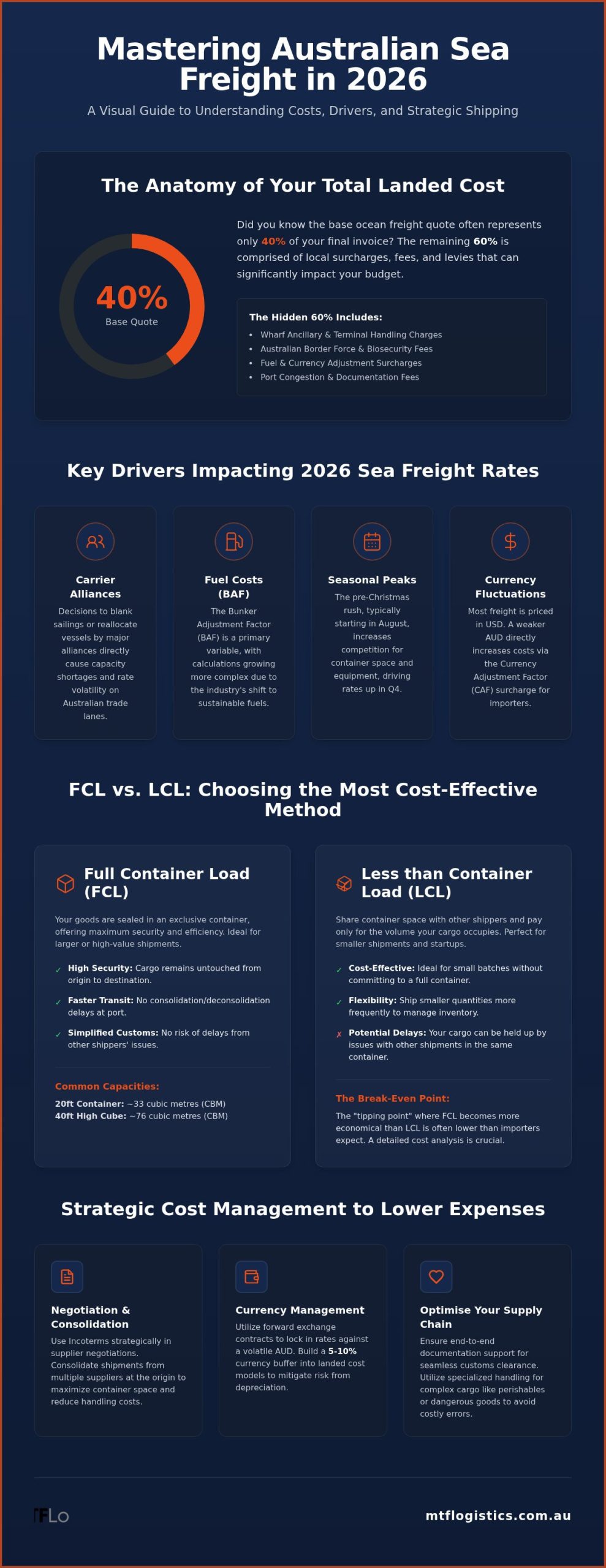
Managing sea freight rates Australia requires moving beyond a reactive stance. In a market where spot rates for FCL shipments from China climbed up to 25% month-on-month into June 2026, strategic planning is your best defense against budget blowouts. Real savings aren’t found by chasing the lowest base rate, but by optimizing the entire logistical chain. For a comprehensive overview of how to navigate these pressures, our sea freight Australia 2026 strategic guide covers the full range of market forces shaping container shipping this year. This involves a combination of smart negotiation, cargo consolidation, and rigorous timeline management to avoid the penalties that often plague unmanaged shipments.
Long-term rate agreements provide a level of stability that the spot market cannot offer. While spot rates can offer temporary wins, the 2026 market has shown that these prices can double within a single year. Securing a contract with a reliable partner ensures your business isn’t held hostage by sudden capacity shortages or peak season surcharges. Additionally, optimizing your packaging to maximize cubic metre (CBM) utilization ensures you aren’t paying to ship empty space. Small adjustments to pallet heights or carton dimensions can often be the difference between needing an LCL service or a more cost-effective FCL container.
Incoterms dictate who is responsible for costs and risks at every stage of the journey. Australian importers often prefer FOB (Free on Board) because it allows them to maintain total control over the local leg of the shipment. Under FOB, you nominate your own freight forwarder and gain transparency into Australian port charges. Conversely, CIF (Cost, Insurance, and Freight) often hides “arrival” fees that only become apparent once the cargo reaches Australia. DDP (Delivered Duty Paid) agreements carry even higher risks; suppliers may use low-cost carriers that lack the expertise to navigate Australian biosecurity, leading to unexpected delays and inflated “handling” fees. We help our clients select the specific Incoterms that minimize financial exposure while ensuring maximum visibility.
Demurrage and detention fees are the silent killers of a logistics budget. In an Australian context, demurrage refers to the daily fee charged by the terminal for containers that remain on the wharf past the allocated free days. Detention applies when you have moved the container off the wharf but fail to return the empty equipment to the designated park within the agreed timeframe. These costs can escalate into thousands of dollars if not managed correctly. To mitigate these risks, ensure all documentation is submitted for pre-clearance before the vessel even berths. Fast-tracking the container return process and maintaining clear communication with your transport provider are essential steps to keep your project on budget and on time.
MTF Logistics approaches every shipment as a managed project rather than a simple transaction. In an era where sea freight rates Australia are subject to rapid shifts, having a partner who prioritizes transparency and end-to-end visibility is vital. We manage the entire lifecycle of your cargo, from the initial supplier pick-up at the origin to the final delivery at your Australian warehouse. This comprehensive oversight eliminates the communication gaps that often lead to storage fees or documentation errors. Our quotes are built on a foundation of clarity; we ensure you understand every component of your cost structure so there are no hidden fees at the destination.
Our national reach covers all major Australian port operations, allowing us to provide localized expertise regardless of where your cargo berths. We understand the specific terminal requirements and empty container park protocols in Sydney, Melbourne, Brisbane, and Fremantle. This logistical depth ensures that your goods move through the wharf and across the border with minimal friction. By acting as a steady hand in a volatile market, we provide the reassurance that your supply chain remains resilient against global disruptions. We don’t just move boxes; we facilitate the growth of your business through organized expertise.
Efficient logistics also depends on having the right tools for the job; for businesses looking to optimize their local transport fleets, you can learn more about Tim Halpin Equipment Corp and their specialized truck equipment and upfitting solutions.
Handling standard containers is only one part of our capability. We specialize in project logistics, managing oversized infrastructure and heavy lift freight that requires technical precision. For clients in the food and medical sectors, we maintain strict cold chain integrity to protect sensitive perishable and pharmaceutical shipments. Our 30+ years of industry experience, dating back to our founding in 2014, translates into a sophisticated understanding of Australian biosecurity and customs regulations. This history allows us to anticipate potential bottlenecks and implement solutions before they impact your schedule. Whether you’re moving garment industry logistics or dangerous goods, our methodical approach ensures that every safety and compliance standard is met.
Customs clearance is often the most complex part of the international shipping process. We provide integrated customs brokerage and export documentation services to ensure your cargo meets all regulatory requirements before it reaches the border. Our team uses modern tracking tools to provide real-time visibility, ensuring you’re always informed of your shipment status. Proactive communication is at the core of our service; we don’t just report delays, we work to prevent them. If you’re looking for a reliable partner to manage your global supply chain, request a tailored sea freight quote from the MTF Logistics team today.
Navigating the complexities of international trade requires more than just monitoring sea freight rates Australia. Success in the 2026 market depends on your ability to integrate base shipping costs with technical compliance and strategic cargo management. By mastering the nuances of Incoterms and identifying the exact breakeven points for container consolidation, you can transform your logistics from a variable expense into a predictable asset. It doesn’t have to be a source of constant stress when you have the right data and a methodical approach to your global operations.
MTF Logistics has been a steady hand in the global market since 2014. We offer decades of Australian trade expertise to help you manage everything from comprehensive customs brokerage to complex biosecurity requirements. Our team provides specialized experience in handling dangerous goods and perishables, ensuring cold chain integrity and regulatory safety at every port. Take the first step toward a more efficient and transparent supply chain and Get an Expert Sea Freight Quote for Your Business today. We’re ready to help you move forward with confidence and clarity.
Sea freight rates Australia are calculated as a composite of the base ocean freight cost and various local surcharges. The base rate covers port to port transport, while additional fees like Terminal Handling Charges (THC), Bunker Adjustment Factors (BAF), and wharfage are added based on the specific route and container type. Market demand and carrier alliance capacity also influence the final price, making it essential to review a line item breakdown of your quote.
Full Container Load (FCL) means you have exclusive use of a 20ft or 40ft container, offering higher security and faster processing. Less than Container Load (LCL) involves sharing container space with other importers, which is cost effective for smaller volumes. While LCL has lower upfront costs, it often incurs higher destination handling fees and requires extra time for consolidation and de-consolidation at Australian ports.
The total cost of customs clearance involves a combination of service fees from your broker and mandatory government charges. The Australian Border Force (ABF) applies an Import Processing Charge based on the value of the goods, while the Department of Agriculture, Fisheries and Forestry (DAFF) levies biosecurity fees. These costs are separate from any import duties or GST, which are calculated based on the specific HS Code of your cargo.
Transit times vary significantly depending on the origin port and the chosen shipping service. Direct routes from major Asian hubs like Shanghai typically take between 14 and 25 days to reach major Australian ports. Shipments from Europe or North America generally require 40 to 60 days, especially if transshipment is involved. These estimates exclude the time required for origin consolidation and final customs clearance upon arrival in Australia.
The Bunker Adjustment Factor (BAF) is a floating surcharge applied by shipping lines to account for fluctuations in global fuel prices. Carriers adjust this fee quarterly or monthly to protect themselves against the volatility of the oil market. In 2026, BAF calculations also reflect the industry’s shift toward low emission fuels, making it a critical component to monitor when budgeting for long term sea freight rates Australia.
Yes, you can ship dangerous goods via sea freight, provided you comply with strict international and Australian maritime regulations. This process requires detailed documentation, including a Material Safety Data Sheet (MSDS) and a Dangerous Goods Declaration. Specialized handling and stowage are necessary to manage risks, which results in additional surcharges. It’s vital to declare these items early to ensure vessel space and proper terminal handling.
A customs broker ensures your cargo complies with complex Australian trade laws while identifying opportunities to minimize duty and tax. They manage the accurate classification of goods using HS Codes, which prevents overpayment and avoids costly penalties for misdeclaration. Beyond compliance, brokers facilitate faster cargo release by ensuring all documentation is submitted correctly to the Australian Border Force and biosecurity agencies before the vessel berths.
Avoiding demurrage requires proactive management of the container’s arrival and return cycle. You should ensure all customs and biosecurity documentation is pre-cleared before the ship arrives to allow for immediate pick up. Coordinating with your transport provider to return empty containers to the designated park within the carrier’s free time window is equally important. Delays in documentation or transport scheduling are the most common causes of these expensive daily penalties.


 Email
Email 1300 710 683
 Tariff Lookup
 HS Code Lookup
 Newsletter Signup